

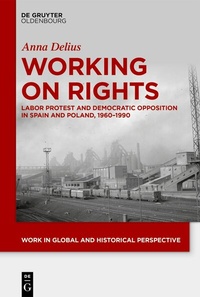
Working on Rights
Description

This book is the first to connect global labor history and the history of human rights: By focusing on democratic labor oppositions in Spain and Poland between 1960 and 1990, it shows how workers in authoritarian regimes addressed repression and whether they developed a language of rights in the light of a globally dynamic human rights discourse.
The study argues that the democratic labor oppositions in Spain and Poland were both variants of emancipatory and democracy-oriented social movements with global interconnections that emerged in the 1960s. It reveals that the demands for free and independent trade unions, which in both countries became a flashpoint in the fight for broader democratic demands, was not always discussed in rights terms, but rather presented as an inevitable necessity. At the same time, these labor movements and their intellectual allies morally delegitimized state repression against workers and thereby employed the concepts of democracy, participation, solidarity, progress and eventually, rights.
Integrating the history of two European semi-peripheric societies into a broader narrative, this book is relevant for readers interested in global labor history, human rights history and the history of democratization in Europe in the late twentieth century.
More details
Other editions
Additional editions
Person
Content
- Intro
- Acknowledgements
- Contents
- List of Abbreviations
- 1 Introduction: On Democratic Labor Oppositions in Spain and Poland 1960-1990
- 2 Emerging Oppositions - Citizens Starting to Organize
- 3 Illiberal Backlashes - State Reactions to Oppositional Dynamics
- 4 Conclusion - Working on Rights under Authoritarian Rule
- 5 Sources and Bibliography
- Index
