

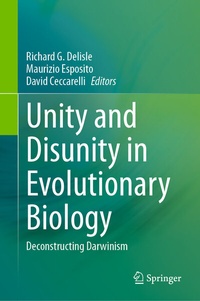
Unity and Disunity in Evolutionary Biology
Description

It is not uncommon to see in major areas of research concerned with science that historical studies are accompanied by the rise of complementary or contradictory historiographies. With time, it seems, scholars discover new approaches to study topics, thus questioning old concepts, traditions, periodizations and historical labels. Apparently, this has not been the case in evolutionary thought. In that area, the main historiographic labels such as Darwinian Revolution, Eclipse of Darwinism, and Modern Synthesis have been in place and largely uncontested for about 50 years. Such labels seem to work as irrefutable, and often hidden, premises of many historical reconstructions, philosophical analyses, and scientific conceptualizations.
This volume aims to move beyond this state of affair, opening new thinking avenues by revisiting the traditional historiography and laying the groundwork for establishing a "new historiography" that considers the intertwined threads that compose evolutionary biology. Notably, evolutionary studies seem to have been marked by the tension between unification attempts and the proliferation of approaches, methodologies, and styles of thinking. As the contributors to this volume illustrate, research traditions branched off throughout the history of evolutionary thought, before and after Charles Darwin. The resulting complexity challenges traditional thinking categories, throwing a somewhat different light on a more recent label like the Extended Evolutionary Synthesis.
More than 40 years after the now classic, The Evolutionary Synthesis: Perspectives on the Unification of Biology (1980), edited by Ernst Mayr and William Provine, the contributors to this volume aim to reevaluate where evolutionary biology stands today.
More details
Other editions
Additional editions
Persons
Richard G. Delisle owns a PhD in paleoanthropology (University of the Witwatersrand, South Africa) and a PhD in philosophy (University of Montreal, Canada). He teaches evolutionary biology and history/philosophy of science in the programs of archaeology, philosophy, and liberal education at the University of Lethbridge (Canada). His research interest focuses on the multidisciplinary quest of understanding evolutionary studies under the intimate light of its past and current developments.
Maurizio Esposito owns a PhD in History and Philosophy of Science (University of Leeds). He teaches History and Philosophy of Biology in the Faculty of Science of the University of Lisbon (Portugal). His research interests focus on the historical development of life sciences as well as its social and philosophical implications.
David Ceccarelli owns a PhD in Historical, Social and Philosophical Sciences (University of Rome "Tor Vergata"). He has taught History of Science at the University of Rome "Tor Vergata" and at the University of Florence. His research interests focus on the history and historiography of evolutionary biology, the history of evolutionary social theories and the visual history of life sciences.
Content
Part I: Introductory Essays.- Toward a New Historiography.- "Reformist" and "Radical" Historiographies Behind and Beyond the Unity and Disunity of the Evolutionary Thought.- Darwin as a Unifying Figure in Evolutionary Biology: A Meta-Historical Overview.- Part II: Deconstructing Darwinism.- Constructing, Deconstructing and Reconstructing. On "Darwinism" and "Darwinisms", with Some Disparate Considerations on the History of Science.- The Evolution of "Darwinism": Up Close and Personal.- Richard Owen's Deconstruction of Darwinian Natural Selection.- Darwin, Archaeopteryx lithographica and the Problem of Intermediate Species.- Deconstructing Darwinism with Darwin, Mayr, and Gould: Through the Lens of Evolutionary Contingency.- Is Darwinism a Metaphysical Research Program? Analysis and Discussion of Karl Popper's Position.- Part III: Around and Beyond the Synthesis.- Typology/Population Distinction and Its Role in the Marginalization of 19th-Century Non-Darwinian Theories in Modern Historiography.- Fisher, Wright and Haldane: Three Philosophical Conceptions of Evolution.- A Synthesis Without Darwin: Unification Attempts in Early Theoretical Biology.- The Strange Story of Mosaic Evolution.- Deconstructing the Extended Evolutionary Synthesis: Do We Need a New Theory of Evolution?.- Part IV: Deconstructing the Historiography of Evolutionary Biology.- Deconstructing and Reconstructing the History of Evolutionary Thought: An Agenda for a "Post-Darwinian" Historiography.- What if Darwin Had Published His 1844 Essay?.- Redrawing the Boundaries of Darwinism: Addressing Darwin's Endorsement of the Inheritance of Acquired Characteristics in Darwin's Celebrations, 1909-1959-2009.- The "Darwinian Revolution" as a Presentist Discourse: Ideological Implications Beyond the Anglo-Saxon Context.- Historicity, Temporalities and Causality: A Confusion at the Heart of Debates on Darwinism.- Shacking the Tree: Discussing an Evolutionary Icon.
