

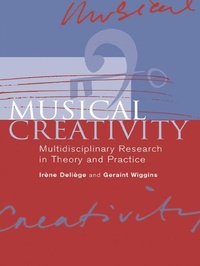
Musical Creativity
Multidisciplinary Research in Theory and Practice
Published on 16. October 2006
448 pages
978-1-135-42268-4 (ISBN)
Description

This collection initiates a resolutely interdisciplinary research dynamic specifically concerning musical creativity. Creativity is one of the most challenging issues currently facing scientific psychology and its study has been relatively rare in the cognitive sciences, especially in artificial intelligence. This book will address the need for a coherent and thorough exploration.
Musical Creativity: Multidisciplinary Research in Theory and Practice comprises seven sections, each viewing musical creativity from a different scientific vantage point, from the philosophy of computer modelling, through music education, interpretation, neuroscience, and music therapy, to experimental psychology. Each section contains discussions by eminent international specialists of the issues raised, and the book concludes with a postlude discussing how we can understand creativity in the work of eminent composer, Jonathan Harvey.
This unique volume presents an up-to-date snapshot of the scientific study of musical creativity, in conjunction with ESCOM (the European Society for the Cognitive Sciences of Music). Describing many of the different aspects of musical creativity and their study, it will form a useful springboard for further such study in future years, and will be of interest to academics and practitioners in music, psychology, cognitive science, artificial intelligence, neuroscience and other fields concerning the study of human cognition in this most human of behaviours.
Musical Creativity: Multidisciplinary Research in Theory and Practice comprises seven sections, each viewing musical creativity from a different scientific vantage point, from the philosophy of computer modelling, through music education, interpretation, neuroscience, and music therapy, to experimental psychology. Each section contains discussions by eminent international specialists of the issues raised, and the book concludes with a postlude discussing how we can understand creativity in the work of eminent composer, Jonathan Harvey.
This unique volume presents an up-to-date snapshot of the scientific study of musical creativity, in conjunction with ESCOM (the European Society for the Cognitive Sciences of Music). Describing many of the different aspects of musical creativity and their study, it will form a useful springboard for further such study in future years, and will be of interest to academics and practitioners in music, psychology, cognitive science, artificial intelligence, neuroscience and other fields concerning the study of human cognition in this most human of behaviours.
Reviews / Votes
"Musical Creativity: Multidisciplinary Research in Theory and Practice provides comprehensive treatment of musical creativity, viewed in a broad sense that embraces not only composition but also listening, performing, learning, and therapy. The authors take a variety of philosophical, theoretical, empirical, neuroscientific, and computational approaches to this difficult yet important topic. The result is a bold collection that is destined to become an indispensable reference for future research in the field." - Fred Lerdahl, Fritz Reiner Professor of Music, Columbia University"This collection shows that the study of musical creativity is not 'beyond science' as many skeptics have believed. A contemporary understanding of creativity must be rooted in actual variety of concrete musical acts and practices, and the equal variety of modes of reception. This volume samples widely from such variety, and ranges from the macro (such as the composition of a symphony) to the micro (such as the selection of a particular chord in an improvisatory sequence), and across all levels of musical sophistication, from untrained child to professional adult." - John Sloboda FBA, Professor of Psychology, Keele University
More details
Language
English
Place of publication
London
United Kingdom
Publishing group
Taylor & Francis Ltd
Target group
College/higher education
Illustrations
15 s/w Tabellen, 6 s/w Photographien bzw. Rasterbilder, 54 s/w Zeichnungen
15 Tables, black and white; 54 Line drawings, black and white; 6 Halftones, black and white
File size
3,57 MB
ISBN-13
978-1-135-42268-4 (9781135422684)
Copyright in bibliographic data and cover images is held by Nielsen Book Services Limited or by the publishers or by their respective licensors: all rights reserved.
Schweitzer Classification
Other editions
Additional editions
Irene Deliege | Geraint A. Wiggins
Musical Creativity
Multidisciplinary Research in Theory and Practice
Book
11/2013
1st Edition
Psychology Press Ltd
€84.36
Shipment within 15-20 days
Irene Deliege | Geraint A. Wiggins
Musical Creativity
Multidisciplinary Research in Theory and Practice
Book
06/2006
1st Edition
Psychology Press Ltd
€215.41
Article not available at the moment
Persons
Irene Deliege obtained her qualifications at the Royal Conservatory of Brussels. After a twenty-year career as a music teacher, she retrained in psychology and obtained her PhD in 1991 from the University of Liege. A founding member of ESCOM, she has acted since its inception as permanent secretary and Editor of its journal, Musicae Scientiae. She is the author of several articles and co-edited books dedicated to music perception.
Geraint Wiggins studied at Corpus Christi College, Cambridge and at Edinburgh's Artificial Intelligence and Music Departments. He is Professor of Computational Creativity in the Department of Computing at Goldsmiths' College, University of London, where he leads the Intelligent Sound and Music Systems (ISMS) group. He is a past chair of SSAISB, the UK learned society for AI and Cognitive Science, whose journal he co-edits, and is also an Associate Editor of Musicae Scientiae, the journal of ESCOM.
Geraint Wiggins studied at Corpus Christi College, Cambridge and at Edinburgh's Artificial Intelligence and Music Departments. He is Professor of Computational Creativity in the Department of Computing at Goldsmiths' College, University of London, where he leads the Intelligent Sound and Music Systems (ISMS) group. He is a past chair of SSAISB, the UK learned society for AI and Cognitive Science, whose journal he co-edits, and is also an Associate Editor of Musicae Scientiae, the journal of ESCOM.
Content
Foreword. I. Deliege and G. Wiggins, Prelude. I. Deliege and M. Richelle, The Spectrum of Musical Creativity. Section 1: Philosophy. N. Cook, Playing God: Creativity, Analysis and Aesthetic Inclusion. B.H. Merker, Layered Constraints on the Multiple Creativities of Music. M.M. Reybrouck, Musical Creativity between Symbolic Modelling and Perceptual Constraints: The Role of Adaptive Behaviour and Epistemic Autonomy. Section 2: Listening. I. Deliege, Analogy: Creative Support to Elaborate a Model of Music Listening. M. Baroni, Hearing Musical Style: Cognitive and Creative Problems. Section 3: Music Education. M. Hickey and S.D. Lipscomb, How Different Is Good? How Good Is Different? The Assessment of Children`s Creative Musical Thinking. P. Burnard, Understanding Children`s Meaning-Making as Composers. J. Tafuri, Processes and Teaching Strategies in Musical Improvisation with Children. Section 4: Performance. A. Williamon, S. Thompson, T. Lisboa and C. Wiffen, Creativity, Originality and Value in Music Performance. J. Davidson and A. Coulam, Exploring Jazz and Classical Solo Singing Performance Behaviours: A Preliminary Step towards Understanding Performer Creativity. R. Chaffin, A.F. Lemieux and C. Chen, Spontaneity and Creativity in Highly Practised Performance. Section 5: Music Therapy. T. Wigram, Musical Creativity in Children with Cognitive and Social Impairment. C. Lee, Aesthetics of Creativity in Clinical Improvisation. J.P. Sutton, Hidden Music: An Exploration of Silence in Music and Music Therapy. Section 6: Neuropsychology. M. Lotze, G. Scheler and N. Birbaumer, From Music Perception to Creative Performance: Mapping Cerebral Differences between Professional and Amateur Musicians. E. Brattico and M. Tervaniemi, Musical Creativity and the Human Brain. M.O. Belardinelli, Beyond Global and Local Theories of Musical Creativity: Looking for Specific Indicators of Mental Activity During Music Processing. Section 7: Computer Models of Creative Behaviour. F. Pachet, Creativity Studies and Musical Interaction. F. Pachet, Enhancing Individual Creativity with Interactive Musical Reflective Systems. P.M. Todd, E.R. Miranda, Putting Some (Artificial) Life into Models of Musical Creativity. Postlude. How Can We Understand Creativity in a Composer`s Work? A Conversation between Irene Deliege and Jonathan Harvey.
