

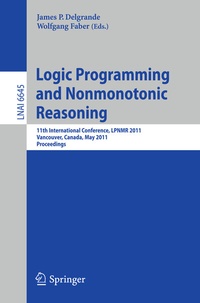
Logic Programming and Nonmonotonic Reasoning
11th International Conference, LPNMR 2011, Vancouver, Canada, May 16-19, 2011, Proceedings
Published on 25. April 2011
XIII, 406 pages
978-3-642-20895-9 (ISBN)
Description

This volume contains the refereed proceedings of the 11th International Conference on Logic Programming and Nonmonotonic Reasoning, LPNMR 2011, held in May 2011 in Vancouver, Canada.
The 16 revised full papers (13 technical papers, 1 application description, and 2 system descriptions) and 26 short papers (16 technical papers, 3 application description, and 7 system descriptions) which were carefully reviewed and selected from numerous submissions, are presented together with 3 invited talks. Being a forum for exchanging ideas on declarative logic programming, nonmonotonic reasoning, and knowledge representation, the conference aims to facilitate interactions between those researchers and practitioners interested in the design and implementation of logic-based programming languages and database systems, and those who work in the area of knowledge representation and nonmonotonic reasoning.
More details
Other editions
Additional editions
James Delgrande | Wolfgang Faber
Logic Programming and Nonmonotonic Reasoning
11th International Conference, LPNMR 2011, Vancouver, Canada, May 16-19, 2011, Proceedings
Book
05/2011
Springer
€53.49
Shipment within 7-9 days
Content
- Title Page
- Preface
- Organization
- Table of Contents
- Invited Talks
- Logic, Probability and Computation: Foundations and Issues of Statistical Relational AI
- Introduction
- Motivation
- Representation
- Inference
- Learning
- Actions
- Identity and Existence Uncertainty
- Ontologies and Semantic Science
- Conclusions
- Foundations and Extensions of Answer Set Programming: The Logical Approach
- Lessons from Efforts to Automatically Translate English to Knowledge Representation Languages
- Technical Papers
- Long Technical Papers
- Modularity of P-Log Programs
- Introduction and Motivation
- Preliminaries
- P-Log Programs
- Modularity in Answer Set Programming
- P-Log Modules
- P-Log Module Theorem
- Conclusions and Future Work
- Symmetry Breaking for Distributed Multi-Context Systems
- Introduction
- Logical Background
- Algebraic Background
- Symmetry in Multi-Context Systems
- Distributed Symmetry Detection
- Symmetry Detection via Graph Automorphism
- Distributed Symmetry-Breaking Constraints
- Experiments
- Conclusion
- Splitting an Argumentation Framework
- Introduction
- Preliminaries
- Formal Foundation
- Splitting and Expansion
- Reduct, Undefined Set and Modification
- Splitting Results
- Monotonicity Result
- Splitting Theorem
- Dynamical Argumentation
- Computing Extensions
- Terms of Equivalence
- Related Work and Conclusions
- Reactive Answer Set Programming
- Introduction
- Background
- Reactive Answer Set Programming
- Reactive Modularity
- The Reactive ASP Solver oclingo
- Further Case Studies
- Discussion
- Communicating ASP and the Polynomial Hierarchy
- Introduction
- Background on Answer Set Programming
- Communicating Programs
- Multi-focused Answer Sets
- Related Work
- Conclusion
- Loop Formulas for Splitable Temporal Logic Programs
- Introduction
- Preliminaries
- Temporal Logic Programs
- Splitting a Temporal Logic Program
- Loop Formulas
- Conclusions
- Pushing Efficient Evaluation of HEX Programs by Modular Decomposition
- Introduction
- Preliminaries
- Formal Framework
- Evaluation
- Implementation and Experiments
- Discussion and Conclusion
- ApproximationsforExplanationsofInconsistencyinPartiallyKnownMulti-ContextSystems
- Introduction
- Preliminaries
- Information Hiding
- Approximations
- Limited Querying
- Discussion
- Related Work and Conclusion
- Relational Information Exchange and Aggregation in Multi-Context Systems
- Introduction
- Preliminaries
- MCSs with Relational Beliefs and Aggregates
- Relational Multi-Context Systems
- Aggregates
- Complexity
- Grounded Equlibria
- FLP Semantics
- SPT-PDB Semantics
- Ferraris Semantics
- Implementation and Initial Experiments
- Conclusion
- Stepping through an Answer-Set Program
- Introduction
- Preliminaries
- Stepping Framework
- Interactive Stepping
- Obtaining a Breakpoint
- Stepping
- Application Scenarios
- Related Work
- Conclusion
- Dynamic Magic Sets for Programs with Monotone Recursive Aggregates
- Introduction
- The DLPAm,s Language
- Magic Sets for DLPAm,s Programs
- Query Equivalence Theorem
- Experimental Results
- Conclusion
- Strong Equivalence of Logic Programs with Abstract Constraint Atoms
- Introduction
- Preliminaries
- Characterization of Strong and Uniform Equivalence
- Program Reduct
- Strong Equivalence
- Uniform Equivalence
- Constraint Replacements
- Conjunctive Encoding
- Disjunctive Encoding
- Shannon Encodings
- Interconnections to Some Existing Encodings
- Related Work
- Conclusion and Directions of Future Work
- Back and Forth between Rules and SE@?????-Models
- Motivation
- Preliminaries
- Rule Equivalence Classes and Their Canonical Rules
- Canonical Rules
- Reconstructing Rules
- Sets of SE@?????--Interpretations Representable by a Rule
- Discussion
- Short Technical Papers
- What are the Necessity Rules in Defeasible Reasoning?
- Introduction
- Basics of Defeasible Logic
- Inferiorly Defeated Rules
- Statement of Results
- Implementation and Some Experimental Results
- Related Works and Conclusions
- Partial Preferences and Ambiguity Resolution in Contextual Defeasible Logic
- Introduction
- Representation Model
- Argumentation Semantics
- Ambiguity Blocking Semantics
- Ambiguity Blocking with Team Defeat
- Ambiguity Propagating without Team Defeat
- Ambiguity Propagating with Team Defeat
- Properties
- Discussion
- On Influence and Contractions in Defeasible Logic Programming
- Introduction
- Defeasible Logic Programming
- Influence in Defeasible Logic Programs
- Rationality Postulates for Contraction in DeLP
- Conclusions
- Termination of Grounding Is Not Preserved by Strongly Equivalent Transformations
- Introduction
- The Example
- Proofs
- Proof of Proposition 1
- Proof of Proposition 2
- Proof of Proposition 3
- Conclusion
- Aggregates in Answer Set Optimization
- Introduction
- ASOG Programs: Syntax
- ASOG Programs: Semantics
- Optimizing the Distributed Evaluation of Stratified Programs via Structural Analysis
- Introduction
- Single Rule Optimized Evaluation
- Evaluation of the Program
- Experiments
- Contingency-Based Equilibrium Logic
- Introduction
- The Logic of Contingency
- Models with at Most Two Points
- Contingency and the Logic of Here-and-There
- Contingency and Equilibrium Logic
- Conclusion
- Weight Constraints with Preferences in ASP
- Introduction
- RASP-Like Preferences in Cardinality Constraints
- Semantics
- Concluding Remarks
- Parametrized Equilibrium Logic
- Introduction
- Parametrized Equilibrium Logic
- Temporal Here-and-There Logic
- Conclusions
- Random vs. Structure-Based Testing of Answer-Set Programs: An Experimental Comparison
- Introduction
- Background
- Experimental Setup
- Results and Discussion
- Integrating Rules and Ontologies in the First-Order Stable Model Semantics (Preliminary Report)
- Introduction
- FOSM Based Hybrid KB
- Relating to DL+log by Rosati
- Relating to Nonmonotonic dl-Programs by Eiter et al.
- Conclusion
- Gentzen-Type Refutation Systems for Three-Valued Logics with an Application to Disproving Strong Equivalence
- Introduction
- Preliminaries
- The Refutation Calculi SRCL and SRCP
- An Application for Disproving Strong Equivalence
- New Semantics for Epistemic Specifications
- Introduction
- The New Definition of Epistemic Specifications
- cmMUS: A Tool for Circumscription-Based MUS Membership Testing
- Introduction
- Background
- cmMUS Description
- Experimental Results
- Summary
- Transaction Logic with External Actions
- Introduction
- Syntax and Oracles
- Model Theory
- Conclusions
- An Application of Clasp in the Study of Logics
- Introduction
- Background
- Hilbert Style
- Multi-valued Logics
- Main Contribution
- Conclusions
- Application Descriptions
- Long Application Description
- Industrial-Size Scheduling with ASP+CP
- Introduction
- Background
- Problem Definition
- Encoding and Solving Scheduling Problems
- Incremental and Penalty-Based Scheduling
- Conclusions
- Short Application Descriptions
- Secommunity: A Framework for Distributed Access Control
- Introduction
- Access Control Policies in ASP
- Implementation
- Querying External Sources
- Tests and Results
- Conclusions and Further Work
- Itemset Mining as a Challenge Application for Answer Set Enumeration
- Introduction
- Itemset Mining
- Itemsets as Answer Sets
- Experiments
- Conclusions
- Causal Reasoning for Planning and Coordination of Multiple Housekeeping Robots
- Introduction
- Representation of Housekeeping Domain
- Reasoning about Housekeeping Domain
- Monitoring the Cleaning Robots
- Conclusion
- System Descriptions
- Long System Descriptions
- ASPIDE: Integrated Development Environment for Answer Set Programming
- Introduction
- Main Features of ASPIDE
- Interface Overview and Implementation
- Usage Example
- Related Work
- Conclusion
- ASP-Prolog for Negotiation among Dishonest Agents
- Introduction
- Background
- Abductive Logic Programming (ALP), Preferences, and Disinformation
- Negotiation Knowledge Base (n-KB)
- Negotiations Using n-KBs
- ASP-Prolog
- A Platform for Negotiation Systems
- ALP Modules
- Negotiation Agent
- Computing and Evaluating Proposals
- Agents: Responses, Strategies, and Negotiations
- A Program for Automated Negotiation
- Conclusion
- Short System Descriptions
- Advances in gringo Series 3
- Introduction
- Advances in gringo Series 3
- Discussion
- A Portfolio Solver for Answer Set Programming: Preliminary Report
- Introduction
- Architecture
- Experiments
- Discussion
- plasp: A Prototype for PDDL-Based Planning in ASP
- Introduction
- Architecture
- Compilations and Meta-Programs
- Experiments
- Discussion
- Cluster-Based ASP Solving with claspar
- Introduction
- Advances in claspar
- Search
- Nogood Exchange
- Optimization
- Experiments
- Search
- Nogood Exchange
- Optimization
- Discussion
- STeLP - A Tool for Temporal Answer Set Programming
- Introduction
- Splitable Temporal Logic Programs
- The Input Language
- Implementation
- Compiling Answer Set Programs into Event-Driven Action Rules
- Introduction
- The Procedure for Computing Answer Sets
- Right-to-Left Propagation
- Left-to-Right Propagation
- Seek-Support
- Labeling
- Translation from ASP into AR
- Performance Evaluation
- Conclusion
- VIDEAS: A Development Tool for Answer-Set Programs Based on Model-Driven Engineering Technology
- Introduction
- Answer-Set Programming with VIDEAS
- Implementation
- Conclusion and Future Work
- ASP Competition
- The Third Answer Set Programming Competition: Preliminary Report of the System Competition Track
- Introduction
- System Competition Format
- Competition Language Overview
- Participants
- Benchmark Suite
- Scoring System
- Software and Hardware Settings
- Results and Discussion
- Overall Results
- Polynomial Problems
- NP Problems
- Beyond-NP Problems
- Author Index
