

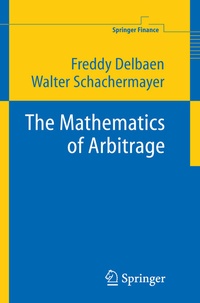
The Mathematics of Arbitrage
Description

This book presents a rigorous mathematical treatment of the theory of pricing and hedging of derivative securities by the principle of "no arbitrage". The first part presents a relatively elementary introduction, restricting itself to the case of finite probability spaces. The second part consists of an updated edition of seven original research papers by the authors, which analyzes the topic in the general framework of semi-martingale theory.
Reviews / Votes
From the reviews:
"As a learning device, I think this works really well. The second half of the book allows readers to 'put to use' the mathematics they learn in the first half. I really like the authors' writing style. They provide plenty of intuitive insights and historical notes along the way as they formally develop concepts. . I recommend it highly to theoretically-inclined financial engineers and researchers." (www.riskbook.com, September, 2006)
"The aim of the book, as the authors state . is to give the reader a guided tour through the mathematics of arbitrage. . The book will be of invaluable help to new researchers in the area of incomplete markets. A new graduate student wishing to do such research would start by reading the papers in the book. She or he now has a very good book to assist this study." (Angelos Dassios, Mathematical Reviews, Issue 2007 a)
More details
Other editions
Additional editions
Persons
Walter Schachermeyer, born in 1950 in Linz, Austria, has received--as the first mathematician--the 1998 Wittgenstein Award, Austria's highest honor for scienctific achievement. Since 1998 he holds the Chair for Actuarial and Financial Mathematics at the Vienna University of Technolgoy. Among his achievements is the proof of the "Fundamental Theorem of Asset Pricing" in its general form, which was done in joint work with Freddy Delbaen.
Freddy Delbaen, born in 1946 in Duffel/Antwerpen, Belgium, is Professor for Financial Mathematics at the ETH in Zurich since 1995.
Content
9.1 Introduction
A basic result in mathematical .nance, sometimes called the fundamental theorem of asset pricing (see [DR 87]), is that for a stochastic process (St)t ¸R +, the existence of an equivalent martingale measure is essentially equivalent to the absence of arbitrage opportunities. In .nance the process (St)t ¸R + describes the random evolution of the discounted price of one or several .nancial assets. The equivalence of no-arbitrage with the existence of an equivalent probability martingale measure is at the basis of the entire theory of "pricing by arbitrage". Starting from the economically meaningful assumption that S does not allow arbitrage pro.ts (di.erent variants of this concept will be de.ned below), the theorem allows the probability P on the underlying probability space (.,F,P) to be replaced by an equivalent measure Q such that the process S becomes a martingale under the new measure. This makes it possible to use the rich machinery of martingale theory. In particular the problem of fair pricing of contingent claims is reduced to taking expected values with respect to the measure Q. This method of pricing contingent claims is known to actuaries since the introduction of actuarial skills, centuries ago and known by the name of "equivalence principle".
The theory of martingale representation allows to characterise those assets that can be reproduced by buying and selling the basic assets. One might get the impression that martingale theory and the general theory of stochastic processes were tailor-made for .nance (see [HP 81]). The change of measure from P to Q can also be seen as a result of risk aversion. By changing the physical probability measure from P to Q, one can attribute more weight to unfavourable events and less weight to more favourable ones.
As an example that this technique has in fact a long history, we quote the use of mortality tables in insurance. The actual mortality table is replaced by a table re.ecting more mortality if a life insurance premium is calculated but is replaced by a table re.ecting a lower mortality rate if e.g. a lump sum buying a pension is calculated. Changing probabilities is common practice in actuarial sciences. It is therefore amazing to notice that today's actuaries are introducing these modern .nancial methods at such a slow pace.
The present paper focuses on the question: "What is the precise meaning of the word essentially in the .rst paragraph of the paper?" The question has a twofold interest. From an economic point of view one wants to understand the precise relation between concepts of no-arbitrage type and the existence of an equivalent martingale measure in order to understand the exact limitations up to which the above sketched approach may be extended. From a purely mathematical point of view it is also of natural interest to get a better understanding of the question which stochastic processes are martingales after an appropriate change to an equivalent probability measure. We refer to the well-known fact that a semi-martingale becomes a quasi-martingale under a well-chosen equivalent law (see [P 90]); from here to the question whether we can obtain a martingale, or more generally a local martingale, is natural.
