

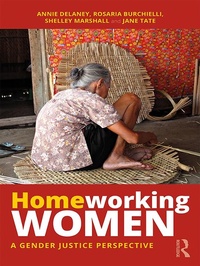
Homeworking Women
A Gender Justice Perspective
1st Edition
Published on 13. November 2018
196 pages
978-0-429-77203-0 (ISBN)
Description

Homework; work that is categorised as informal employment, performed in the home, mainly for subcontractors and mostly undertaken by women. The inequities and injustices inherent in homework conditions maintain women's weak bargaining position, preventing them from making any improvements to their lives via their work. The best way to tackle these issues is not to abolish, but to bring equality and justice to homework.
This book contributes a gender justice framework to analyse and confront the issues and problems of homework. The authors propose four justice dimensions - recognition, representation, rights and redistribution - to examine and analyse homework. This framework also takes into account the structures and processes of capitalism and the patriarchy, and the relations of domination that are widely held to be the major factors that determine homework injustice. The authors discuss strategies and approaches that have worked for homeworkers, highlighting why they worked and the features that were beneficial for them.
Homeworking Women will be of interest to individuals and organisations working with or for the collective benefit of homeworkers, academics and students interested in feminism, labour regulation, informal work, supply chains and social and political justice.
This book contributes a gender justice framework to analyse and confront the issues and problems of homework. The authors propose four justice dimensions - recognition, representation, rights and redistribution - to examine and analyse homework. This framework also takes into account the structures and processes of capitalism and the patriarchy, and the relations of domination that are widely held to be the major factors that determine homework injustice. The authors discuss strategies and approaches that have worked for homeworkers, highlighting why they worked and the features that were beneficial for them.
Homeworking Women will be of interest to individuals and organisations working with or for the collective benefit of homeworkers, academics and students interested in feminism, labour regulation, informal work, supply chains and social and political justice.
Reviews / Votes
"The injustices experienced by women homeworkers across the globe are shockingly familiar, systemic and exploitative. Importantly this book analyses the problem and takes us to the powerful change that is possible through homeworkers collectively organising."Michele O'Neil President of Australian Council of Trade Unions
"This is a very important and timely book, drawing together the authors' collective experience of research and activism on homeworkers. It highlights the lack of recognition or rights of homeworkers' despite their important commercial contribution, and argues forcefully for gender justice. A must read for anyone interested in homeworkers."
Stephanie Barientos, Professor of Global Development University of Manchester, a.barrientos@manchester.ac.uk
"Attentive to patriarchy and capitalism, informal economies and global supply chains, and the material and ideological components of neoliberalism, these activist scholars wield a robust gender justice framework to expose the harms of exploitative homework. Delaney, Burchielli, Marshall, and Tate unmask the making of invisibility and uncover the lives and labors of women whose dwellings have turned into workplaces. But they do more: in analyzing strategies that have worked and those which have not, they offer roadmaps to achieving rights, recognition, redistribution, and a larger social justice."
Eileen Boris, Hull Professor and Distinguished Professor of Feminist Studies, University of California, Santa Barbara
More details
Edition
1. Auflage
Language
English
Place of publication
London
United Kingdom
Publishing group
Taylor & Francis Ltd
Target group
College/higher education
Illustrations
1 Tables, black and white; 2 Line drawings, black and white; 3 Illustrations, black and white
File size
4,43 MB
ISBN-13
978-0-429-77203-0 (9780429772030)
Copyright in bibliographic data and cover images is held by Nielsen Book Services Limited or by the publishers or by their respective licensors: all rights reserved.
Schweitzer Classification
Other editions
Additional editions
Book
11/2018
1st Edition
Greenleaf Publishing
€67.00
Shipment within 3-4 weeks
Book
11/2018
1st Edition
Greenleaf Publishing
€206.10
Shipment within 3-4 weeks
Persons
Annie Delaney is Senior Lecturer, School of Management, College of Business, RMIT University Melbourne, Australia.
Rosaria Burchielli is Associate Professor (Honorary), Department of Management, La Trobe University, Australia.
Shelley Marshall is Vice Chancellor's Senior Research Fellow, RMIT University, Australia.
Jane Tate worked as Coordinator of Homeworkers Worldwide, Leeds, UK, until September 2018.
Rosaria Burchielli is Associate Professor (Honorary), Department of Management, La Trobe University, Australia.
Shelley Marshall is Vice Chancellor's Senior Research Fellow, RMIT University, Australia.
Jane Tate worked as Coordinator of Homeworkers Worldwide, Leeds, UK, until September 2018.
Content
Introduction: Homework and Gender justice
Chapter 1: Understanding Homework and Homeworkers
Chapter 2: The Invisibilisation of Homework
Chapter 3: Extension of labour regulation to homeworkers
Chapter 4: Corporate Social Responsibility (CSR): Improving Homeworkers Recognition?
Chapter 5: The Logic of the Supply Chain: Barriers and Strategies for Homeworker Representation
Chapter 6: Homeworkers Organising: Transnational to Local
Chapter 7: Making Change: A Gender Justice Framework
Chapter 1: Understanding Homework and Homeworkers
Chapter 2: The Invisibilisation of Homework
Chapter 3: Extension of labour regulation to homeworkers
Chapter 4: Corporate Social Responsibility (CSR): Improving Homeworkers Recognition?
Chapter 5: The Logic of the Supply Chain: Barriers and Strategies for Homeworker Representation
Chapter 6: Homeworkers Organising: Transnational to Local
Chapter 7: Making Change: A Gender Justice Framework
