

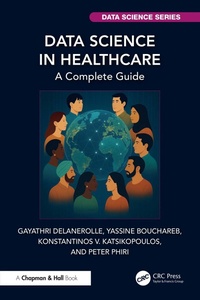
Data Science in Healthcare
Description

Unlike other texts, this book integrates technical foundations with ethical, regulatory, and societal considerations. It covers the entire data science lifecycle, from acquisition and processing to advanced analytics, application development, and decision support. Real-world case studies-including a detailed example of using electronic health records in Rwanda-illustrate how data science can drive impact in low- and high-resource settings alike.
Key Features:
Comprehensive coverage of data science fundamentals, machine learning, and advanced analytics
In-depth exploration of ethical, governance, and regulatory challenges
Practical insights into developing applications and decision support systems
Global case studies demonstrating applied data science in healthcare and public policy
Clear explanations suitable for multidisciplinary audiences
This book is ideal for students, researchers, and professionals in data science, healthcare, public policy, and technology development. It equips readers with both the technical and ethical tools needed to navigate today's data-rich world and to leverage data for innovation, problem-solving, and societal good.
More details
Other editions
Additional editions
Persons
Dr Gayathri Delanerolle, Senior Clinical Researcher, Southern Health NHS Foundation Trust, UK.
Dr Yassine Bouchareb is a Registered Clinical Scientist, Health Care Professions Council, UK. As well as an Assistant Professor of Medical Physics, College of Medicine and Health Sciences, Sultan Qaboos University, Oman.
Ashish Laxminarayana Shetty, Visiting Professor of Anaesthesiology & Pain Medicine, SSAHE, India. Shetty is also an Honorary Associate Professor, UCL, London and Chief Medical Officer (Pain and Neuromodulation) at NuroKor.
Konstantinos V. Katsikopoulos, Professor of Behavioural Sciences and Founding Co-Director at the Center for Behavioral Experimental Action and Research, University of Southampton, UK.
Peter Phiri, Director of Research & Innovation (Interim), Southern Health NHS Foundation Trust, UK.
Content
1. Brief History
2. Data Science in Medicine
3. Data Science for Clinical Practice
4. Data Science and Application Use
5. Human Factors and Data Science
6. Case Study
Part II: Data Science and Artificial Intelligence
7. Introduction to AI
8. Machine Learning and Model Development
9. Deep Learning and Model Development
10. Algorithm Development as Clinical Decision Making Tools
11. Evidence-Based Medicine Methods to Model Data Science
12. Clinical Trials for AI Tools
13. Developing AI as Effectiveness Tools
14. The Use of Big Data and Data Platforms
15. Case Study
Part III: Ethical Implications and Social Policy
16. Introduction to Data Science and Ethics
17. Ethical Issues and Legislation Development
18. Patient-Public Involvement and Engagement
19. Data Science and Social Policy
20. Case Study
Part IV: Medical Statistics
21. Introduction to Medical Statistics
22. Epidemiology Model Development
23. Epidemiology Model Validation and their Constraints in Medicine
24. Epidemiology Models for Data Augmentation
25. Synthetic Data Development and Modelling
26. Introduction to Clinical Trial Statistics
27. Gaussian Methodology and Application in Clinical Epidemiology
28. Bayesian Methodology and Application in Clinical Epidemiology
29. Case Study
Part V: Application Development Using Data Science
30. Digital Medicine Tool Development
31. Mobile Applications as Clinician Decision Aids
32. Real-World Data Tool for Real-Time Data Gathering
33. Precision Medicine Tool for Predicting Outcomes
34. Software Development Using Data Science Principles
35. Simulation Tools for Medical Education
36. Robotic Surgery Using Data Applications
37. Cognitive Performance Applications
38. Case Study
Part VI: Governance and Regulatory Approvals
39. Quality Assurance, Quality Control, and Quality Management
40. Quality Indicators and Continuous Improvement
41. Research Governance
42. Data Codes of Practice and Frameworks
43. Developing Data Governance and Regulatory Frameworks
44. Audits and Regulatory Inspection Preparation
45. Case Study
