

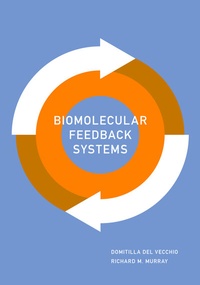
Biomolecular Feedback Systems
1st Edition
Published on 28. July 2015
288 pages
978-1-4008-5050-1 (ISBN)
Description

This book provides an accessible introduction to the principles and tools for modeling, analyzing, and synthesizing biomolecular systems. It begins with modeling tools such as reaction-rate equations, reduced-order models, stochastic models, and specific models of important core processes. It then describes in detail the control and dynamical systems tools used to analyze these models. These include tools for analyzing stability of equilibria, limit cycles, robustness, and parameter uncertainty. Modeling and analysis techniques are then applied to design examples from both natural systems and synthetic biomolecular circuits. In addition, this comprehensive book addresses the problem of modular composition of synthetic circuits, the tools for analyzing the extent of modularity, and the design techniques for ensuring modular behavior. It also looks at design trade-offs, focusing on perturbations due to noise and competition for shared cellular resources.
Featuring numerous exercises and illustrations throughout, Biomolecular Feedback Systems is the ideal textbook for advanced undergraduates and graduate students. For researchers, it can also serve as a self-contained reference on the feedback control techniques that can be applied to biomolecular systems.
- Provides a user-friendly introduction to essential concepts, tools, and applications
- Covers the most commonly used modeling methods
- Addresses the modular design problem for biomolecular systems
- Uses design examples from both natural systems and synthetic circuits
- Solutions manual (available only to professors at press.princeton.edu)
- An online illustration package is available to professors at press.princeton.edu
Featuring numerous exercises and illustrations throughout, Biomolecular Feedback Systems is the ideal textbook for advanced undergraduates and graduate students. For researchers, it can also serve as a self-contained reference on the feedback control techniques that can be applied to biomolecular systems.
- Provides a user-friendly introduction to essential concepts, tools, and applications
- Covers the most commonly used modeling methods
- Addresses the modular design problem for biomolecular systems
- Uses design examples from both natural systems and synthetic circuits
- Solutions manual (available only to professors at press.princeton.edu)
- An online illustration package is available to professors at press.princeton.edu
All prices
More details
Edition
Course Book
Language
English
Place of publication
Princeton, NJ
United States
Publishing group
De Gruyter
Target group
Professional and scholarly
Edition type
Digital original
Product notice
Reflowable
Illustrations
13 halftones. 113 line illus. 3 tables
File size
6,22 MB
ISBN-13
978-1-4008-5050-1 (9781400850501)
Schweitzer Classification
Other editions
Additional editions
Domitilla Del Vecchio | Richard Murray
Biomolecular Feedback Systems
Book
10/2014
Princeton University Press
€111.50
Shipment within 10-20 days
Persons
Domitilla Del Vecchio is associate professor of mechanical engineering at the Massachusetts Institute of Technology. Richard M. Murray is professor of control and dynamical systems and bioengineering at the California Institute of Technology. His books include Feedback Systems: An Introduction for Scientists and Engineers (Princeton).
Content
Preface vii
1 Introductory Concepts 1
1.1 Systems biology: Modeling, analysis and role of feedback 1
1.2 The cell as a system 8
1.3 Control and dynamical systems tools 11
1.4 Input/output modeling 18
1.5 From systems to synthetic biology 22
1.6 Further reading 28
2 Dynamic Modeling of Core Processes 29
2.1 Modeling chemical reactions 29
2.2 Transcription and translation 44
2.3 Transcriptional regulation 55
2.4 Post-transcriptional regulation 70
2.5 Cellular subsystems 81
Exercises 86
3 Analysis of Dynamic Behavior 89
3.1 Analysis near equilibria 89
3.2 Robustness 103
3.3 Oscillatory behavior 113
3.4 Bifurcations 124
3.5 Model reduction techniques 127
Exercises 133
4 Stochastic Modeling and Analysis 139
4.1 Stochastic modeling of biochemical systems 139
4.2 Simulation of stochastic systems 154
4.3 Input/output linear stochastic systems 157
Exercises 164
5 Biological Circuit Components 169
5.1 Introduction to biological circuit design 169
5.2 Negative autoregulation 171
5.3 The toggle switch 177
5.4 The repressilator 180
5.5 Activator-repressor clock 184
5.6 An incoherent feedforward loop (IFFL) 189
5.7 Bacterial chemotaxis 191
Exercises 203
6 Interconnecting Components 205
6.1 Input/output modeling and the modularity assumption 205
6.2 Introduction to retroactivity 206
6.3 Retroactivity in gene circuits 209
6.4 Retroactivity in signaling systems 214
6.5 Insulation devices: Retroactivity attenuation 219
6.6 A case study on the use of insulation devices 236
Exercises 239
7 Design Tradeoffs 243
7.1 Competition for shared cellular resources 243
7.2 Stochastic effects: Design tradeoffs in systems with large gains 253
Exercises 257
Bibliography 259
Index 267
1 Introductory Concepts 1
1.1 Systems biology: Modeling, analysis and role of feedback 1
1.2 The cell as a system 8
1.3 Control and dynamical systems tools 11
1.4 Input/output modeling 18
1.5 From systems to synthetic biology 22
1.6 Further reading 28
2 Dynamic Modeling of Core Processes 29
2.1 Modeling chemical reactions 29
2.2 Transcription and translation 44
2.3 Transcriptional regulation 55
2.4 Post-transcriptional regulation 70
2.5 Cellular subsystems 81
Exercises 86
3 Analysis of Dynamic Behavior 89
3.1 Analysis near equilibria 89
3.2 Robustness 103
3.3 Oscillatory behavior 113
3.4 Bifurcations 124
3.5 Model reduction techniques 127
Exercises 133
4 Stochastic Modeling and Analysis 139
4.1 Stochastic modeling of biochemical systems 139
4.2 Simulation of stochastic systems 154
4.3 Input/output linear stochastic systems 157
Exercises 164
5 Biological Circuit Components 169
5.1 Introduction to biological circuit design 169
5.2 Negative autoregulation 171
5.3 The toggle switch 177
5.4 The repressilator 180
5.5 Activator-repressor clock 184
5.6 An incoherent feedforward loop (IFFL) 189
5.7 Bacterial chemotaxis 191
Exercises 203
6 Interconnecting Components 205
6.1 Input/output modeling and the modularity assumption 205
6.2 Introduction to retroactivity 206
6.3 Retroactivity in gene circuits 209
6.4 Retroactivity in signaling systems 214
6.5 Insulation devices: Retroactivity attenuation 219
6.6 A case study on the use of insulation devices 236
Exercises 239
7 Design Tradeoffs 243
7.1 Competition for shared cellular resources 243
7.2 Stochastic effects: Design tradeoffs in systems with large gains 253
Exercises 257
Bibliography 259
Index 267

