

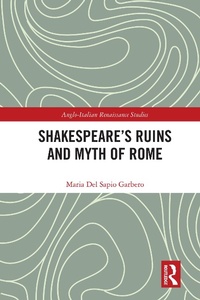
Shakespeare's Ruins and Myth of Rome
1st Edition
Published on 30. December 2021
404 pages
978-1-000-53156-5 (ISBN)
Description

Rome was tantamount to its ruins, a dismembered body, to the eyes of those - Italians and foreigners - who visited the city in the years prior to or encompassing the lengthy span of the Renaissance. Drawing on the double movement of archaeological exploration and creative reconstruction entailed in the humanist endeavour to 'resurrect' the past, 'ruins' are seen as taking precedence over 'myth', in Shakespeare's Rome. They are assigned the role of a heuristic model, and discovered in all their epistemic relevance in Shakespeare's dramatic vision of history and his negotiation of modernity. This is the first book of its kind to address Shakespeare's relationship with Rome's authoritative myth, archaeologically, by taking as a point of departure a chronological reversal, namely the vision of the 'eternal' city as a ruinous scenario and hence the ways in which such a layered, 'silent', and aporetic scenario allows for an archaeo-anatomical approach to Shakespeare's Roman works.
Reviews / Votes
"Maria Del Sapio Garbero's concern with ruins is profoundly scholarly, blending as it does an impressive knowledge of Shakespeare with an intimate knowledge of Rome, its ruins and Renaissance humanism. Yet the project resonates beyond itself with the postmodern aesthetic of an artist such as Anselm Kiefer whose style might be characterized as a destructive gouging or shattering or alternatively a thick impasting or palimpesting of the artwork's surface. Though refraining from so explicit a link, Del Sapio treats the text of Shakespeare's Roman works in much this way. The ruin (in Benjamin's words, 'the form which things assume in oblivion') interrupts the narrative of history, threatening to smother it at birth. If historical narrative is called forth by what Benjamin called the 'heliotropism' of the present, then the ruin threatens to return history to its tumbled ground, where in Nietzsche's words, 'with an excess of history man again ceases to exist'. The process is announced in Titus Andronicus, where tropes of ruin - burial, mourning, dismembering, remembering, palimpsesting - threaten to collapse the present to a traumatic heap. Yet ruins also beget the Humanist idea of rebirth and the project of modernity; it is the threat of ruin that translates desire into a language and artistry capable of inheriting the future." John Gillies, University of Essex"Shakespeare did not have to leave England to know that he was living amid the ruins of Rome. He and his contemporaries constantly encountered the physical remains of the ancient conquerors, their still-standing bridges, uncannily straight roads, baths, walls, and half-broken battlements; their fragmented statues and coins, perfume bottles and monumental inscriptions routinely unearthed from the loam. Still more, anyone with a grammar school education was steeped in the cultural remains of Rome, the language, history, stories, and underlying beliefs that had once ruled much of the world. Maria Del Sapio Garbero's book focuses on the remarkable succession of plays, along with the narrative poem "The Rape of Lucrece", in which Shakespeare directly engaged with Roman themes. Richly learned, probing, and intellectually generous, Shakespeare's Ruins and Myth of Rome is an essential guide to these works. But it is also a brilliant guide to what it means here and now to think creatively with the traces of the shattered past. This book itself is what it says of its great subject: 'A field of possibilities springing out of a field of ruins.'" Stephen Greenblatt, Cogan University Professor of the Humanities at Harvard "Maria Del Sapio Garbero's concern with ruins is profoundly scholarly, blending as it does an impressive knowledge of Shakespeare with an intimate knowledge of Rome, its ruins and Renaissance humanism. Yet the project resonates beyond itself with the postmodern aesthetic of an artist such as Anselm Kiefer whose style might be characterized as a destructive gouging or shattering or alternatively a thick impasting or palimpesting of the artwork's surface. Though refraining from so explicit a link, Del Sapio treats the text of Shakespeare's Roman works in much this way. The ruin (in Benjamin's words, 'the form which things assume in oblivion') interrupts the narrative of history, threatening to smother it at birth. If historical narrative is called forth by what Benjamin called the 'heliotropism' of the present, then the ruin threatens to return history to its tumbled ground, where in Nietzsche's words, 'with an excess of history man again ceases to exist'. The process is announced in Titus Andronicus, where tropes of ruin - burial, mourning, dismembering, remembering, palimpsesting - threaten to collapse the present to a traumatic heap. Yet ruins also beget the Humanist idea of rebirth and the project of modernity; it is the threat of ruin that translates desire into a language and artistry capable of inheriting the future." John Gillies, University of Essex, UK
"Shakespeare did not have to leave England to know that he was living amid the ruins of Rome. He and his contemporaries constantly encountered the physical remains of the ancient conquerors, their still-standing bridges, uncannily straight roads, baths, walls, and half-broken battlements; their fragmented statues and coins, perfume bottles and monumental inscriptions routinely unearthed from the loam. Still more, anyone with a grammar school education was steeped in the cultural remains of Rome, the language, history, stories, and underlying beliefs that had once ruled much of the world. Maria Del Sapio Garbero's book focuses on the remarkable succession of plays, along with the narrative poem "The Rape of Lucrece", in which Shakespeare directly engaged with Roman themes. Richly learned, probing, and intellectually generous, Shakespeare's Ruins and Myth of Rome is an essential guide to these works. But it is also a brilliant guide to what it means here and now to think creatively with the traces of the shattered past. This book itself is what it says of its great subject: 'A field of possibilities springing out of a field of ruins.'"
Stephen Greenblatt, Cogan University Professor of the Humanities at Harvard
More details
Series
Edition
1. Auflage
Language
English
Place of publication
London
United Kingdom
Publishing group
Taylor & Francis Ltd
Target group
College/higher education
Illustrations
15 Halftones, black and white; 15 Illustrations, black and white
ISBN-13
978-1-000-53156-5 (9781000531565)
Copyright in bibliographic data and cover images is held by Nielsen Book Services Limited or by the publishers or by their respective licensors: all rights reserved.
Schweitzer Classification
Other editions
Additional editions
Maria Del Sapio Garbero
Shakespeare's Ruins and Myth of Rome
Book
09/2023
1st Edition
Routledge
€69.50
Shipment within 10-20 days
Maria Del Sapio Garbero
Shakespeare's Ruins and Myth of Rome
Book
01/2022
1st Edition
Routledge
€232.00
Shipment within 15-20 days
Person
Maria Del Sapio Garbero is Professor Emerita of English Literature in the Department of Foreign Languages, Literatures and Cultures at Roma Tre University (Italy).
Content
Introduction
Part 1. Ruins
Part 2. The ruins of England
Chap. 1. Starting with the debris of finis imperii: Titus Andronicus
Chap. 2. Lucrece's pictorial anatomy of ruin
Chap. 3. Anatomizing the body of a king: knowledge, conspiracy,
and memory in Julius Caesar
Chap. 4. 'My memory is tired': Coriolanus's forgetful Humanism
Chap.5. 'Caesar's wing': negotiating the myth of Rome in Cymbeline
Chap.6. World and ruin in Antony and Cleopatra. A conclusion
Part 1. Ruins
Part 2. The ruins of England
Chap. 1. Starting with the debris of finis imperii: Titus Andronicus
Chap. 2. Lucrece's pictorial anatomy of ruin
Chap. 3. Anatomizing the body of a king: knowledge, conspiracy,
and memory in Julius Caesar
Chap. 4. 'My memory is tired': Coriolanus's forgetful Humanism
Chap.5. 'Caesar's wing': negotiating the myth of Rome in Cymbeline
Chap.6. World and ruin in Antony and Cleopatra. A conclusion
