

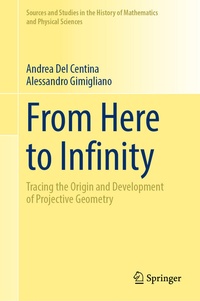
From Here to Infinity
Description

This monograph traces the development of projective geometry from its Greek origins to the early 20th century. It covers Renaissance perspective studies and insights from the late sixteenth to seventeenth centuries, examining the contributions of Desargues and Pascal.
Most of the book is devoted to the evolution of the subject in the 19th century, from Carnot to von Staudt. In particular, the book offers an unusually thorough appreciation of Brianchon's work, a detailed study of Poncelet's innovations, and a remarkable account of the contributions of Möbius and Plücker. It also addresses the difficult question of the historical relationship between synthetic and analytic points of view in geometry, analyzing the work of prominent synthetic geometers Steiner, Chasles, and von Staudt in detail. The book concludes around 1930, after the synthetic point of view was axiomatized and the analytic point of view became intertwined with algebraic geometry.
Balancing historical analysis with technical precision and providing deep insights into the evolution of the mathematics, this richly illustrated book serves as a central reference on the history of projective geometry.
Reviews / Votes
"The authors examine many primary sources from Western European heritage, in great detail, ranging from the ancient times to the mid 20th century. If they do not discuss some parts of that vast legacy, the reader is informed about it. The sizable reference list contains over 670 references, including those of the authors' papers. Many geometrical drawings illustrate the text - some of them are coming from the original sources (modified when appropriate), some are made by the authors . ." (Radoslav M. Dimitric, zbMATH 1571.01001, 2026)
"FHTI is a very good book. It should be in every university library, or, as things seem to be going, available online to patrons. It is 788 pages long. The mathematical exposition is excellent; the history is authoritative. Chapter by chapter, the history is set out and the mathematics is clearly explained- most key propositions come with original proofs, clarified as needed, with numerous line figures. A reader with some background and persistence can follow the mathematical arguments." (Christopher Baltus, Bulletin of the Canadian Society for History and Philosophy of Mathematics, Issue 77, November, 2025)
More details
Other editions
Additional editions
Persons
Andrea Del Centina has been full professor at the University of Ferrara, where he taught Higher Geometry from 1990 to his retirement in 2012. Previously he taught Analysis and Geometry at the universities of Florence and Urbino. Del Centina has been working in Algebraic geometry until his retirement, and in this field he is author and co-author of many research articles published in international mathematics Journals. Since 2000, he has been also working in History of mathematics, and he has produced important research articles and books concerning the work and life of N. H. Abel, S. Germain, G. Libri. More recently he has turned his interest to the history of projective geometry, and he had published several papers which appeared in Archive for History of Exact Sciences and Historia Mathematica.
Alessandro Gimigliano (PhD, Queens'University, Kingston, CA) is full professor of Geometry at the University of Bologna since 2000, where he teaches Projective Geometry and History of Mathematics. Previously he taught at the universities of Genoa, Potenza and Rome Tor Vergata. His research is in the fields of Algebraic Geometry, Commutative Algebra and their Applications, with over 50 published research articles in international journals. He is also co-author of two university textbooks.
Content
- 1. The Greek Legacy.- 2. Perspective in the Renaissance.- 3. New ways of looking at conics.- 4. Desargues, the dawn of projective geometry.- 5. Pascal's geometrical achievements.- 6. An interlude a century and a half long.- 7. Towards a new geometry.- 8. Poncelet, the projective properties of figures.- 9. The algebraic way to projective geometry.- 10. The synthetic route: the contributions of Steiner and Chasles.- 11. Von Staudt's pure synthetism.- 12. Projective geometry 1870-1930 and beyond.
