

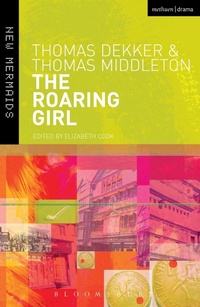
The Roaring Girl
1st Edition
Published on 13. June 2014
192 pages
978-1-4081-4420-6 (ISBN)
Description

This Jacobean city comedy is a curiosity in that it presents a
real-life character, the notorious cross-dresser Moll Frith, who
probably was among the first audiences of 'her' play before she was
taken up for public misconduct. Middleton and Dekker's 'roaring girl'
may outrage her society with her pipe, bluster and swagger, but she
turns out to be the moral centre of the play. Her code of honour leads
her to call the bluff on rogues and conspicuous consumers, to thrash a
hypocritical gallant in a duel, and to act as go-between for the young
lovers thwarted by parental tyranny. This wry dramatisation of female
deviancy exposing male ineffectuality is as much to the point today as
it was in King James's England. An appendix helps the modern reader to
appreciate the canting terms used by the low-life characters.
real-life character, the notorious cross-dresser Moll Frith, who
probably was among the first audiences of 'her' play before she was
taken up for public misconduct. Middleton and Dekker's 'roaring girl'
may outrage her society with her pipe, bluster and swagger, but she
turns out to be the moral centre of the play. Her code of honour leads
her to call the bluff on rogues and conspicuous consumers, to thrash a
hypocritical gallant in a duel, and to act as go-between for the young
lovers thwarted by parental tyranny. This wry dramatisation of female
deviancy exposing male ineffectuality is as much to the point today as
it was in King James's England. An appendix helps the modern reader to
appreciate the canting terms used by the low-life characters.
More details
Series
Edition
1. Auflage
Language
English
Place of publication
London
United Kingdom
Publishing group
Bloomsbury Publishing PLC
Target group
Professional and scholarly
Illustrations
c 5 photographs/line drawings
ISBN-13
978-1-4081-4420-6 (9781408144206)
Copyright in bibliographic data and cover images is held by Nielsen Book Services Limited or by the publishers or by their respective licensors: all rights reserved.
Schweitzer Classification
Other editions
Additional editions

Thomas Dekker | Thomas Middleton | Elizabeth Cook
The Roaring Girl
Book
08/2003
2nd Edition
Methuen Drama
€17.60
Shipment within 10-20 days
Persons
Thomas Dekker was an English Elizabethan dramatist, born in 1572. Possibly of Dutch origin, very little is known of Dekker's early life and education. His career in the theatre began in the mid-1590s but it is unclear how or why Dekker came to write for the stage. By that time he was odd-jobbing for various London theatre companies, including both the Admiral's Men and its rivals the Lord Chamberlain's Men; he probably joined the large team of playwrights, including Shakespeare, who penned the controversial drama Sir Thomas More around this time. Dekker struggled to make ends meet, however, and in 1598 he was imprisoned for debt.
1599 was, by contrast, an annus mirabilis for Dekker. The theatrical entrepreneur and impresario of the Admiral's Men, Philip Henslowe, lists payments to Dekker that year for contributions to no fewer than eleven plays; two of these, Old Fortunatus and The Shoemaker's Holiday, were selected to be performed at Court during the Queen's Christmas festivals. Dekker received royal favour again after the death of Elizabeth and the accession of King James I in 1603 when he was contracted with Ben Jonson to write the ceremonial entertainments for James's coronation procession through London. He was sorely in need of such commissions; the playhouses were closed for much of this year because of a plague outbreak that killed as many as a quarter of London's population.
During the outbreak, he retooled himself as a writer of satires - a genre in which he had acquired some dramatic experience in 1602, when he penned Satiromastix, a play that took aim at Ben Jonson (who had lampooned him the previous year in Poetaster). Dekker's prose satires about the plague year reveal a new skill for gritty reportage and sympathetic attention to the enormous sufferings of the afflicted. He repeatedly returned to this genre when he was prevented, whether by theatre closures or by imprisonment, from writing for the stage.
Like The Shoemaker's Holiday, Dekker's plays in the years of James's reign tend to dramatize the stories of citizens. And they again display a sympathetic fascination with socially marginal characters, often women - a prostitute (The Honest Whore, co-written with Thomas Middleton, 1604), a transvestite (The Roaring Girl, 1611, also co-written with Middleton), and a witch (The Witch of Edmonton, 1621, co-written with John Ford and William Rowley). But Dekker's financial woes continued through these years, and he was once more imprisoned for debt between 1612 and 1619, a harrowing experience that he later claimed turned his hair white. Upon his release, he continued to write plays, citizen pageants, and prose pamphlets, but he never enjoyed the success of his earlier years. He died, leaving his widow no estate except his writings, in 1632.
1599 was, by contrast, an annus mirabilis for Dekker. The theatrical entrepreneur and impresario of the Admiral's Men, Philip Henslowe, lists payments to Dekker that year for contributions to no fewer than eleven plays; two of these, Old Fortunatus and The Shoemaker's Holiday, were selected to be performed at Court during the Queen's Christmas festivals. Dekker received royal favour again after the death of Elizabeth and the accession of King James I in 1603 when he was contracted with Ben Jonson to write the ceremonial entertainments for James's coronation procession through London. He was sorely in need of such commissions; the playhouses were closed for much of this year because of a plague outbreak that killed as many as a quarter of London's population.
During the outbreak, he retooled himself as a writer of satires - a genre in which he had acquired some dramatic experience in 1602, when he penned Satiromastix, a play that took aim at Ben Jonson (who had lampooned him the previous year in Poetaster). Dekker's prose satires about the plague year reveal a new skill for gritty reportage and sympathetic attention to the enormous sufferings of the afflicted. He repeatedly returned to this genre when he was prevented, whether by theatre closures or by imprisonment, from writing for the stage.
Like The Shoemaker's Holiday, Dekker's plays in the years of James's reign tend to dramatize the stories of citizens. And they again display a sympathetic fascination with socially marginal characters, often women - a prostitute (The Honest Whore, co-written with Thomas Middleton, 1604), a transvestite (The Roaring Girl, 1611, also co-written with Middleton), and a witch (The Witch of Edmonton, 1621, co-written with John Ford and William Rowley). But Dekker's financial woes continued through these years, and he was once more imprisoned for debt between 1612 and 1619, a harrowing experience that he later claimed turned his hair white. Upon his release, he continued to write plays, citizen pageants, and prose pamphlets, but he never enjoyed the success of his earlier years. He died, leaving his widow no estate except his writings, in 1632.
