

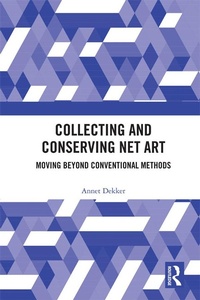
Collecting and Conserving Net Art
Moving beyond Conventional Methods
1st Edition
Published on 8. May 2018
202 pages
978-1-351-20862-8 (ISBN)
Description

Collecting and Conserving Net Art explores the qualities and characteristics of net art and its influence on conservation practices. By addressing and answering some of the challenges facing net art and providing an exploration of its intersection with conservation, the book casts a new light on net art, conservation, curating and museum studies.
Viewing net art as a process rather than as a fixed object, the book considers how this is influenced by and executed through other systems and users. Arguing that these processes and networks are imbued with ambiguity, the book suggests that this is strategically used to create suspense, obfuscate existing systems and disrupt power structures. The rapid obsolescence of hard and software, the existence of many net artworks within restricted platforms and the fact that artworks often act as assemblages that change or mutate, make net art a challenging case for conservation. Taking the performative and interpretive roles conservators play into account, the book demonstrates how practitioners can make more informed decisions when responding to, critically analysing or working with net art, particularly software-based processes.
Collecting and Conserving Net Art is intended for researchers, academics and postgraduate students, especially those engaged in the study of museum studies, conservation and heritage studies, curatorial studies, digital art and art history. The book should also be interesting to professionals who are involved in the conservation and curation of digital arts, performance, media and software.
Viewing net art as a process rather than as a fixed object, the book considers how this is influenced by and executed through other systems and users. Arguing that these processes and networks are imbued with ambiguity, the book suggests that this is strategically used to create suspense, obfuscate existing systems and disrupt power structures. The rapid obsolescence of hard and software, the existence of many net artworks within restricted platforms and the fact that artworks often act as assemblages that change or mutate, make net art a challenging case for conservation. Taking the performative and interpretive roles conservators play into account, the book demonstrates how practitioners can make more informed decisions when responding to, critically analysing or working with net art, particularly software-based processes.
Collecting and Conserving Net Art is intended for researchers, academics and postgraduate students, especially those engaged in the study of museum studies, conservation and heritage studies, curatorial studies, digital art and art history. The book should also be interesting to professionals who are involved in the conservation and curation of digital arts, performance, media and software.
Reviews / Votes
"The book, highly original in its approach, builds on existing literature in this field by offering a novel and ground-breaking way to think of net art and its influence on conservation practices that does not consider net art as fixed but rather a process, an assemblage that can mutate over time and according to context. The implication for museum professionals is that they become part of a 'network of care' that is collaborative and most likely interdisciplinary, looking at preserving not just the object of art but also its variability. The book is likely to have a strong impact for academics and professionals working in the field.Gabriella Giannachi, University of Exeter, UK
"Annet Dekker's book Collecting and Conserving Net Art is the most comprehensive analysis to date of how net art is influencing art conservation practices. It is the result of very rigorous research. In a clear and analytical way, Dekker describes the processes involved in net artworks and their consequences for museums as the starting point for her proposal of an "expanded conservation practice" in the computational age. The reader will also find a superb analysis on the question of what net art is. In many of the conferences and meetings on digital art that I have participated in over the last fifteen years, the issues addressed in this book have been recurring topics that needed to be treated in depth. Therefore, this book is going to be a key material not only for many masters programs on digital and media arts, but also for numerous postgraduate courses in museum and conservation studies, where this book should also attract a lot of attention"
Juan Martin Prada, Universidad de Cadiz, Spain
Collecting and Conserving Net Art makes an invaluable contribution to the fields of digital conservation and new media art history and theory. Rigorous, concise, and original, the book takes the machinic, systemic, social and cultural aspects of net art as a starting point for developing models for the art form's preservation. Dekker argues against the superficial claims that net art isn't presentable, collectable, or preservable in order to establish a framework for conserving, documenting, and embracing the variability of the art form. Collecting and Conserving Net Art is a testimony to both the unique philosophical and pragmatic challenges that net art poses to standard preservation practices and the need for a publication that provides an in-depth discussion of these challenges.
Christiane Paul, Sheila C. Johnson Design Center, and Whitney Museum of American Art, USA
More details
Edition
1. Auflage
Language
English
Place of publication
London
United Kingdom
Publishing group
Taylor & Francis Ltd
Target group
College/higher education
Illustrations
15 Illustrations, black and white
ISBN-13
978-1-351-20862-8 (9781351208628)
Copyright in bibliographic data and cover images is held by Nielsen Book Services Limited or by the publishers or by their respective licensors: all rights reserved.
Schweitzer Classification
Other editions
Additional editions
Book
08/2020
1st Edition
Routledge
€67.10
Shipment within 15-20 days
Book
04/2018
1st Edition
Routledge
€215.77
Shipment within 15-20 days
Person
Annet Dekker is Assistant Professor Media Studies: Archival and Information Studies at the University of Amsterdam in the Netherlands, and Visiting Professor and co-director of the Centre for the Study of the Networked Image at London South Bank University, UK. Other recent publications include Lost and Living (in) Archives (2017).
Content
Introduction
1. Net Art
2. Documenting Variability
3. Networks of Care
4. Following Process and Openness
5. Authentic Alliances
6. What is a Document?
7. Conclusion
1. Net Art
2. Documenting Variability
3. Networks of Care
4. Following Process and Openness
5. Authentic Alliances
6. What is a Document?
7. Conclusion
