

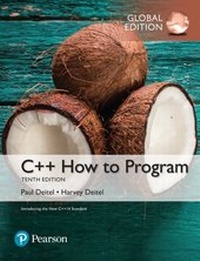
C++ How to Program, Global Edition
Global Edition
10th Edition
Published on 3. July 2020
1080 pages
978-1-292-15341-4 (ISBN)
Description

For courses in C++ Programming
The best-selling C++ How to Program is accessible to readers with little or no programming experience, yet comprehensive enough for the professional programmer. The Deitels' signature live-code approach presents the concepts in the context of full working programs followed by sample executions. The early objects approach gets readers thinking about objects immediately-allowing them to more thoroughly master the concepts. Emphasis is placed on achieving program clarity and building well-engineered software. Interesting, entertaining, and challenging exercises encourage students to make a difference and use computers and the Internet to work on problems. To keep readers up-to-date with leading-edge computing technologies, the 10th Edition conforms to the C++11 standard and the new C++14 standard.
The full text downloaded to your computer
With eBooks you can:
search for key concepts, words and phrases
make highlights and notes as you study
share your notes with friends
eBooks are downloaded to your computer and accessible either offline through the Bookshelf (available as a free download), available online and also via the iPad and Android apps.
Upon purchase, you'll gain instant access to this eBook.
Time limit
The eBooks products do not have an expiry date. You will continue to access your digital ebook products whilst you have your Bookshelf installed.
The best-selling C++ How to Program is accessible to readers with little or no programming experience, yet comprehensive enough for the professional programmer. The Deitels' signature live-code approach presents the concepts in the context of full working programs followed by sample executions. The early objects approach gets readers thinking about objects immediately-allowing them to more thoroughly master the concepts. Emphasis is placed on achieving program clarity and building well-engineered software. Interesting, entertaining, and challenging exercises encourage students to make a difference and use computers and the Internet to work on problems. To keep readers up-to-date with leading-edge computing technologies, the 10th Edition conforms to the C++11 standard and the new C++14 standard.
The full text downloaded to your computer
With eBooks you can:
search for key concepts, words and phrases
make highlights and notes as you study
share your notes with friends
eBooks are downloaded to your computer and accessible either offline through the Bookshelf (available as a free download), available online and also via the iPad and Android apps.
Upon purchase, you'll gain instant access to this eBook.
Time limit
The eBooks products do not have an expiry date. You will continue to access your digital ebook products whilst you have your Bookshelf installed.
All prices
More details
Edition
10th edition
Language
English
Place of publication
Harlow
United Kingdom
Target group
Professional and scholarly
ISBN-13
978-1-292-15341-4 (9781292153414)
Copyright in bibliographic data and cover images is held by Nielsen Book Services Limited or by the publishers or by their respective licensors: all rights reserved.
Schweitzer Classification
Other editions
New editions

Paul Deitel | Harvey Deitel & Associates
C++ How to Program, Global Edition
E-Book
12/2024
11th Edition
Pearson Education Limited
€59.49
Available for download
Additional editions
Paul Deitel | Harvey Deitel
C++ How to Program, Global Edition
Book
12/2016
10th Edition
Pearson Education Limited
€115.96
Shipment within 10-20 days
Content
1 Introduction to Computers and C++ 1
2 Introduction to C++ Programming, Input/Output and Operators
3 Introduction to Classes, Objects, Member Functions and Strings
4 Algorithm Development and Control Statements: Part 1
5 Control Statements: Part 2; Logical Operators
6 Functions and an Introduction to Recursion
7 Class Templates array and vector; Catching Exceptions
8 Pointers
9 Classes: A Deeper Look
10 Operator Overloading; Class string
11 Object-Oriented Programming: Inheritance
12 Object-Oriented Programming: Polymorphism
13 Stream Input/Output: A Deeper Look
14 File Processing
15 Standard Library Containers and Iterators
16 Algorithms
17 Exception Handling: A Deeper Look
18 Introduction to Custom Templates
19 Custom Templatized Data Structures
20 Searching and Sorting
21 Class string and String Stream Processing: A Deeper Look
22 Bits, Characters, C Strings and structs
Chapters on the Web
A Operator Precedence and Associativity
B ASCII Character Set
C Fundamental Types
D Number Systems
D.1 Introduction
D.2 Abbreviating Binary Numbers as Octal and Hexadecimal Numbers
D.3 Converting Octal and Hexadecimal Numbers to Binary Numbers
D.4 Converting from Binary, Octal or Hexadecimal to Decimal
D.5 Converting from Decimal to Binary, Octal or Hexadecimal
D.6 Negative Binary Numbers: Two's Complement Notation
E Preprocessor
E.1 Introduction
E.2 #include Preprocessing Directive
E.3 #define Preprocessing Directive: Symbolic Constants
E.4 #define Preprocessing Directive: Macros
E.5 Conditional Compilation
E.6 #error and #pragma Preprocessing Directives
E.7 Operators # and ##
E.8 Predefined Symbolic Constants
E.9 Assertions
E.10 Wrap-Up
Appendices on the Web
Index
2 Introduction to C++ Programming, Input/Output and Operators
3 Introduction to Classes, Objects, Member Functions and Strings
4 Algorithm Development and Control Statements: Part 1
5 Control Statements: Part 2; Logical Operators
6 Functions and an Introduction to Recursion
7 Class Templates array and vector; Catching Exceptions
8 Pointers
9 Classes: A Deeper Look
10 Operator Overloading; Class string
11 Object-Oriented Programming: Inheritance
12 Object-Oriented Programming: Polymorphism
13 Stream Input/Output: A Deeper Look
14 File Processing
15 Standard Library Containers and Iterators
16 Algorithms
17 Exception Handling: A Deeper Look
18 Introduction to Custom Templates
19 Custom Templatized Data Structures
20 Searching and Sorting
21 Class string and String Stream Processing: A Deeper Look
22 Bits, Characters, C Strings and structs
Chapters on the Web
A Operator Precedence and Associativity
B ASCII Character Set
C Fundamental Types
D Number Systems
D.1 Introduction
D.2 Abbreviating Binary Numbers as Octal and Hexadecimal Numbers
D.3 Converting Octal and Hexadecimal Numbers to Binary Numbers
D.4 Converting from Binary, Octal or Hexadecimal to Decimal
D.5 Converting from Decimal to Binary, Octal or Hexadecimal
D.6 Negative Binary Numbers: Two's Complement Notation
E Preprocessor
E.1 Introduction
E.2 #include Preprocessing Directive
E.3 #define Preprocessing Directive: Symbolic Constants
E.4 #define Preprocessing Directive: Macros
E.5 Conditional Compilation
E.6 #error and #pragma Preprocessing Directives
E.7 Operators # and ##
E.8 Predefined Symbolic Constants
E.9 Assertions
E.10 Wrap-Up
Appendices on the Web
Index
