

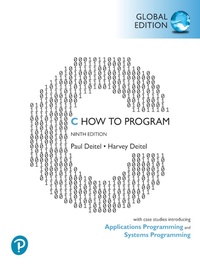
C How to Program: With Case Studies introducing Applications Programming and Systems Programming, Global Edition
With Case Studies in Applications and Systems Programming, Global Edition
9th Edition
Published on 30. May 2022
832 pages
978-1-292-43699-9 (ISBN)
Description

This print textbook is available for you to rent for your classes. The Pearson print rental program provides you with affordable access to learning materials, so you go to class ready to succeed.
C How to Program is a user-friendly, code-intensive introduction to C programming with case studies introducing applications and system programming. Like other texts of the Deitels' How to Program series, the book's modular presentation serves as a detailed beginner source of information for college students looking to embark on a career in coding, or instructors and software-development professionals seeking to learn how to program with C. The signature Deitel live-code approach presents concepts in the context of 142 full-working programs rather than incomplete snips of code. This gives you a chance to run each program as you study it and see how your learning applies to real-world programming scenarios.
Current standards, contemporary practice, and hands-on learning opportunities are integrated throughout the 9th Edition. Over 340 new integrated Self-Check exercises with answers allow you to test your understanding of important concepts - and check your code - as you read. New and enhanced case studies and exercises use real-world data and focus on the latest ACM/IEEE computing curricula recommendations, highlighting security, data science, ethics, privacy, and performance concepts.
C How to Program is a user-friendly, code-intensive introduction to C programming with case studies introducing applications and system programming. Like other texts of the Deitels' How to Program series, the book's modular presentation serves as a detailed beginner source of information for college students looking to embark on a career in coding, or instructors and software-development professionals seeking to learn how to program with C. The signature Deitel live-code approach presents concepts in the context of 142 full-working programs rather than incomplete snips of code. This gives you a chance to run each program as you study it and see how your learning applies to real-world programming scenarios.
Current standards, contemporary practice, and hands-on learning opportunities are integrated throughout the 9th Edition. Over 340 new integrated Self-Check exercises with answers allow you to test your understanding of important concepts - and check your code - as you read. New and enhanced case studies and exercises use real-world data and focus on the latest ACM/IEEE computing curricula recommendations, highlighting security, data science, ethics, privacy, and performance concepts.
More details
Edition
9th edition
Language
English
Place of publication
Harlow
United Kingdom
Target group
College/higher education
ISBN-13
978-1-292-43699-9 (9781292436999)
Copyright in bibliographic data and cover images is held by Nielsen Book Services Limited or by the publishers or by their respective licensors: all rights reserved.
Schweitzer Classification
Other editions
Additional editions
Paul Deitel | Harvey M. Deitel
C How to Program: With Case Studies in Applications and SystemsProgramming, Global Edition
Book
06/2022
9th Edition
Pearson Education Limited
€94.27
Shipment within 10-20 days
Persons
About our authors Paul J. Deitel, CEO and Chief Technical Officer of Deitel & Associates, Inc., is an MIT graduate with 41 years of experience in computing. Paul is one of the world's most experienced programming-languages trainers, having taught professional courses to software developers since 1992. He has delivered hundreds of programming courses to academic, industry, government and military clients internationally, including Cisco, IBM, Siemens, Sun Microsystems (now Oracle), Dell, Fidelity, NASA at the Kennedy Space Center, the National Severe Storm Laboratory, White Sands Missile Range, Rogue Wave Software, Boeing, Nortel Networks, Puma, iRobot, UCLA and many more. He and his coauthor, Dr. Harvey M. Deitel, are among the world's best-selling programming-language textbook, professional book, video and interactive multimedia e-learning authors.
Dr. Harvey M. Deitel, Chairman and Chief Strategy Officer of Deitel & Associates, Inc., has 59 years of experience in computing. Dr. Deitel earned B.S. and M.S. degrees in Electrical Engineering from MIT and a Ph.D. in Mathematics from Boston University; he studied computing in each of these programs before they spun off Computer Science programs. He has extensive college teaching experience, including earning tenure and serving as the Chairman of the Computer Science Department at Boston College before founding Deitel & Associates, Inc., in 1991 with his son, Paul. The Deitels' publications have earned international recognition, with more than 100 translations published in Japanese, German, Russian, Spanish, French, Polish, Italian, Simplified Chinese, Traditional Chinese, Korean, Portuguese, Greek, Urdu and Turkish. Dr. Deitel has delivered 100s of programming courses to academic, corporate, government and military clients.
Dr. Harvey M. Deitel, Chairman and Chief Strategy Officer of Deitel & Associates, Inc., has 59 years of experience in computing. Dr. Deitel earned B.S. and M.S. degrees in Electrical Engineering from MIT and a Ph.D. in Mathematics from Boston University; he studied computing in each of these programs before they spun off Computer Science programs. He has extensive college teaching experience, including earning tenure and serving as the Chairman of the Computer Science Department at Boston College before founding Deitel & Associates, Inc., in 1991 with his son, Paul. The Deitels' publications have earned international recognition, with more than 100 translations published in Japanese, German, Russian, Spanish, French, Polish, Italian, Simplified Chinese, Traditional Chinese, Korean, Portuguese, Greek, Urdu and Turkish. Dr. Deitel has delivered 100s of programming courses to academic, corporate, government and military clients.
Content
PART 1: (Introductory) Programming Fundamentals Quickstart
Introduction to Computers and C: Test-Driving Microsoft Visual Studio, Apple Xcode, GNU gcc, and GNU gcc in a Docker container
Intro to C Programming: Input, Output, Types, Arithmetic, Decision Making
Structured Program Development: Algorithmic Development, Problem Solving, if, if/else, while
Program Control: for, do/while, switch, break, continue, Logical Operators
Functions: Custom Functions, Simulation, Random-Number Generation, Enumerations, Function Call and Return Mechanism, Recursion, Recursive Factorial, Recursive Fibonacci
PART 2: (Intermediate) Arrays, Pointers, and Strings
Arrays: One- and Two-Dimensional Arrays, Passing Arrays to Functions, Searching, Sorting
Pointers: Pointers operators & and *, Pass-By-Value vs. Pass-By-Reference, Array and Pointer Relationship
Characters and Strings: C Standard Library String- and Character-Processing Functions
PART 3: (Intermediate) Formatted Input/Output, Structures, and File Processing
Formatted Input/Output: scanf and printf formatting
Structures, Unions, Bit Manipulation and Enumerations: Creating Custom Types with structs and unions, Bitwise Operators, Named Constants
File Processing: Streams, Text and Binary Files, CSV Files, Sequential and Random-Access Files
PART 4: (Advanced) Algorithms and Data Structures
Data Structures: Dynamic Memory Allocation and Deallocation, Lists, Stacks, Queues, Binary Trees
Computer-Science Thinking: Sorting Algorithms and Big O Insertion Sort, Selection Sort, Merge Sort, Additional Algorithms including Quicksort in the Exercises
PART 5: (Advanced) Preprocessor and Other Topics
Preprocessor: #include, Conditional Compilation, Macros with Arguments, Assertions
Other Topics: Variable-Length Argument Lists, Command-line Arguments, Multiple-Source-Pile Programs, extern, exit/atexit, calloc/realloc, goto, Numeric Literal Suffixes, Signal Handling
Appendices
Operator Precedence Chart
ASCII Character Set
Numerical Integration
Number Systems
Multithreading/Multicore and other C18/C11/C99 Topics
Intro to Object-Oriented Programming Concepts
Online Appendices
F-H. Using the Visual Studio Debugger, Using the GNU gdb Debugger, and Using the Xcode Debugger
Case Studies
System Programming Case Studies
Systems Software: Building Your Own Computer
Systems Software: Building Your Own Compiler
Embedded Systems Programming: Robotics with the Webots Simulator
Performance with Multithreading and Multicore Systems
Applications Programming Case Studies
Random-Number Simulation: Building a Casino Game
Random-Number Simulation: Card Shuffling and Dealing
Random-Number Simulation: The Tortoise and the Hare Race
Intro to Data Science: Survey Data Analysis
Direct-Access File Processing: Transaction-Processing System
Visualizing a Sorting Algorithm: Merge Sort
Artificial Intelligence/Data Science: NLP: Who Wrote Shakespeare's Works?
Artificial Intelligence/Data Science: Machine Learning with the GNU Scientific Library
Game Programming: SpotOn Game with the raylib Library
Game Programming: Cannon Game with the raylib Library
Security and Cryptography: Implementing a Vigenere Cipher
Visualization with gnuplot: Law of Large Numbers Animation
Web Services and the Cloud: libcurl and OpenWeatherMap
Introduction to Computers and C: Test-Driving Microsoft Visual Studio, Apple Xcode, GNU gcc, and GNU gcc in a Docker container
Intro to C Programming: Input, Output, Types, Arithmetic, Decision Making
Structured Program Development: Algorithmic Development, Problem Solving, if, if/else, while
Program Control: for, do/while, switch, break, continue, Logical Operators
Functions: Custom Functions, Simulation, Random-Number Generation, Enumerations, Function Call and Return Mechanism, Recursion, Recursive Factorial, Recursive Fibonacci
PART 2: (Intermediate) Arrays, Pointers, and Strings
Arrays: One- and Two-Dimensional Arrays, Passing Arrays to Functions, Searching, Sorting
Pointers: Pointers operators & and *, Pass-By-Value vs. Pass-By-Reference, Array and Pointer Relationship
Characters and Strings: C Standard Library String- and Character-Processing Functions
PART 3: (Intermediate) Formatted Input/Output, Structures, and File Processing
Formatted Input/Output: scanf and printf formatting
Structures, Unions, Bit Manipulation and Enumerations: Creating Custom Types with structs and unions, Bitwise Operators, Named Constants
File Processing: Streams, Text and Binary Files, CSV Files, Sequential and Random-Access Files
PART 4: (Advanced) Algorithms and Data Structures
Data Structures: Dynamic Memory Allocation and Deallocation, Lists, Stacks, Queues, Binary Trees
Computer-Science Thinking: Sorting Algorithms and Big O Insertion Sort, Selection Sort, Merge Sort, Additional Algorithms including Quicksort in the Exercises
PART 5: (Advanced) Preprocessor and Other Topics
Preprocessor: #include, Conditional Compilation, Macros with Arguments, Assertions
Other Topics: Variable-Length Argument Lists, Command-line Arguments, Multiple-Source-Pile Programs, extern, exit/atexit, calloc/realloc, goto, Numeric Literal Suffixes, Signal Handling
Appendices
Operator Precedence Chart
ASCII Character Set
Numerical Integration
Number Systems
Multithreading/Multicore and other C18/C11/C99 Topics
Intro to Object-Oriented Programming Concepts
Online Appendices
F-H. Using the Visual Studio Debugger, Using the GNU gdb Debugger, and Using the Xcode Debugger
Case Studies
System Programming Case Studies
Systems Software: Building Your Own Computer
Systems Software: Building Your Own Compiler
Embedded Systems Programming: Robotics with the Webots Simulator
Performance with Multithreading and Multicore Systems
Applications Programming Case Studies
Random-Number Simulation: Building a Casino Game
Random-Number Simulation: Card Shuffling and Dealing
Random-Number Simulation: The Tortoise and the Hare Race
Intro to Data Science: Survey Data Analysis
Direct-Access File Processing: Transaction-Processing System
Visualizing a Sorting Algorithm: Merge Sort
Artificial Intelligence/Data Science: NLP: Who Wrote Shakespeare's Works?
Artificial Intelligence/Data Science: Machine Learning with the GNU Scientific Library
Game Programming: SpotOn Game with the raylib Library
Game Programming: Cannon Game with the raylib Library
Security and Cryptography: Implementing a Vigenere Cipher
Visualization with gnuplot: Law of Large Numbers Animation
Web Services and the Cloud: libcurl and OpenWeatherMap
