

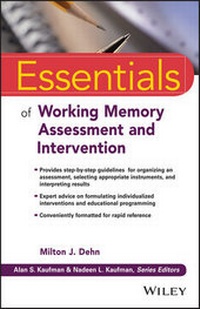
Essentials of Working Memory Assessment and Intervention
Description

Essentials of Working Memory Assessment and Interventionis an accessible, practical guide to accurately and efficientlyassessing working memory. This comprehensive resource explains thetheories of working memory, with an emphasis on cognitive loadtheory, and provides step-by-step guidelines for organizing across-battery assessment, selecting appropriate instruments,interpreting results, and formulating individualized interventionsand educational programming. In-depth case studies illustratetypical profiles found in children and adolescents with workingmemory deficits, and the companion CD features worksheets, testingcharts, and other useful resources. Reader-friendly design elementsincluding Rapid Reference, Caution, and Don't Forget boxes, andpractice questions, bullet points, and icons make this guide usefulfor both study and desk reference.
Working memory deficits are the main reason why students withdisabilities are unable to successfully respond to regulareducation interventions. Given the strong relationship betweenworking memory and all areas of academic learning, a deeperunderstanding of working memory and the related assessments andinterventions can facilitate greater achievement. This book helpsreaders:
* Understand the development and neuroanatomy of workingmemory
* Learn techniques for improving working memory in theclassroom
* Examine strategies for brain-based working memory training
* Effectively utilize working memory assessment measures
By examining the critical functions of working memory and itsrelationship with specific learning disabilities, then providingstrategies for assessment and detailed intervention guidance, thisbook helps educatorsand professionals guide their students andclients toward improved cognitive functioning, , reducedfrustration, and improved academic performance . For those seekinga practical approach to working memory, Essentials of WorkingMemory Assessment and Intervention provides the tools andinformation they need.
All prices
More details
Other editions
Additional editions
Persons
Content
Series Preface xiii
Acknowledgments xv
One Working Memory Models 1
Working Memory's Influence 2
Baddeley's Working Memory Model 3
Other Models of Working Memory 7
The Controversy Regarding Working Memory Capacity 12
Retention Intervals 15
Cognitive LoadTheory 15
The Integrated Model of Working Memory 16
Two Cognitive Processes Highly Related With Working Memory 25
General Intelligence 26
Fluid Reasoning 28
The Big Three 30
Executive Functions 30
Attention 31
Attention-Deficit/Hyperactivity Disorder 32
Oral Language 34
Auditory Processing 35
Phonological Processing 35
Processing Speed 36
Visual-Spatial Processing 37
Sequential Processing 37
Long-Term Memory 38
Metamemory 42
Strategies 43
Three Development, Neuroanatomy, and Risk Factors 45
Development of Working Memory 45
Metamemory Development 50
Long-Term Memory Development 51
The Neuroanatomy of Working Memory 51
The Neuroanatomy of Long-Term Memory 56
Risk Factors for Working Memory Impairments 58
Four Working Memory's Influence on Academic Learning and Performance 64
Working Memory and Classroom Learning 65
Cognitive Load in the Classroom 66
Working Memory and Basic Reading Skills 69
Working Memory and Reading Comprehension 72
Working Memory and Mathematics 75
Working Memory and Written Expression 81
Working Memory and Oral Language 82
Working Memory and Scholastic Performance 84
Working Memory and LD 85
The Importance of Automaticity 89
Implications for Assessment 90
Conclusions 91
Five Assessment Strategies 95
How to Determine Which Working Memory Component a Subtest Measures 96
Informal Assessment Procedures 102
Assessing Interaction With Long-Term Memory 114
Working Memory Testing 116
Testing Related Cognitive Processes 122
Analyzing Test Results 122
Interpretation of Working Memory Assessment Data 132
Specific Learning Disability Determination 137
Memory Processes Analyzer 138
Six Psychological Scales That Measure Working Memory 141
Child and Adolescent Memory Profile (CHAMP) 143
Cognitive Assessment System, Second Edition (CAS-II) 143
Comprehensive Test of Phonological Processing, Second Edition (CTOPP2) 145
Differential Ability Scales, Second Edition (DAS-II) 146
Kaufman Assessment Battery for Children, Second Edition (KABC-II) 148
The NEPSY II 149
Stanford-Binet Intelligence Scales, Fifth Edition (SB5) 151
Test of Auditory Processing Skills, Third Edition (TAPS-3) 152
Test of Memory and Learning, Second Edition (TOMAL-2) 153
The Wechsler Intelligence Scales 155
WISC-IV Integrated 158
WechslerMemory Scale, Fourth Edition (WMS-IV) 159
Wide Range Assessment of Memory and Learning, Second Edition (WRAML2) 161
Woodcock-Johnson IV Tests of Achievement (WJ IV ACH) 163
Woodcock-Johnson IV Tests of Cognitive Abilities (WJ IV COG) 163
Woodcock-Johnson IV Tests of Oral Language (WJ IV OL) 165
Seven Working Memory Interventions That Change the Brain 168
Types of Working Memory Interventions 169
Selecting Working Memory Exercises and Strategies 169
Measuring Progress 175
Metamemory Training 177
The Efficacy of Working Memory Training 177
How Working Memory Training Changes the Brain 181
Conclusions Regarding the Efficacy of Working Memory Training 183
Internet-Based Working Memory Training 184
Hands-On Working Memory Exercises 188
Interventions That Improve Related Cognitive Processes 192
Eight Supporting Working Memory in the Classroom 197
The Mnemonic-Based Classroom 198
Metamemory Instruction 200
Instruction That Reduces Cognitive Load 201
Accommodations and Modifications for Specific Academic Subjects 205
General Accommodations 208
Instructional Practices That Support Working Memory 209
Teaching Working Memory Strategies 213
Bypassing Working Memory by Using LTM Strategies 222
Nine Case Study 225
Working Memory Interpretation Section 225
Case Study Assessment 227
Example of a Written Interpretation 236
Jon's Interventions 241
Appendix A Scaled Score to Standard Score Conversion Table With Percentiles 253
Appendix B T-Score to Standard Score Conversion Table 256
Appendix C Working Memory Composites and Subtests Sorted by Scale 259
Annotated Bibliography 266
References 269
About the Author 303
About the Online Resources 304
Index 307
Chapter One
Working Memory Models
In their attempts to better understand the workings of the mind, psychologists develop explanatory models known as constructs. A hypothetical construct is inferred from data because it is not directly observable. For example, intelligence is a well-known and long-debated construct that cannot be directly observed or measured. This book is about working memory (WM), one of the most influential psychological constructs of the past 40 years. The behaviors associated with WM are measurable and real. However, the underlying construct associated with these behaviors remains hypothetical. Its exact nature, functioning, neurological structure, and even its name are still open to debate and refinement.
WM is the cognitive ability to briefly hold, maintain, or store information while processing the same or other information. Simply put, brief storage plus simultaneous cognitive processing equals WM. The brief storage aspect is commonly referred to as short-term memory (STM). Thus, the construct of WM includes STM, with WM having a supervisory role over the STM component (Baddeley, 1986). The supervisory role is just one of WM's executive functions. WM is complex; it has both cognitive and metacognitive dimensions (Dehn, 2014a).
Don't Forget
Working memory occurs whenever there is concurrent temporary storage and processing of information. Short-term memory provides the storage function. Thus, short-term memory is embedded within working memory. In this book, the term "working memory" includes short-term memory.
What makes WM so interesting and so influential is that it is very limited in humans, and these limitations have significant consequences for all sorts of human endeavors. Without keeping information refreshed in WM, it will be retained only for a few seconds. In the typical adult, only four to seven pieces of information can be maintained in WM during cognitive processing (Cowan, 2001).
Psychologists were measuring WM long before the construct was even proposed. The digit span test goes back more than 100 years. This test includes digits backward, which requires the examinee to reverse the sequence of orally presented digits. Digits backward is now recognized as a robust measure of WM. Prior to the 1990s, the widely used Wechsler Intelligence Scale for Children incorporated the digit span subtest into a composite score it called Freedom From Distractibility, a label that describes one of WM's key functions but gave psychologists little understanding of what they were actually measuring.
Caution
Despite working memory's wide-ranging influence, the definition of working memory should remain narrow. For example, reasoning and working memory are not the same thing, even though reasoning heavily depends on working memory capacity.
When defining WM and discussing the roles that it plays in cognitive functioning, it is important to consider how WM is typically measured. The usual task requires the maintenance of oral or visual stimuli while processing those stimuli in some manner. What is actually measured is not the processing but the number of sequential items (a span) that is retained. All of the empirical data on how WM is related with cognitive abilities, academic learning, and daily functioning is based on such traditional span measures of WM. Consequently, the definition and application of the WM construct should not go beyond how it is measured. For example, WM should not be equated with intelligence, general executive functioning, or all conscious mental activity. When the definition goes beyond the measurement of the construct, then WM becomes too inclusive and less meaningful. Also, very broad applications of the construct create false impressions that WM training should lead to improved functioning in psychological processes that may not really be WM.
Working Memory's Influence
Nearly all cognitive and metacognitive functions are closely interrelated with WM. For example, language expression, processing speed, reasoning, phonological processing, attentional control, and executive functions have high correlations with WM (see Chapter 2). Furthermore, nearly all aspects of learning, especially academic learning, depend on adequate levels of WM (see Chapter 4). Finally, performance and application of skills, as well as cognitively challenging daily activities, depend on WM. A short list of activities that are influenced by WM capacity includes:
- Keeping up with the flow of a conversation and remembering what one was going to say.
- Noticing errors that are contained in a written sentence one just produced.
- Keeping track of one's place while counting.
- Being able to take detailed notes while listening at the same time.
- Remembering multistep directions that were just presented or read.
- Completing a task in a time-efficient manner.
- Coping with distractions while thinking.
- Comprehending what is being said or read.
- Remembering what one was going to do next.
- Keeping track of subproducts while doing mental arithmetic.
- Being able to switch between mental tasks.
- Being able to reason, such as comparing and contrasting two concepts.
- Integrating visual and auditory information.
- Efficiently memorizing information.
- Consciously retrieving a name or word that does not come immediately.
Obviously, a normal WM ability is essential for all kinds of cognitive, learning, and daily activities (Engle, 2002). Consequently, unusual shortcomings or deficits in WM can lead to all kinds of problems. Such problems include forgetfulness, inattentiveness, difficulty following directions, difficulty completing tasks, difficulty communicating, and various types of learning disorders.
Baddeley's Working Memory Model
The predominant model of WM was originally proposed by Baddeley and Hitch in 1974 and later expanded by Baddeley (1986, 2000). The Baddeley model of WM is the theoretical basis of the majority of research on WM. This multicomponent model has been validated through neuropsychological research and has been operationalized in measurement instruments. Baddeley defines working memory as "a system for the temporary holding and manipulation of information during the performance of a range of cognitive tasks such as comprehension, learning, and reasoning" (1986, p. 34). The original multifaceted model was made up of three components: a phonological loop, a visuospatial sketchpad, and a central executive. In 2000, Baddeley added another component-the episodic buffer (see Rapid Reference 1.1). Baddeley's model is hierarchical, with the central executive as the top-level, domain-free facet that controls all of the subcomponents.
Rapid Reference 1.1 Baddeley's Working Memory Model
Figure 1.1 Baddeley's Working Memory Model
The Phonological Loop
What Baddeley refers to as the phonological loop is also known as auditory, phonological, or verbal short-term memory. (In this text, this aspect of WM will be called phonological short-term memory.) The phonological loop is a limited capacity component that briefly stores verbal information in phonological form. Baddeley (1986, 2003a) divides the phonological loop into passive storage and subvocal, articulatory rehearsal. The number of unconnected verbal items (such as words from a list) that can be retained in the phonological loop depends on the time it takes to articulate them (Baddeley, 2003a). Individuals can recall only a sequential span that they can articulate (aloud or subvocally) within 2 seconds (Ellis & Hennelley, 1980; Hulme & Mackenzie, 1992). For instance, if an individual's speech rate is two monosyllable words per second, his memory span will be about four monosyllable words. Thus, auditory STM span varies according to the length of the words and the individual's speech rate. Individuals with faster articulation rates can maintain more items than individuals who are slow articulators (Hulme & Mackenzie, 1992). Also, more monosyllable words can be retained than multisyllable words. For adults, normal phonological loop span is approximately seven monosyllable units.
Despite the strong evidence that word length and articulatory rehearsal speed determine auditory STM span, other influences also affect memory span. One influence is prior knowledge. Meaningful phonological information may activate relevant long-term memory (LTM) representations, which may then facilitate immediate recall from short-term storage. For instance, the average adult has a longer span for meaningful words than for pseudo-words. The degree of chunking or grouping of items into larger units also affects span. For example, the separate digits "five" and "eight" can be chunked as "fifty-eight." Also, individuals can remember sentences that take several seconds to articulate because the sentences can be chunked into meaningful phrases or ideas.
Subvocal rehearsal seems to largely determine verbal span because whenever individuals are prevented from rehearsing, performance is markedly impaired. The typical interference task prevents rehearsal by requiring the participant to engage in an unrelated attention-demanding task, such as counting. The impact of disrupting phonological short-term rehearsal...
