

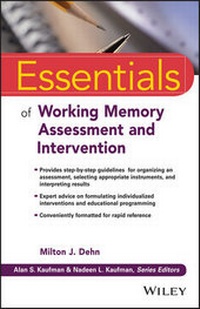
Essentials of Working Memory Assessment and Intervention
Published on 10. August 2015
336 pages
978-1-118-70557-5 (ISBN)
Description

Improve academic learning outcomes with accurate working memoryassessment and evidence-based interventions
Essentials of Working Memory Assessment and Interventionis an accessible, practical guide to accurately and efficientlyassessing working memory. This comprehensive resource explains thetheories of working memory, with an emphasis on cognitive loadtheory, and provides step-by-step guidelines for organizing across-battery assessment, selecting appropriate instruments,interpreting results, and formulating individualized interventionsand educational programming. In-depth case studies illustratetypical profiles found in children and adolescents with workingmemory deficits, and the companion CD features worksheets, testingcharts, and other useful resources. Reader-friendly design elementsincluding Rapid Reference, Caution, and Don't Forget boxes, andpractice questions, bullet points, and icons make this guide usefulfor both study and desk reference.
Working memory deficits are the main reason why students withdisabilities are unable to successfully respond to regulareducation interventions. Given the strong relationship betweenworking memory and all areas of academic learning, a deeperunderstanding of working memory and the related assessments andinterventions can facilitate greater achievement. This book helpsreaders:
* Understand the development and neuroanatomy of workingmemory
* Learn techniques for improving working memory in theclassroom
* Examine strategies for brain-based working memory training
* Effectively utilize working memory assessment measures
By examining the critical functions of working memory and itsrelationship with specific learning disabilities, then providingstrategies for assessment and detailed intervention guidance, thisbook helps educatorsand professionals guide their students andclients toward improved cognitive functioning, , reducedfrustration, and improved academic performance . For those seekinga practical approach to working memory, Essentials of WorkingMemory Assessment and Intervention provides the tools andinformation they need.
More details
Other editions
Additional editions
Milton J. Dehn
Essentials of Working Memory Assessment and Intervention
Book
10/2015
Wiley
€58.00
Shipment within 15-20 days
Persons
MILTON J. DEHN, Ed.D., NCSP, is the cofounder and program director of SchoolhouseTutoring¯® and a former practicing school psychologist, associate professor, anddirector of a graduate training program in school psychology. He is the author of Working Memory and Academic Learning, Long-Term Memory Problems in Children and Adolescents, and Essentials of Processing Assessment, Second Edition all from Wiley.
Content
- Cover
- Title Page
- Copyright
- Contents
- Series Preface
- Acknowledgments
- Chapter One Working Memory Models
- Working Memory's Influence
- Baddeley's Working Memory Model
- The Phonological Loop
- The Visuospatial Sketchpad
- The Episodic Buffer
- The Central Executive
- Other Models of Working Memory
- Daneman and Carpenter's Processing Efficiency Model
- Kane and Engle's Executive Attention Model
- Cowan's Embedded-Process Model
- Ericsson and Kintsch's Long-Term Working Memory Model
- The Relationship Between Working Memory and Long-Term Memory
- The Controversy Regarding Working Memory Capacity
- Retention Intervals
- Cognitive Load Theory
- The Integrated Model of Working Memory
- Short-Term Memory
- Verbal Working Memory
- Visual-Spatial Working Memory
- Executive Working Memory
- Interaction With Long-Term Memory
- Capacity of Working Memory Operations
- Chapter Two Cognitive Processes Highly Related With Working Memory
- General Intelligence
- Fluid Reasoning
- The Big Three
- Executive Functions
- Attention
- Attention-Deficit/Hyperactivity Disorder
- Oral Language
- Auditory Processing
- Phonological Processing
- Processing Speed
- Visual-Spatial Processing
- Sequential Processing
- Long-Term Memory
- Encoding
- Consolidation
- Retrieval
- Recall Versus Recognition
- Metamemory
- Strategies
- Chapter Three Development, Neuroanatomy, and Risk Factors
- Development of Working Memory
- Phonological STM
- Verbal WM
- Visual-Spatial STM
- Visual-Spatial WM
- Executive WM
- WM Strategies
- Metamemory Development
- Long-Term Memory Development
- The Neuroanatomy of Working Memory
- Interconnectivity Determines Capacity
- Phonological STM
- Visual-Spatial STM and WM
- Executive WM
- The Neuroanatomy of Long-Term Memory
- The Medial Temporal Lobe
- The Hippocampus
- Hippocampal Related Structures
- Amygdala
- Thalamus
- Risk Factors for Working Memory Impairments
- Concussions and Traumatic Brain Injuries
- Extreme Prematurity
- Childhood Diabetes
- Dopamine Deficiency
- Depression
- Anxiety
- Stress
- Chapter Four Working Memory's Influence on Academic Learning and Performance
- Working Memory and Classroom Learning
- Cognitive Load in the Classroom
- Instructional Variables
- Internal Processing Variables
- Content Variables
- Working Memory and Basic Reading Skills
- Case Illustration
- Reading Fluency
- Working Memory and Reading Comprehension
- The Role of Verbal WM
- The Role of Executive WM
- The Role of Visual-Spatial Working Memory
- Related Cognitive Processes
- Case Illustration
- Summary
- Working Memory and Mathematics
- The Role of Visual-Spatial STM and WM
- The Role of Phonological STM
- The Role of Verbal WM
- The Role of Executive WM
- Other Cognitive Factors
- Case Illustration
- Summary
- Working Memory and Written Expression
- Automaticity of Basic Writing Skills
- Case Illustration
- Working Memory and Oral Language
- Case Illustration
- Working Memory, Second Language Acquisition, and Bilingualism
- Working Memory and Scholastic Performance
- Working Memory and LD
- Reading Disabilities
- Mathematics Disabilities
- Oral Language Disabilities
- The Importance of Automaticity
- Implications for Assessment
- Other Cognitive Processing Deficits
- Preschool WM Screening
- Conclusions
- Chapter Five Assessment Strategies
- How to Determine Which Working Memory Component a Subtest Measures
- Differences Between STM Components and WM Components
- Phonological STM Tasks
- Verbal WM Tasks
- Visual-Spatial STM Tasks
- Visual-Spatial WM Tasks
- Executive WM Tasks
- Task Analysis
- Informal Assessment Procedures
- Collecting Background Information
- Interviewing
- Assessment of Metamemory and Strategy Use
- Assessing Cognitive Load in the Classroom
- Observations
- Assessing Interaction With Long-Term Memory
- Activated Long-Term Memory Items
- The Influence ofWorking Memory on Long-Term Memory
- Working Memory Testing
- Criteria for Composite and Subtest Inclusion
- Selecting Composites and Subtests for Testing
- Using Rating Scales
- Testing Related Cognitive Processes
- Analyzing Test Results
- Step 1. Decide on the Components and Processes That Will Be Included
- Step 2. Enter the Names of the Scales, Composites, and Subtests Administered
- Step 3. Calculate and Enter Obtained Standard Scores
- Step 4. Calculate and Enter the Component or Process Scores
- Step 5. Enter 95% Confidence Intervals
- Step 6. Enter the IQ or Mean as the Predicted Score
- Step 7. Compute and Enter the Discrepancy Values
- Step 8. Determine Normative Strengths and Weaknesses
- Step 9. Determine Intra-Individual Strengths and Weaknesses
- Step 10. Determine Deficits and Assets
- Step 11. Examine Pairs for Significance
- Step 12. Determine Whether Each Composite Is Unitary
- Interpretation of Working Memory Assessment Data
- Phonological Short-Term Memory
- Visual-Spatial Short-Term Memory
- Verbal Working Memory
- Visual-Spatial Working Memory
- Executive Working Memory
- Short-Term Memory Versus Working Memory Components
- Specific Learning Disability Determination
- Memory Processes Analyzer
- Chapter Six Psychological Scales That Measure Working Memory
- Child and Adolescent Memory Profile (CHAMP)
- Visual-Spatial STM: Objects
- Verbal WM: Instructions
- Visual-Spatial WM: Places
- Cognitive Assessment System, Second Edition (CAS-II)
- Composites
- Subtests
- Comprehensive Test of Phonological Processing, Second Edition (CTOPP2)
- Phonological Memory Composite
- Subtests
- Differential Ability Scales-Second Edition (DAS-II)
- Working Memory Composite
- Subtests
- Kaufman Assessment Battery for Children-Second Edition (KABC-II)
- Phonological STM: Number Recall
- Visual-Spatial STM: Face Recognition
- Visual-Spatial STM: Hand Movements
- Executive WM:Word Order
- The NEPSY II
- Phonological STM: Repetition of Nonsense Words
- Verbal WM: Narrative Memory
- Verbal WM: Sentence Repetition
- Verbal WM:Word List Interference
- Visual-Spatial STM: Memory for Faces
- Visual-Spatial STM: Memory for Designs
- Stanford-Binet Intelligence Scales-Fifth Edition (SB5)
- Visual-Spatial STM: Delayed Response
- Verbal WM: Memory for Sentences
- Visual-Spatial STM and WM: Block Span
- Executive WM: LastWord
- Test of Auditory Processing Skills, Third Edition (TAPS-3)
- Phonological STM: Number Memory Forward
- Phonological STM: Word Memory
- Verbal WM: Sentence Memory
- Executive WM: Number Memory Reversed
- Test of Memory and Learning-Second Edition (TOMAL-2)
- Phonological STM: Digits Forward and Letters Forward
- Visual-Spatial STM: Abstract Visual Memory
- Visual-Spatial STM: Facial Memory
- Visual-Spatial STM: Manual Imitation
- Visual-Spatial STM: Memory for Location
- Visual-Spatial STM: Visual Sequential Memory
- Verbal WM: Memory for Stories
- Executive WM: Digits Backward and Letters Backward
- The Wechsler Intelligence Scales
- Composites
- Subtests
- WISC-IV Integrated
- Phonological STM: Letter Span Rhyming and Nonrhyming
- Visual-Spatial STM: Spatial Span Forward
- Visual-Spatial STM: Visual Digit Span
- Visual-Spatial WM: Spatial Span Backward
- Executive WM: Letter-Number Sequencing Process Approach
- Wechsler Memory Scale, Fourth Edition (WMS-IV)
- Composite
- Subtests
- Wide Range Assessment of Memory and Learning-Second Edition (WRAML2)
- Composites
- Subtests
- Woodcock-Johnson IV Tests of Achievement (WJ IV ACH)
- Woodcock-Johnson IV Tests of Cognitive Abilities (WJ IV COG)
- Composites
- Subtests
- Woodcock-Johnson IV Tests of Oral Language (WJ IV OL)
- Verbal WM: Sentence Repetition
- Executive WM: Understanding Directions
- Chapter Seven Working Memory Interventions That Change the Brain
- Types of Working Memory Interventions
- Selecting Working Memory Exercises and Strategies
- Phonological STM Methods
- Verbal Working Memory Methods
- Visual-Spatial STM Methods
- Visual-Spatial Working Memory Methods
- Executive Working Memory Methods
- Measuring Progress
- Metamemory Training
- The Efficacy of Working Memory Training
- Concerns About the Efficacy of Working Memory Training
- Cognitive and Academic Gains Produced by Working Memory Training
- How Working Memory Training Changes the Brain
- Conclusions Regarding the Efficacy of Working Memory Training
- Internet-Based Working Memory Training
- Cogmed
- Jungle Memory
- Lumosity
- Brain HQ
- Guidelines for Internet-Based Working Memory Training
- Hands-On Working Memory Exercises
- N-Back
- Counting Span
- Arithmetic Flash Cards
- Visual-Spatial Recall
- Following Directions
- Verbal Span Practice
- Last Word
- Rehearsal as an Exercise
- Interventions That Improve Related Cognitive Processes
- Attention
- Executive Functions
- Phonological Processing
- Processing Speed
- Chapter Eight Supporting Working Memory in the Classroom
- The Mnemonic-Based Classroom
- Metamemory Instruction
- Instruction That Reduces Cognitive Load
- Accommodations and Modifications for Specific Academic Subjects
- Modifications for Written Expression
- Modifications for Taking Notes
- Modifications for Mathematics
- Modifications for Basic Reading Skills
- Modifications for Reading Comprehension
- General Accommodations
- Instructional Practices That Support Working Memory
- Visually Oriented Instruction
- Direct Instruction
- Repetition and Review
- Mastery and Automaticity
- Elaboration
- Teaching Working Memory Strategies
- Strategy Training Guidelines
- Rehearsal
- Chunking
- Teaching the Strategies of Switching and Updating
- Teaching Visualization Strategies
- Dual Encoding
- Bypassing Working Memory by Using LTM Strategies
- Chapter Nine Case Study
- Working Memory Interpretation Section
- Case Study Assessment
- Results From the Initial Assessment
- Analysis of Working Memory Results
- Example of a Written Interpretation
- Phonological Short-Term Memory
- Visual-Spatial Short-Term Memory
- Verbal Working Memory
- Visual-Spatial Working Memory
- Executive Working Memory
- Encoding
- Retrieval Fluency
- Summary
- Jon's Interventions
- Parent Training Model
- Jon's Exercises and Strategies
- Rehearsal Practice
- Increasing Span
- Chunking
- Semantic Clustering
- Visualizing
- Counting Dots
- Math Flash Cards
- N-Back
- Listening Span
- Elaboration
- Metamemory
- First Postintervention Assessment
- Second Postintervention Assessment
- Appendix A Scaled Score to Standard Score Conversion Table With Percentiles
- Appendix B T-Score to Standard Score Conversion Table
- Appendix C Working Memory Composites and Subtests Sorted by Scale
- Annotated Bibliography
- References
- About the Author
- About the Online Resources
- Index
- EULA
