

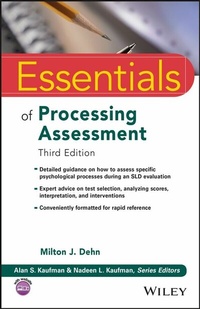
Essentials of Processing Assessment, 3rd Edition
Description

A critical handbook for practitioners and clinicians engaged in processing assessments
In the newly revised third edition of Essentials of Processing Assessment, a team of distinguished practitioners delivers an expert framework for planning, conducting, and interpreting an assessment of psychological processes. Emphasizing a pattern-of-strengths-and-weaknesses (PSW) perspective, the book offers an overview of evidence-based interventions for various psychological processes.
In the book, readers will review cognitive processing theories, apply a PSW model for specific learning disability (SLD) identifications, review the relationships between psychological processes and specific kinds of achievement, and detailed information on how to assess 14 different processes covered in the model.
Readers will also find:
- Step-by-step guidelines and worksheets that walk readers through the analysis and interpretation of test results
- Strategies for identifying students with specific learning disabilities
- Information about major cognitive and memory scales, as well as scales designed for processing assessment
An essential handbook for psychologists and other practitioners and clinicians engaged in processing assessments of children and adults, Essentials of Processing Assessment, 3rd Edition will earn a place in the libraries of anyone seeking to make more accurate diagnoses and identify more effective treatments.
MILTON J. DEHN, EdD, is the co-founder and Program Director of Schoolhouse Tutoring, an agency that provides assessment, tutoring, and instructional support for students of all ages and abilities. Formerly a practicing school psychologist, an associate professor, and a director of a graduate training program in school psychology, Dr. Dehn is the creator of the Children's Psychological Processes Scale (CPSS), an online teacher-rating scale designed to identify children with psychological processing deficits. He is the author of several books, including Working Memory and Academic Learning: Assessment and Intervention, Long-Term Memory Problems in Children and Adolescents, and Helping Students Remember: Exercises and Strategies to Strengthen Memory.
More details
Other editions
Additional editions
Person
MILTON J. DEHN, EdD, is the co-founder and Program Director of Schoolhouse Tutoring, an agency that provides assessment, tutoring, and instructional support for students of all ages and abilities. Formerly a practicing school psychologist, an associate professor, and a director of a graduate training program in school psychology, Dr. Dehn is the creator of the Children's Psychological Processes Scale (CPSS), an online teacher-rating scale designed to identify children with psychological processing deficits. He is the author of several books, including Working Memory and Academic Learning: Assessment and Intervention, Long-Term Memory Problems in Children and Adolescents, and Helping Students Remember: Exercises and Strategies to Strengthen Memory.
Content
Series Preface xiii
Acknowledgments xv
About the Companion Website xvii
One Introduction and Overview 1
Two Psychological Processes and Achievement 27
Three The Neuropsychology of Psychological Processes 69
Four Planning, Organizing, and Conducting a Processing Assessment 89
Five Analyzing and Interpreting Test Results 127
Six Identifying PSW and SLD with the PPA and MPA 157
Seven Using the CPPS to Screen Psychological Processes 169
Eight Recommended Batteries and Scales 189
Nine Assessing Memory 229
Ten Evidence-Based Interventions for Processing Deficits 267
Eleven Illustrative Case Study 309
References 343
Annotated Bibliography 355
About the Author 357
Index 359
Note: All appendices are available online
Appendix A Selective Testing Tables for Processing and Achievement Testing
Appendix B Selective Testing Table for Memory Testing
Appendix C Parent Interview Items for Processing Assessment
Appendix D Teacher Interview Items for Processing
Appendix E Behaviors Indicative of Specific Processing Weaknesses
Appendix F Classroom Behaviors Indicative of Working Memory Problems
Appendix G Classroom Behaviors Indicative of Long-Term Memory Problems
Appendix H Psychological Processing Assessment Planner
Appendix I PSW Analysis Worksheet (Hand Computation)
Appendix J PSW Analysis Worksheet (Excel)
Appendix K Memory Assessment Planner
Appendix L PSW Analysis Worksheet for Memory (Hand Computation)
Appendix M PSW Analysis Worksheet for Memory (Excel)
Appendix N T-Score to Standard Score Conversion Table
Appendix O Scaled Score to Standard Score Conversion Table
Appendix P Long-Term Memory Interview Items
Appendix Q Self-Monitoring Sheets: Paying Attention and Staying on Task
