

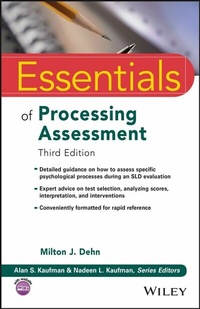
Essentials of Processing Assessment, 3rd Edition
Description

In the newly revised third edition of Essentials of Processing Assessment, a team of distinguished practitioners delivers an expert framework for planning, conducting, and interpreting an assessment of psychological processes. Emphasizing a pattern-of-strengths-and-weaknesses (PSW) perspective, the book offers an overview of evidence-based interventions for various psychological processes.
In the book, readers will review cognitive processing theories, apply a PSW model for specific learning disability (SLD) identifications, review the relationships between psychological processes and specific kinds of achievement, and detailed information on how to assess 14 different processes covered in the model.
Readers will also find:
* Step-by-step guidelines and worksheets that walk readers through the analysis and interpretation of test results
* Strategies for identifying students with specific learning disabilities
* Information about major cognitive and memory scales, as well as scales designed for processing assessment
An essential handbook for psychologists and other practitioners and clinicians engaged in processing assessments of children and adults, Essentials of Processing Assessment, 3rd Edition will earn a place in the libraries of anyone seeking to make more accurate diagnoses and identify more effective treatments.
More details
Other editions
Additional editions
Person
MILTON J. DEHN, EdD, is the co-founder and Program Director of Schoolhouse Tutoring, an agency that provides assessment, tutoring, and instructional support for students of all ages and abilities. Formerly a practicing school psychologist, an associate professor, and a director of a graduate training program in school psychology, Dr. Dehn is the creator of the Children's Psychological Processes Scale (CPSS), an online teacher-rating scale designed to identify children with psychological processing deficits. He is the author of several books, including Working Memory and Academic Learning: Assessment and Intervention, Long-Term Memory Problems in Children and Adolescents, and Helping Students Remember: Exercises and Strategies to Strengthen Memory.
Content
Series Preface xiii
Acknowledgments xv
About the Companion Website xvii
One Introduction and Overview 1
Two Psychological Processes and Achievement 27
Three The Neuropsychology of Psychological Processes 69
Four Planning, Organizing, and Conducting a Processing Assessment 89
Five Analyzing and Interpreting Test Results 127
Six Identifying PSW and SLD with the PPA and MPA 157
Seven Using the CPPS to Screen Psychological Processes 169
Eight Recommended Batteries and Scales 189
Nine Assessing Memory 229
Ten Evidence-Based Interventions for Processing Deficits 267
Eleven Illustrative Case Study 309
References 343
Annotated Bibliography 355
About the Author 357
Index 359
Note: All appendices are available online
Appendix A Selective Testing Tables for Processing and Achievement Testing
Appendix B Selective Testing Table for Memory Testing
Appendix C Parent Interview Items for Processing Assessment
Appendix D Teacher Interview Items for Processing
Appendix E Behaviors Indicative of Specific Processing Weaknesses
Appendix F Classroom Behaviors Indicative of Working Memory Problems
Appendix G Classroom Behaviors Indicative of Long-Term Memory Problems
Appendix H Psychological Processing Assessment Planner
Appendix I PSW Analysis Worksheet (Hand Computation)
Appendix J PSW Analysis Worksheet (Excel)
Appendix K Memory Assessment Planner
Appendix L PSW Analysis Worksheet for Memory (Hand Computation)
Appendix M PSW Analysis Worksheet for Memory (Excel)
Appendix N T-Score to Standard Score Conversion Table
Appendix O Scaled Score to Standard Score Conversion Table
Appendix P Long-Term Memory Interview Items
Appendix Q Self-Monitoring Sheets: Paying Attention and Staying on Task
One
INTRODUCTION AND OVERVIEW
The primary purpose of psychological and educational assessment is to better understand the client or student. Individuals are referred for a variety of concerns requiring different types of assessment, but what all evaluations have in common is the need to better understand why the individual is experiencing the difficulties that prompted the referral. In educational settings, students are often referred for learning problems that are manifestations of specific learning disabilities and underlying psychological processing deficits. To better understand such students, an assessment of psychological processes, which includes cognitive abilities or processes, is typically conducted. Analysis of the testing results will usually reveal the examinee's processing strengths and weaknesses, with the weaknesses typically related to the learner's low areas of achievement. Discovery of a student's cognitive and achievement strengths and weaknesses profile should lead to a better understanding of why the student is experiencing learning problems. When teachers, parents, and related support staff better understand the learner, they can adapt instruction, provide accommodations, and offer interventions that better meet the learner's needs, regardless of whether special education services for a specific learning disability (SLD) is provided.
This book is written for psychologists, neuropsychologists, school psychologists, educational diagnosticians, special education teachers, special education administrators, and all related professionals who conduct evaluations of youth who are referred for learning problems. The goal is to help these readers improve their assessment practices, leading to better decisions, recommendations, and interventions for students who struggle with academic learning and performance. Although this book focuses on psychological processing deficits in learning disabled students and using a pattern of strengths and weaknesses (PSW) to identify specific learning disabilities, the methods and principles promoted in this work apply to all psychoeducational assessments and all types of childhood disabilities that affect academic learning and performance. The overall goal of the model advocated in this book is to use testing and assessment data to gain a deeper understanding of the examinee's psychological and academic functioning, especially a better understanding of why the examinee is experiencing learning problems.
DON'T FORGET
The model, methods, and principles promoted in this work apply to all psychoeducational assessments and all types of childhood disabilities that affect achievement and scholastic performance.
The author of this volume, and the two previous editions of Essentials of Processing Assessment, has been thinking about, developing, practicing, and advocating for this model for more than 3 decades. His interest and involvement began during his school psychology internship when he was directed to identify a basic psychological processing deficit in a student he had evaluated for possible SLD. He was informed that federal and state legislation required this and that he could meet this requirement by checking one of the items listed on an SLD placement form. The processing deficit options listed on the form were storage, organization, acquisition, retrieval, expression, and manipulation, referred to as SOAREM. This was puzzling to the young intern because none of the assessment batteries he had used for the evaluation contained any such labels. Furthermore, when he reviewed the examples given for each processing deficit option, he discovered that "has a messy desk" met the requirement for the organization category. He found this very troubling: a student could be placed for SLD because he had a messy desk.
Shortly thereafter, the author of this volume began teaching cognitive assessment to school psychology graduate students. In his course, he began working out and teaching how to address the SLD legislative requirement of having a deficit in one or more basic psychological processes. The questions involved included:
- How should each of the SOAREM categories be defined?
- How did common processing areas, such as auditory processing, align with SOAREM?
- How should deficit be defined?
- What was meant by basic?
- Were cognitive abilities part of psychological processes?
- Should test scores be required to document a deficit?
- How low should such test scores be?
- Should psychological processes be tested in a comprehensive manner?
- How should test scores be analyzed to determine a possible deficit?
- Could learners with low IQs have processing deficits, or were they excluded?
- What did these processing deficits have to do with learning and SLD?
- When multibattery testing was conducted, how could test scores be compared across batteries?
- Regarding this requirement, how could SLD identification procedures be improved?
The result of trying to answer these questions was the initial development of guidelines and procedures for his graduate students. These included the recommendations that identification of processing deficits should require:
- Testing all commonly recognized psychological processes, at least those that could be tested with the cognitive scales that were available.
- Explaining how each process tested was related to or part of one of the SOAREM categories.
- Allowing only below-average processes to be considered deficits.
- Comparing each processing score with the examinee's IQ to judge whether there was a deficit.
- Including informal assessment data that corroborated the low processing scores.
- Explaining how the processing deficit might be related to the identified SLD.
At the same time, the author began to question his state's SLD criteria, not just the processing component but why the state was using grade equivalents to determine IQ-achievement discrepancies. After he raised these questions in a state publication, his state department of public instruction invited him to join a committee that was writing a new SLD identification guide. He was assigned to defining the SOAREM categories, aligning them with processes tested with contemporary scales, and recommending guidelines for determining the existence of a deficit. Because SOAREM was based on the old information processing model from the 1960s, the processing options it allowed were fairly narrow, with most of them applying to some aspect of memory. Consequently, the author recommended that more psychological processes, such as auditory processing and processing speed, be explicitly added to the list.
Following this experience, the author was influenced by leaders in the field of intellectual assessment, such as Woodcock, McGrew, and Flanagan who were expanding the applications of Cattell-Horn-Carroll (CHC) theory in such publications as the Intelligence Test Desk Reference (McGrew & Flanagan, 1998). These new applications led the author to further refine his procedures for analyzing test scores and determining the existence of processing deficits. The final influence was the advent of the school neuropsychology movement, first promoted by Hale and Fiorello (2004) in their work titled School Neuropsychology: A Practitioner's Handbook. Later, Miller (2010) would specialize in training school neuropsychologists. These developments encouraged this author to begin emphasizing the brain basis of psychological processes and the brain basis of learning disabilities. For this author, the culmination of these experiences, influences, and developments was a proposal to Alan Kaufman, the editor of this Essentials series, for a new book on processing assessment. With Kaufman's approval, work on the first Essentials of Processing Assessment began in 2004, prior to the release of the latest federal legislation that was to open the door for a PSW approach to SLD identification.
Thus, the first edition of this book was not influenced by the PSW movement because it had not yet occurred. However, the PSW procedures that were to be advanced by several experts were consistent with what this author had already developed for identifying processing deficits. The point is that the methodology recommended in this book works equally well for identifying processing deficits, identifying a PSW in cognitive abilities and achievement, and just plain identifying within-child strengths and weaknesses.
DON'T FORGET
The model and procedures is this book were originally developed for the identification of psychological processing deficits. The model and procedures were later adapted to incorporate a PSW approach to SLD identification.
With the release of this edition, it is time to give this author's model and method a name. Because it's both a processing model and a PSW model, an appropriate descriptive name for it is Dehn's Processing/PSW Model. This is how it will be referred to throughout this text. Dehn's Processing/PSW Model focuses on 14 psychological processes that are highly related to academic achievement in reading, writing, and mathematics (see Rapid Reference 1.1).
DON'T FORGET
The model promoted is this book is referred to as Dehn's...
