

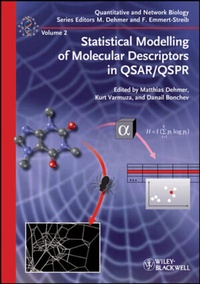
Statistical Modelling of Molecular Descriptors in QSAR/QSPR
1st Edition
Published on 13. September 2012
XX, 436 pages
978-3-527-64501-5 (ISBN)
Description

This handbook and ready reference presents a combination of statistical, information-theoretic, and data analysis methods to meet the challenge of designing empirical models involving molecular descriptors within bioinformatics. The topics range from investigating information processing in chemical and biological networks to studying statistical and information-theoretic techniques for analyzing chemical structures to employing data analysis and machine learning techniques for QSAR/QSPR.
The high-profile international author and editor team ensures excellent coverage of the topic, making this a must-have for everyone working in chemoinformatics and structure-oriented drug design.
The high-profile international author and editor team ensures excellent coverage of the topic, making this a must-have for everyone working in chemoinformatics and structure-oriented drug design.
More details
Other editions
Additional editions
Software
03/2012
Wiley-VCH
€191.57
No shipping information available

Matthias Dehmer | Kurt Varmuza | Danail Bonchev
Statistical Modelling of Molecular Descriptors in QSAR/QSPR
Book
02/2012
1st Edition
Wiley-Blackwell
€145.00
Article exhausted; check different version
Persons
Matthias Dehmer studied mathematics at the University of Siegen (Germany) and received his Ph.D. in computer science from the Technical University of Darmstadt (Germany). Afterwards, he was a research fellow at Vienna Bio Center (Austria) and at Vienna University of Technology. Currently, he is an Associate Professor at UMIT - The Health and Life Sciences University (Austria). His research interests are in bioinformatics, chemical graph theory, systems biology, complex networks, statistics and information theory. In particular, he is also working on machine learning-based methods to design new data analysis methods for solving problems in computational biology and medicinal chemistry.
Kurt Varmuza studied chemistry at the Vienna University of Technology (Austria). His research activities were first mass spectrometry and then moved to chemometrics - mainly the application of multivariate statistical analysis for chemistry related problems, such as spectra-structure relationships and structureproperty relationships. Since 1992, he has been working as a professor at the Vienna University of Technology, currently at the Institute of Chemical Engineering.
Danail Bonchev received his Ph. D. in quantum chemistry in Sofia, Bulgaria and D. Sc. in mathematical chemistry from the Moscow State University in Russia. He worked till 1992 as a professor of physical chemistry in the Assen Zlatarov University in Bourgas, Bulgaria. In 1992 he joined Texas A&M University at Galveston, and since 2003 he is professor at Virginia Commonwealth University in Richmond. His research includes quantum chemistry, molecular topology, QSPR and QSAR and, recently, bioinformatics and computational biology.
Kurt Varmuza studied chemistry at the Vienna University of Technology (Austria). His research activities were first mass spectrometry and then moved to chemometrics - mainly the application of multivariate statistical analysis for chemistry related problems, such as spectra-structure relationships and structureproperty relationships. Since 1992, he has been working as a professor at the Vienna University of Technology, currently at the Institute of Chemical Engineering.
Danail Bonchev received his Ph. D. in quantum chemistry in Sofia, Bulgaria and D. Sc. in mathematical chemistry from the Moscow State University in Russia. He worked till 1992 as a professor of physical chemistry in the Assen Zlatarov University in Bourgas, Bulgaria. In 1992 he joined Texas A&M University at Galveston, and since 2003 he is professor at Virginia Commonwealth University in Richmond. His research includes quantum chemistry, molecular topology, QSPR and QSAR and, recently, bioinformatics and computational biology.
Editor
Techn. Universität Vienna, Vienna, Austria
Series Editor
Queen's University Belfast, Belfast, United Kingdom
Content
Current Modeling Methods used in QSAR/QSPR (Liew Chin Yee and Yap Chun Wei)
Developing Best Practices for Descriptor-Based Property Prediction: Appropriate Matching of Datasets, Descriptors, Methods, and Expectations (Michael Krein, Tao-wei Huang, Lisa Morkowchuk, Dimitris K. Agrafiotis, and Curt M. Breneman)
Mold Molecular Descriptors for QSAR (Huixiao Hong, Svetoslav Slavov, Weigong Ge, Feng Qian, Zhenqiang Su, Hong Fang, Yiyu Cheng, Roger Perkins, Leming Shi and Weida Tong)
Multivariate Analysis of Molecular Descriptors (Viviana Consonni and Roberto Todeschini)
Partial Order Ranking and Linear Modeling: Their Use in Predictive QSAR/QSPR Studies (Andrew G. Mercader, Eduardo A. Castro)
Graph-theoretical Descriptors for Branched Polymers (Koh-hei Nitta)
Structural Similarity based Approaches for the Development of Clustering and QSPR/QSAR Models in Chemical Databases (Irene Luque Ruiz, Gonzalo Cerruela García and Miguel Ángel Gómez-Nieto)
Statistical Methods for Predicting Compound Recovery Rates for Ligand-based Virtual Screening and Assessing the Probability of Activity (Martin Vogt and Jürgen Bajorath)
Molecular Descriptors and the Electronic Structure (Horst Bögel)
New types of Descriptors and Models in QSAR/QSPR (Christian Kramer and Timothy Clark)
Consensus Models of Activity Landscapes (José L. Medina-Franco, Austin B. Yongye and Fabian López-Vallejo)
Reverse Engineering Chemical Reaction Networks from Time Series Data (Dominic P. Searson, Mark J. Willis and Allen Wright)
Reduction of Dimensionality, Order and Classification in Spaces of Theoretical Descriptions of Molecules. An Approach based on Metrics, Pattern Recognition Techniques and Graph Theoretic Considerations (George Maroulis)
The Analysis of Organic Reaction Pathways by Brownian Processing (Daniel J. Graham)
Generation of Chemical Transformations - Reaction Pathways Prediction and Synthesis Design (Grazyna Nowak and Grzegorz Fic)
Developing Best Practices for Descriptor-Based Property Prediction: Appropriate Matching of Datasets, Descriptors, Methods, and Expectations (Michael Krein, Tao-wei Huang, Lisa Morkowchuk, Dimitris K. Agrafiotis, and Curt M. Breneman)
Mold Molecular Descriptors for QSAR (Huixiao Hong, Svetoslav Slavov, Weigong Ge, Feng Qian, Zhenqiang Su, Hong Fang, Yiyu Cheng, Roger Perkins, Leming Shi and Weida Tong)
Multivariate Analysis of Molecular Descriptors (Viviana Consonni and Roberto Todeschini)
Partial Order Ranking and Linear Modeling: Their Use in Predictive QSAR/QSPR Studies (Andrew G. Mercader, Eduardo A. Castro)
Graph-theoretical Descriptors for Branched Polymers (Koh-hei Nitta)
Structural Similarity based Approaches for the Development of Clustering and QSPR/QSAR Models in Chemical Databases (Irene Luque Ruiz, Gonzalo Cerruela García and Miguel Ángel Gómez-Nieto)
Statistical Methods for Predicting Compound Recovery Rates for Ligand-based Virtual Screening and Assessing the Probability of Activity (Martin Vogt and Jürgen Bajorath)
Molecular Descriptors and the Electronic Structure (Horst Bögel)
New types of Descriptors and Models in QSAR/QSPR (Christian Kramer and Timothy Clark)
Consensus Models of Activity Landscapes (José L. Medina-Franco, Austin B. Yongye and Fabian López-Vallejo)
Reverse Engineering Chemical Reaction Networks from Time Series Data (Dominic P. Searson, Mark J. Willis and Allen Wright)
Reduction of Dimensionality, Order and Classification in Spaces of Theoretical Descriptions of Molecules. An Approach based on Metrics, Pattern Recognition Techniques and Graph Theoretic Considerations (George Maroulis)
The Analysis of Organic Reaction Pathways by Brownian Processing (Daniel J. Graham)
Generation of Chemical Transformations - Reaction Pathways Prediction and Synthesis Design (Grazyna Nowak and Grzegorz Fic)
