

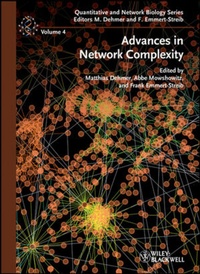
Advances in Network Complexity
1st Edition
Published on 21. June 2013
308 pages
978-3-527-67047-5 (ISBN)
Description

A well-balanced overview of mathematical approaches to complex systems ranging from applications in chemistry and ecology to basic research questions on network complexity. Matthias Dehmer, Abbe Mowshowitz, and Frank
Emmert-Streib, well-known pioneers in the fi eld, have edited this volume with a view to balancing classical and modern approaches to ensure broad coverage of contemporary research problems.
The book is a valuable addition to the literature and a must-have for anyone dealing with network compleaity and complexity issues.
Emmert-Streib, well-known pioneers in the fi eld, have edited this volume with a view to balancing classical and modern approaches to ensure broad coverage of contemporary research problems.
The book is a valuable addition to the literature and a must-have for anyone dealing with network compleaity and complexity issues.
More details
Other editions
Additional editions
Matthias Dehmer | Abbe Mowshowitz | Frank Emmert-Streib
Advances in Network Complexity
Book
07/2013
1st Edition
Wiley-Blackwell
€105.00
Article exhausted; check different version
Persons
Matthias Dehmer studied mathematics at the University of Siegen, Germany, and received his PhD in computer science from the Darmstadt University of Technology, Germany. Afterwards, he was a research fellow at Vienna Bio Center, Austria, Vienna University of Technology and
University of Coimbra, Portugal. Currently, he is Professor at UMIT ? The Health and Life Sciences University, Austria, and is Head of the Institute for Bioinformatics and TranslationalResearch. His research interests are in bioinformatics, chemical graph theory, systems biology, complex networks, complexity, statistics and information theory. He has published extensively on network complexity and methods to analyze complex networks quantitatively.
Abbe Mowshowitz studied mathematics at the University of Chicago (BA 1961), and both mathematics and computer science at the University of Michigan (PhD 1967). He has held academic positions at the University of Toronto, The University of British Columbia, Erasmus
University-Rotterdam, the University of Amsterdam and has been a professor of computer science at the City College of New York and in the PhD Program in Computer Science of the City University of New York since 1984. His research interests lie in applications of graph
theory to the analysis of complex networks, and in the study of virtual organization.
Frank Emmert-Streib studied physics at the University of Siegen, Germany, gaining his PhD in theoretical physics from the University of Bremen. He was a postdoctoral research associate at the Stowers Institute for Medical Research, Kansas City, USA, and a senior fellow at the
University of Washington, Seattle, USA. Currently, he is Lecturer/Assistant Professor at the Queen?s University Belfast, UK, at the Center for Cancer Research and Cell Biology, heading the Computational Biology and Machine Learning Lab. His research interests are in the fi eld
of computational biology, machine learning and network medicine.
University of Coimbra, Portugal. Currently, he is Professor at UMIT ? The Health and Life Sciences University, Austria, and is Head of the Institute for Bioinformatics and TranslationalResearch. His research interests are in bioinformatics, chemical graph theory, systems biology, complex networks, complexity, statistics and information theory. He has published extensively on network complexity and methods to analyze complex networks quantitatively.
Abbe Mowshowitz studied mathematics at the University of Chicago (BA 1961), and both mathematics and computer science at the University of Michigan (PhD 1967). He has held academic positions at the University of Toronto, The University of British Columbia, Erasmus
University-Rotterdam, the University of Amsterdam and has been a professor of computer science at the City College of New York and in the PhD Program in Computer Science of the City University of New York since 1984. His research interests lie in applications of graph
theory to the analysis of complex networks, and in the study of virtual organization.
Frank Emmert-Streib studied physics at the University of Siegen, Germany, gaining his PhD in theoretical physics from the University of Bremen. He was a postdoctoral research associate at the Stowers Institute for Medical Research, Kansas City, USA, and a senior fellow at the
University of Washington, Seattle, USA. Currently, he is Lecturer/Assistant Professor at the Queen?s University Belfast, UK, at the Center for Cancer Research and Cell Biology, heading the Computational Biology and Machine Learning Lab. His research interests are in the fi eld
of computational biology, machine learning and network medicine.
Editor
Universität f. Gesundheitswissenschaft UMIT, Thaur, Austria
Universität f. Gesundheitswissenschaft UMIT, Thaur, Austria
Series Editor
Universität f. Gesundheitswissenschaft UMIT, Thaur, Austria
Content
Functional Complexity Based on Topology (Hildegard Meyer-Ortmanns)
Connections between Artificial Intelligence, Computational Complexity and the Complexity of Graphs (Ángel Garrido)
Selection Based Estimates of Complexity Unravel Some Mechanisms and Selective Pressures Underlying the Evolution of Complexity in Artificial Networks (Hervé Le Nagard, Olivier Tenaillon)
Three Types of Network Complexity Pyramid (Fang Jin-Qing, Li Yong, Liu Qiang)
Computational Complexity of Graphs (Stasys Jukna)
The Linear Complexity of a Graph (David L. Neel, Michael E. Orrison)
Kirchhoff's Matrix Tree Theorem revisited: Counting Spanning Trees with the Quantum Relative Entropy (Vittorio Giovannetti, Simone Severini)
Dimension Measure for Complex Networks (O. Shanker)
Information Based Complexity of Networks (Russell K. Standish)
Thermodynamic Depth in Undirected and Directed Networks (Francisco Escolano, Edwin R. Hancock)
Circumscribed Complexity in Ecological Networks (Robert E. Ulanowicz)
Metros as Biological Systems: Complexity in Small Real-life Networks (Sybil Derrible)
Connections between Artificial Intelligence, Computational Complexity and the Complexity of Graphs (Ángel Garrido)
Selection Based Estimates of Complexity Unravel Some Mechanisms and Selective Pressures Underlying the Evolution of Complexity in Artificial Networks (Hervé Le Nagard, Olivier Tenaillon)
Three Types of Network Complexity Pyramid (Fang Jin-Qing, Li Yong, Liu Qiang)
Computational Complexity of Graphs (Stasys Jukna)
The Linear Complexity of a Graph (David L. Neel, Michael E. Orrison)
Kirchhoff's Matrix Tree Theorem revisited: Counting Spanning Trees with the Quantum Relative Entropy (Vittorio Giovannetti, Simone Severini)
Dimension Measure for Complex Networks (O. Shanker)
Information Based Complexity of Networks (Russell K. Standish)
Thermodynamic Depth in Undirected and Directed Networks (Francisco Escolano, Edwin R. Hancock)
Circumscribed Complexity in Ecological Networks (Robert E. Ulanowicz)
Metros as Biological Systems: Complexity in Small Real-life Networks (Sybil Derrible)
