

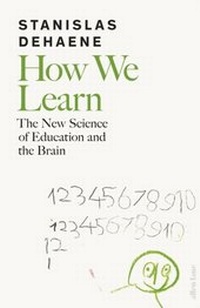
How We Learn
The New Science of Education and the Brain
1st Edition
Published on 28. January 2020
336 pages
978-0-241-36647-9 (ISBN)
Description

Humanity's greatest feat is our incredible ability to learn. Even in their first year, infants acquire language, visual and social knowledge at a rate that surpasses the best supercomputers. But how, exactly, do our brains learn?
In How We Learn, leading neuroscientist Stanislas Dehaene delves into the psychological, neuronal, synaptic and molecular mechanisms of learning. Drawing on case studies of children who learned despite huge difficulty and trauma, he explains why youth is such a sensitive period, during which brain plasticity is maximal, but also assures us that our abilities continue into adulthood. We can all enhance our learning and memory at any age and 'learn to learn' by taking maximal advantage of the four pillars of the brain's learning algorithm: attention, active engagement, error feedback and consolidation.
The human brain is an extraordinary machine. Its ability to process information and adapt to circumstances by reprogramming itself is unparalleled, and it remains the best source of inspiration for recent developments in artificial intelligence. How We Learn finds the boundary of computer science, neurobiology, cognitive psychology and education to explain how learning really works and how to make the best use of the brain's learning algorithms - and even improve them - in our schools and universities as well as in everyday life.
In How We Learn, leading neuroscientist Stanislas Dehaene delves into the psychological, neuronal, synaptic and molecular mechanisms of learning. Drawing on case studies of children who learned despite huge difficulty and trauma, he explains why youth is such a sensitive period, during which brain plasticity is maximal, but also assures us that our abilities continue into adulthood. We can all enhance our learning and memory at any age and 'learn to learn' by taking maximal advantage of the four pillars of the brain's learning algorithm: attention, active engagement, error feedback and consolidation.
The human brain is an extraordinary machine. Its ability to process information and adapt to circumstances by reprogramming itself is unparalleled, and it remains the best source of inspiration for recent developments in artificial intelligence. How We Learn finds the boundary of computer science, neurobiology, cognitive psychology and education to explain how learning really works and how to make the best use of the brain's learning algorithms - and even improve them - in our schools and universities as well as in everyday life.
Reviews / Votes
This is an absorbing, mind-enlarging book, studded with insights ... Could have significant real-world results. -- James McConnachie * Sunday Times * An entertaining survey of how science from brain scans to psychological tests is helping inspire pedagogy. Dehaene challenges many tropes [and] describes much of his own pioneering work ... Well translated from the French with some touching references to his upbringing, from the cult film La Jetee to the writing of Daniel Pennac. -- Andrew Jack * Financial Times * An expert overview of learning ... Dehaene's fourth insightful exploration of neuroscience will pay dividends for attentive readers. * Kirkus *More details
Language
English
Place of publication
London
United Kingdom
Target group
Professional and scholarly
College/higher education
File size
20,55 MB
ISBN-13
978-0-241-36647-9 (9780241366479)
Copyright in bibliographic data and cover images is held by Nielsen Book Services Limited or by the publishers or by their respective licensors: all rights reserved.
Schweitzer Classification
Other editions
Additional editions
Book
01/2021
Penguin Books Ltd
€14.00
Available immediately
Book
01/2020
Allen Lane
€50.95
Article exhausted; check different version
Person
Stanislas Dehaene is one of Europe's leading neuroscientists, and has been studying how education changes our brains for over thirty years. He is professor of Experimental Cognitive Psychology at the College de France, and director of the NeuroSpin brain imaging in Saclay. He is a member of seven academies and has received several international prizes, including the highest award in neuroscience, the Brain Prize. Dehaene's previous books, which have been translated into fifteen languages, include Consciousness and the Brain, Reading in the Brain and The Number Sense.
