

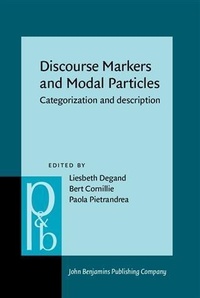
Discourse Markers and Modal Particles
Categorization and description
1st Edition
Published on 14. November 2013
V, 239 pages
978-90-272-7122-8 (ISBN)
Description

Discourse markers and modal particles are fuzzy linguistic categories that are difficult to describe. The contributions in this volume go beyond this statement. They discuss the intersection between modal particles and discourse markers and examine whether or not it is possible to draw a line between these two types of linguistic expressions. On the basis of new synchronic and diachronic data, from speech and writing, from European and Asian languages or cross-linguistically, the authors answer the question whether discourse markers and modal particles are distinct categories, whether they form a cline, or whether modal particles are a subcategory of discourse markers. This common question shows up throughout all chapters, which makes the book to a coherent whole. By disentangling the complexity of categorizing multifunctional expressions, this book also sheds new light on the processes of meaning extension. The traditional discourse and modal functions are complemented by interactional and textual ones. A must read for functional linguists.
More details
Other editions
Additional editions
Liesbeth Degand | Bert Cornillie | Paola Pietrandrea
Discourse Markers and Modal Particles
Categorization and description
Book
11/2013
John Benjamins Publishing Co
€100.70
Shipment within 10-15 days
Persons
Content
- Discourse Markers and Modal Particles
- Editorial page
- Title page
- LCC data
- Table of contents
- Modal particles and discourse markers: Two sides of the same coin?
- 1. Aims
- 2. On categorization and linguistic categories
- 3. On the categorization of modal particles and discourse markers
- 3.1 On discourse markers
- 3.2 On modal particles
- 3.3 On the fuzzy boundaries between DMs and MPs
- 4. Overview of the volume
- 5. Conclusions
- Acknowledgements
- References
- "Same same but different" - Modal particles, discourse markers and the art (and purpose) of categorization
- 1. Introduction
- 2. Discourse markers - definitions and earlier research
- 3. The modal particles of German as a word class
- 4. The class-constitutive function of modal particles in German
- 5. Intercategoriality
- 6. Same same but different - a plea for flexible categorization
- References:
- A radical construction grammar perspective on the modal particle-discourse particle distinction
- 1. Introduction: The approach taken
- 2. Construction grammar and the description of spoken interaction
- 3. Disentangling the contributions of lexemes and constructions
- 4. The case study: German also versus Swedish alltså
- 4.1 Introduction: Also and alltså
- 4.2 German also and Swedish alltså: Their positions and functions
- Discourse particle with up-take function
- Discourse particle with framing function
- Discourse particle with reformulative function
- Conjunctional adverb signaling conclusion
- Modal particle as a signal of common ground
- Discourse particle with repair function
- Discourse particle with hesitation marking function
- Entrenched stable collocation na also
- 5. Constructions as general form-meaning pairs
- 6. Cross-linguistic differences
- 6.1 Radical construction grammar
- 6.2 The conceptual space
- 7. Conclusion
- Transcription conventions
- Material
- References
- Analyzing modal adverbs as modal particles and discourse markers
- 1. Introduction
- 2. Modal adverbs
- 3. Of course and grammaticalization
- 4. Translations as a model to study multifunctionality
- 5. Of course as a discourse marker
- 6. Of course - a modal particle?
- 7. Conclusion
- Primary sources
- English sources:
- Swedish sources:
- Acknowledgement
- References
- Modal particles, discourse markers, and adverbs with lt-suffix in Estonian
- 1. Introduction
- 2. Definition of pragmatic markers
- 2.1 Modal particles
- 2.2 Discourse markers
- 3. The multifunctionality of lt-words
- 3.1 From adverb to modal particle/discourse marker
- 4. The four words in focus
- 4.1 Loomulikult
- 4.2 Ilmselt
- 4.3 Tegelikult
- 4.4 Lihtsalt
- 4.5 In a nutshell
- 5. Conclusion
- Abbreviations used in glossing
- References
- Modal particles: Problems in defining a category
- 1. Introduction
- 2. German modal particles: Problems in defining a category
- 2.1 Internal definition
- 2.2 External definition
- 3. Coming to grips with the issues
- 3.1 Prototypicality
- 3.2 Granularity
- 3.3 Conceptualization
- 4. Discourse markers and modal particles: Two sides of the same coin?
- 5. Comparison with French
- 5.1 Modal particles in other languages
- 5.2 Prototypicality, granularity, and conceptualization in other languages
- 6. Summary and conclusions
- References
- From TAM to discourse
- 1. The discursive uses of Romance phasal adverbs
- 1.1 Discursive 'already' in Romance: Interrogative and interjection
- 2. Interrogative già
- 2.1 Già as a MP: Formal and functional properties
- 3. Interjectional già
- 3.1 Confirmativity
- 3.2 Syntagmatic combinations of già with other interjections
- 3.3 From confirmativity to conclusivity: North-Western Italian oh già
- 3.4 Where interjections become DMs: metadiscursive già
- 4. North-Western Italian già between MPs and DMs
- 5. Future research
- References
- The fuzzy boundaries between discourse marking and modal marking
- 1. Introduction
- 2. Discourse markers and modal markers
- 3. Case study 1. The marker home/dona
- 3.1 Formal features
- 3.2 Functional features
- 4. Case study 2. The marker (és) clar
- 4.1 Formal features
- 4.2 Functional features
- 5. Case study 3. The marker és que
- 5.1 Formal features
- 5.2 Functional features
- 6. Discussion
- 7. Conclusions
- Acknowledgements
- References
- Appendix 1. Transcription conventions (cfr. Payrató 1995 and Bladas 2009)
- From discourse markers to modal/final particles
- 1. Introduction
- 2. Modal particles in German and French
- 2.1 Modal particles in German
- 2.2 Modal particles in French
- 3. Modal/final-particle use of Japanese discourse markers
- 4. Development from discourse markers into modal/final particles
- 4.1 (Inter)subjectivity marking in a restricted sentential position
- 4.2 Intersubjectivity marking in the utterance-final position
- 5. Conclusion
- Abbreviations
- References
- Index
