

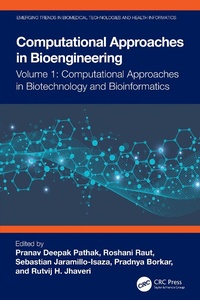
Computational Approaches in Biotechnology and Bioinformatics
1st Edition
Published on 27. May 2024
404 pages
978-1-040-00880-5 (ISBN)
Description

Volume 1 of Computational Approaches in Bioengineering-Computational Approaches in Biotechnology and Bioinformatics-explores many significant topics of biomedical engineering and bioinformatics in an easily understandable format. It explores recent developments and applications in bioinformatics, biomechanics, artificial intelligence (AI), signal processing, wearable sensors, biomaterials, cell biology, synthetic biology, biostatistics, prosthetics, big data, and algorithms. From applications of biomaterials in advanced drug delivery systems to the role of big data, AI, and machine learning in disease diagnosis and treatment, the book will help readers understand how these technologies are being applied across the areas of biomedical engineering, bioinformatics, and healthcare. The chapters also include case studies on the role of medical robots in surgery and the determination of protein structure using genetic algorithms. The contributors are all leading experts across multiple disciplines and provide chapters that truly represent a complete view of these state-of-the-art technologies.
FEATURES
Covers a wide range of subjects from biomedical engineering like wearable devices, biomaterials, synthetic biology, phytochemical extraction, and prosthetics
Explores AI, machine learning, big data analysis, and algorithms in biomedical engineering and bioinformatics in an easily understandable format
Includes case studies on the role of medical robots in surgery and the determination of protein structure using genetic algorithms
Discusses genetic diagnosis, classification, and risk prediction in cancer using next-generation sequencing in oncology
This book is ideally designed for biomedical professionals, biomedical engineers, healthcare professionals, data engineers, clinicians, physicians, medical students, hospital directors, clinical researchers, and others who work in the field of artificial intelligence, bioinformatics, and computational biology.
FEATURES
Covers a wide range of subjects from biomedical engineering like wearable devices, biomaterials, synthetic biology, phytochemical extraction, and prosthetics
Explores AI, machine learning, big data analysis, and algorithms in biomedical engineering and bioinformatics in an easily understandable format
Includes case studies on the role of medical robots in surgery and the determination of protein structure using genetic algorithms
Discusses genetic diagnosis, classification, and risk prediction in cancer using next-generation sequencing in oncology
This book is ideally designed for biomedical professionals, biomedical engineers, healthcare professionals, data engineers, clinicians, physicians, medical students, hospital directors, clinical researchers, and others who work in the field of artificial intelligence, bioinformatics, and computational biology.
More details
Series
Edition
1. Auflage
Language
English
Place of publication
London
United Kingdom
Publishing group
Taylor & Francis Ltd
Target group
Professional and scholarly
College/higher education
Illustrations
42 Tables, black and white; 37 Line drawings, color; 79 Line drawings, black and white; 4 Halftones, black and white; 37 Illustrations, color; 83 Illustrations, black and white
ISBN-13
978-1-040-00880-5 (9781040008805)
Copyright in bibliographic data and cover images is held by Nielsen Book Services Limited or by the publishers or by their respective licensors: all rights reserved.
Schweitzer Classification
Other editions
Additional editions
Pranav Deepak Pathak | Roshani Raut | Sebastian Jaramillo-Isaza
Computational Approaches in Biotechnology and Bioinformatics
Book
05/2026
1st Edition
CRC Press
€66.00
Shipment within 10-20 days
Pranav Deepak Pathak | Roshani Raut | Sebastian Jaramillo-Isaza
Computational Approaches in Biotechnology and Bioinformatics
Book
05/2024
1st Edition
CRC Press
€262.90
Shipment within 10-20 days
Persons
Dr. Pranav D. Pathak is an Associate professor in MIT School of Bioengineering Sciences & Research, Pune. He received his undergraduate, postgraduate degrees from Amravati University and doctoral degrees from Visvesvaraya National Institute of Technology, Nagpur, India. His research interests include use of Indian traditional knowledge in medicines, biorefinery, adsorptive separation, solid waste utilization, and wastewater treatment.
Dr Roshani Raut is an experienced academic and researcher in the field of Computer Science and Engineering at Pimpri Chinchwad College of Engineering, Savitribai Phule Pune University, Pune, India. She completed her PhD in Computer Science and Engineering from SGBAU, Maharashtra, india, ME from VIT, pune, India and Bachelor's in Computer Science and Engineering from Nagpur Univeristy. She has more than 18 years of experience and is currently working as Associate Professor in the Department of Information Technology and also handling the charge of Associate Dean International Relations, in Pimpri Chinchwad College of Engineering, Pune, India.
Sebastian Jaramillo-Isaza is currently working as a Principal Professor in Biomedical Engineering, at the School of Medicine and Health Sciences at the Universidad del Rosario, Colombia. He received a PhD in Biomechanics, Bioengineering, and Biomaterials from Sorbonne Universites - Universite de Technologie de Compiegne (UTC), France. He completed his masters from Ecole Nationale d'Ingenieurs de Metz (ENIM), Metz, France, and received his Bachelor's in Bioengineering from the University of Antioquia, Medellin, Colombia. His current research interests are centred around the fields of biomechanics, assistive technologies, neuroengineering, and rehabilitation engineering.
Dr. Pradnya Borkar, AssociateProfessor, Department of Computer Science and Engineering and R&D Cell Incharge, Jhulelal Institute of Technology, Nagpur did her B.E. in Computer Technology in year 2002, M.Tech in Computer Science and Engineering in 2008 and PHD in Computer Science and Engineering in 2018 from RashtrasantTukdoji Maharaj Nagpur University (formerly Nagpur University).She has worked with many reputed organizations and has an overall teaching experience of around 19 years. She has filed two patents. She has published books as "Data Warehousing and Mining" and "Object Oriented Modelling". Her area of interests are high performance computing, bioinformatics, parallel computing, database management systems, compilers and theory of computation. She is a member of ISTE, CSI, and SDIWC.
Dr. Rutvij H. Jhaveri is an experienced researcher working in the Department of Computer Science & Engineering, Pandit Deendayal Energy University, Gandhinagar, India since Dec. 2019. He conducted his Postdoctoral Research at Delta-NTU Corporate Lab for Cyber-Physical Systems, Nanyang Technological University, Singapore. Before joining PDEU, he worked for more than seventeen years at S.V.M. Institute of Technology affiliated to Gujarat Technological University. He completed his PhD in Computer Engineering from CHARUSAT University, India, Master's degree from Saradar Vallabhbhai National Institute of Technology (SVNIT), Surat and Bachelor's degree from Birla VishvakarmaMahavidyalaya, V. V. Nagar. Apart from numerous academic assignments, he shouldered the responsibility as Head of the Department (IT) for 5 years. In 2017, he was awarded with prestigious Pedagogical Innovation Award by Gujarat Technological University.
Dr Roshani Raut is an experienced academic and researcher in the field of Computer Science and Engineering at Pimpri Chinchwad College of Engineering, Savitribai Phule Pune University, Pune, India. She completed her PhD in Computer Science and Engineering from SGBAU, Maharashtra, india, ME from VIT, pune, India and Bachelor's in Computer Science and Engineering from Nagpur Univeristy. She has more than 18 years of experience and is currently working as Associate Professor in the Department of Information Technology and also handling the charge of Associate Dean International Relations, in Pimpri Chinchwad College of Engineering, Pune, India.
Sebastian Jaramillo-Isaza is currently working as a Principal Professor in Biomedical Engineering, at the School of Medicine and Health Sciences at the Universidad del Rosario, Colombia. He received a PhD in Biomechanics, Bioengineering, and Biomaterials from Sorbonne Universites - Universite de Technologie de Compiegne (UTC), France. He completed his masters from Ecole Nationale d'Ingenieurs de Metz (ENIM), Metz, France, and received his Bachelor's in Bioengineering from the University of Antioquia, Medellin, Colombia. His current research interests are centred around the fields of biomechanics, assistive technologies, neuroengineering, and rehabilitation engineering.
Dr. Pradnya Borkar, AssociateProfessor, Department of Computer Science and Engineering and R&D Cell Incharge, Jhulelal Institute of Technology, Nagpur did her B.E. in Computer Technology in year 2002, M.Tech in Computer Science and Engineering in 2008 and PHD in Computer Science and Engineering in 2018 from RashtrasantTukdoji Maharaj Nagpur University (formerly Nagpur University).She has worked with many reputed organizations and has an overall teaching experience of around 19 years. She has filed two patents. She has published books as "Data Warehousing and Mining" and "Object Oriented Modelling". Her area of interests are high performance computing, bioinformatics, parallel computing, database management systems, compilers and theory of computation. She is a member of ISTE, CSI, and SDIWC.
Dr. Rutvij H. Jhaveri is an experienced researcher working in the Department of Computer Science & Engineering, Pandit Deendayal Energy University, Gandhinagar, India since Dec. 2019. He conducted his Postdoctoral Research at Delta-NTU Corporate Lab for Cyber-Physical Systems, Nanyang Technological University, Singapore. Before joining PDEU, he worked for more than seventeen years at S.V.M. Institute of Technology affiliated to Gujarat Technological University. He completed his PhD in Computer Engineering from CHARUSAT University, India, Master's degree from Saradar Vallabhbhai National Institute of Technology (SVNIT), Surat and Bachelor's degree from Birla VishvakarmaMahavidyalaya, V. V. Nagar. Apart from numerous academic assignments, he shouldered the responsibility as Head of the Department (IT) for 5 years. In 2017, he was awarded with prestigious Pedagogical Innovation Award by Gujarat Technological University.
Content
1. Computational Approaches for Discovery of New Drugs for Inflammatory and Infectious Diseases 2. A Bioinformatics Approach Towards Plant-Based Anticancer Drug Discovery 3. Recent Advances in Anticancer Activity and Bioinformatics Approach from Potential Plants 4. Extraction of Phenolic Compounds from some Ayurvedic Botanicals (Nigella sativa, Andrographis paniculata and Phyllanthus amarus) and Evaluation of their Antibacterial and Antiviral Properties using Bioinformatics Approaches 5. Phenolic Compounds: A Systematic Review of Extraction Methods and A Bioinformatics Approach for their Antibacterial and Antiviral Properties 6. Role of Tissue Engineering in The Treatment of Degenerative Diseases 7. An Algorithmic Soft Computing Technique for Identifying Lipase-producing Yeast Using its Gene Expression Data 8. Plant Phenolic Compound Isolation and its Bioinformatics Approaches of Molecular Mechanisms in Antimicrobial Activities and Resistance 9. Computational Evaluation of Peanut Skin Bioactive Compounds for Cancer Treatment 10. Bioinformatics Tools for the Discovery of Potential Anti Diabetic Drugs from Lichens 11. In silico Analysis of Lapachol and Nickel Lapachol Against Tumor Proteins - Insights into the Molecular Interactions and Drug Likeliness 12. Transcriptome Analysis Identifies Genes Involved in Vitamin B Biosynthesis in Solanum virginianum Whole Fruit 13. Identification of Compounds Present in the Eethanolic Extract of Cecropia pachyatachya Trecul Leaves by CG-MS and in silico Studies with the Enzymes 5-LOX and ?-1-antitrypsin 14. Computational Biology Approach in Viticultu 15. Screenings of Inhibitory Ability of Vietnamese Medicinal Plants-based Substances and Protein Related Structures: Computation-Pharmacological Experiment Correlation
