

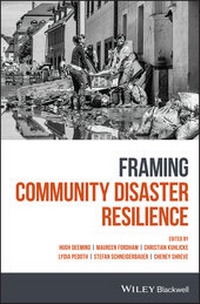
Framing Community Disaster Resilience
Description

Framing Community Disaster Resilience offers a guide to the theories, research and approaches for addressing the complexity of community resilience towards hazardous events or disasters. The text draws on the activities and achievements of the project emBRACE: Building Resilience Amongst Communities in Europe. The authors identify the key dimensions of resilience across a range of disciplines and domains and present an analysis of community characteristics, networks, behaviour and practices in specific test cases.
The text contains an in-depth exploration of five test cases whose communities are facing impacts triggered by different hazards, namely: river floods in Germany, earthquakes in Turkey, landslides in South Tyrol, Italy, heat-waves in London and combined fluvial and pluvial floods in Northumberland and Cumbria. The authors examine the data and indicators of past events in order to assess current situations and to tackle the dynamics of community resilience. In addition, they put the focus on empirical analysis to explore the resilience concept and to test the usage of indicators for describing community resilience. This important text:
* Merges the forces of research knowledge, networking and practices in order to understand community disaster resilience
* Contains the results of the acclaimed project Building Resilience Amongst Communities in Europe - emBRACE
* Explores the key dimensions of community resilience
* Includes five illustrative case studies from European communities that face various hazards
Written for undergraduate students, postgraduates and researchers of social science, and policymakers, Framing Community Disaster Resilience reports on the findings of an important study to reveal the most effective approaches to enhancing community resilience.
The emBRACE research received funding from the European Community's Seventh Framework Programme FP7/2007-2013 under grant agreement n° 283201. The European Community is not liable for any use that may be made of the information contained in this publication.
More details
Other editions
Additional editions
Persons
HUGH DEEMING, Principal Consultant, HD Research, Bentham, UK
MAUREEN FORDHAM, Emerita Professor of Gender and Disaster Resilience, Northumbria University, Newcastle upon Tyne, UK; Centre Director, IRDR Centre for Gender and Disaster, UCL, UK
CHRISTIAN KUHLICKE, Professor of Environmental Risks and Sustainability, joint appointment Helmholtz Centre for Environmental Research and University of Potsdam, Germany
LYDIA PEDOTH, Senior Researcher, Eurac Research, Bolzano, Italy
STEFAN SCHNEIDERBAUER, Senior Researcher, Eurac Research, Bolzano, Italy
CHENEY SHREVE, Adjunct Researcher, Western Washington University, Resilience Institute, Washington, USA
Content
List of Contributors xi
1 Introduction 1 Hugh Deeming
1.1 Book Content 2
References 3
Section I Conceptual and Theoretical Underpinnings to Community Disaster Resilience 5
2 Understanding Disaster Resilience: The emBRACE Approach 9 Thomas Abeling, Nazmul Huq, Denis Chang-Seng, Jörn Birkmann, Jan Wolfertz, Fabrice Renaud, and Matthias Garschagen
2.1 Introduction 9
2.2 Resilience: Concept 9
2.2.1 Resilience in the Social Domain 10
2.2.2 Resilience: An Outcome or a Process? 11
2.2.3 Resilience on Individual and Collective Levels 11
2.3 Resilience: Methodology 12
2.3.1 Social/Political Resilience 12
2.3.2 Linking Biophysical and Social Resilience 14
2.4 Resilience: Indicators 15
2.5 Gaps and Challenges 17
2.5.1 Challenges in the Transition from Ecology to Social Science 17
2.5.2 The Role of Power 18
2.5.3 Representation of Community 19
2.5.4 Transformation 20
2.5.5 Resourcefulness 21
2.6 Conclusion 22
References 22
3 Mobilising Resources for Resilience 27 Cheney Shreve and Maureen Fordham
3.1 Introduction 27
3.2 Background: Origins of Livelihoods Thinking 27
3.2.1 Successes of SLAs: Changing the Way Development was Done 29
3.2.2 Key Criticisms and the Evolution of Livelihoods Thinking 30
3.2.3 A Closer Look at Social Capital: Background and Key Critiques 31
3.2.4 Summary 33
3.3 Resilience and Livelihoods Thinking 34
3.3.1 Why Disasters? 34
3.3.2 Livelihoods and Disaster Vulnerability 35
3.4 Influence of Livelihoods Thinking on Contemporary Disaster Resilience 36
3.4.1 Linking to Sustainable Livelihoods: Resources and Capacities 36
3.4.2 Community Actions 37
3.4.3 Community Learning 38
3.4.4 Summary 38
References 39
4 Social Learning and Resilience Building in the emBRACE Framework 43 Justin Sharpe, Åsa Gerger Swartling, Mark Pelling, and Lucy Pearson
4.1 Introduction 43
4.2 What is Meant by Social Learning? 44
4.3 Capacities for Social Learning 46
4.4 Social Learning at the Individual Level 49
4.5 Social Learning at the Community Level 49
4.6 Social Learning and Resilience Outcomes in the emBRACE Project 52
4.7 How Social Learning Provides Opportunities for Sharing Adaptive Thinking and Practice 54
4.8 Conclusion 56
References 56
5 Wicked Problems: Resilience, Adaptation, and Complexity 61 John Forrester, Richard Taylor, Lydia Pedoth, and Nilufar Matin
5.1 Introduction 61
5.2 A Brief History of Policy 'Mess' and 'Wickedness' 62
5.2.1 'Super-Wicked' Problems 63
5.3 Resilient and Adaptive Responses to Mess 64
5.4 Clumsy Solutions Linking DRR/DRM and CCA: A Mini Case Study 66
5.5 An emBRACE Model of Complex Adaptive Community Resilience 69
5.6 Conclusion 71
References 72
Section II Methods to 'Measure' Resilience - Data and Indicators 77
6 The emBRACE Resilience Framework: Developing an Integrated Framework for Evaluating Community Resilience to Natural Hazards 79 Sylvia Kruse, Thomas Abeling, Hugh Deeming, Maureen Fordham, John Forrester, Sebastian Jülich, A. Nuray Karanci, Christian Kuhlicke, Mark Pelling, Lydia Pedoth, Stefan Schneiderbauer, and Justin Sharpe
6.1 Introduction 79
6.2 Conceptual Tensions of Community Resilience 8
6.3 Developing the emBRACE Resilience Framework 82
6.3.1 Deductive Framework Development: A Structured Literature Review 82
6.3.2 Inductive Framework Development: Empirical Case Study Research 83
6.3.3 Participatory Assessment Workshops with Stakeholder Groups 83
6.3.4 Synthesis: An Iterative Process of Framework Development 83
6.4 The Conceptual Framework for Characterising Community Resilience 84
6.4.1 Intracommunity Domains of Resilience: Resources and Capacities, Action, and Learning 84
6.4.1.1 Resources and Capacities 84
6.4.1.2 Actions 86
6.4.1.3 Learning 88
6.4.2 Extracommunity Framing of Community Resilience 89
6.4.2.1 Disaster Risk Governance 89
6.4.2.2 Non-Directly Hazard-Related Context, Social-Ecological Change, and Disturbances 90
6.5 Discussion and Conclusion 91
6.5.1 Interlinkages between the Domains and Extracommunity Framing 91
6.5.2 Application and Operationalisation of the Framework in Indicator-Based Assessments 91
6.5.3 Reflections on the Results and emBRACE Methodology and Limits of the Findings 91
References 92
7 Disaster Impact and Land Use Data Analysis in the Context of a Resilience-Relevant Footprint 97 Marco Pregnolato, Marcello Petitta, and Stefan Schneiderbauer
7.1 Introduction 97
7.2 Data and Methodology 99
7.2.1 Data 99
7.2.2 Methodology 99
7.3 Results 102
7.3.1 National Scale 102
7.3.2 Regional Scale: Analysis of Landslides that Occurred Near a Change in LULC 103
7.3.3 Subnational Scale: Analysis of HTI Changes 107
7.3.4 Subnational Scale: Analysis of the LULC Changes in Time Domain 108
7.4 Conclusions and Discussions 108
7.4.1 Is There Any Relationship Between LULC and Landslide Events? 108
7.4.2 Is There Any Relationship Between a Change in LULC and a Landslide Event? 109
7.4.3 Is It Possible to Use LULC Data as a Footprint for Landslide Events? 109
7.4.4 Is It Possible to Use Disaster Footprint and Susceptibility for Resilience Research? 109
7.5 Conclusion 110
References 110
8 Development of Quantitative Resilience Indicators for Measuring Resilience at the Local Level 113 Sebastian Jülich
8.1 Introduction 113
8.2 Stages of Indicator Operationalisation 114
8.3 Quantitative Indicator Development 116
8.4 Residence Time as Partial Resilience Indicator 117
8.5 Awareness through Past Natural Disasters as Partial Resilience Indicator 118
8.5.1 Single Factor Time 119
8.5.2 Single Factor Intensity 120
8.5.3 Single Factor Distance 121
8.5.4 Combination of the Three Single Factors 121
8.6 Warning Services as Partial Resilience Indicators 122
8.7 Conclusion 123
References 124
9 Managing Complex Systems: The Need to Structure Qualitative Data 125 John Forrester, Nilufar Matin, Richard Taylor, Lydia Pedoth, Belinda Davis, and Hugh Deeming
9.1 Introduction 125
9.2 Mapping of Social Networks as a Measure of Community Resilience 127
9.2.1 Assessing Resilience Using Network Maps: The embrace Experience 128
9.3 Agent- Based Models 131
9.3.1 Two Case Studies of ABM in emBRACE 132
9.4 Other Qualitative Data-Structuring Methodologies 134
9.5 Discussion 134
9.6 Conclusion 136
References 136
10 Combining Quantitative and Qualitative Indicators for Assessing Community Resilience to Natural Hazards 139 Daniel Becker, Stefan Schneiderbauer, John Forrester, and Lydia Pedoth
10.1 Introduction 139
10.2 Current Indicator-Based Approaches for Assessing Community Resilience 140
10.3 From Concept to Assessment: The emBRACE Approach 142
10.3.1 Using Indicators for Assessing Community Resilience within emBRACE 142
10.3.2 The Process of Grounding our Indicators 143
10.4 Systematisation of Indicators 145
10.5 Deriving Key Indicators of Community Resilience 148
10.6 Conclusion 151
References 151
Section III Empirically Grounding the Resilience Concept 155
11 Resilience, the Limits of Adaptation and the Need for Transformation in the Context of Multiple Flood Events in Central Europe 159 Christian Kuhlicke, Anna Kunath, Chloe Begg, and Maximilian Beyer
11.1 Introduction 159
11.2 Key Concepts for the Case Study 161
11.3 Insights into the Case Study Settings and Methods 162
11.3.1 Flood Risk Management in Saxony and Bavaria 162
11.3.2 Methods of Case Study Research - Description of Empirical Work 163
11.3.2.1 Interviews 163
11.3.2.2 Household Survey 163
11.4 Results of the Interviews: Resilience, Learning, and Transformation 165
11.5 Results of the Household Survey: Resilience, Limits of Adaptation, and Responsibility 167
11.5.1 Impacts of (Multiple) Flood Experience 167
11.5.2 Perception of Responsibility in Flood Risk Management 170
11.5.3 Attitudes towards Participation 171
11.6 Community
Resilience and the Idea of Transformation 172
References 173
12 River and Surface Water Flooding in Northern England: The Civil Protection-Social Protection Nexus 177 Hugh Deeming, Belinda Davis, Maureen Fordham, and Simon Taylor
12.1 Introduction 177
12.2 Conceptualising Community 179
12.3 Methods 181
12.4 Results 182
12.4.1 Rural Resilience 182
12.4.2 Urban Resilience 185
12.4.2.1 Keswick 185
12.4.2.2 Cockermouth 189
12.4.2.3 Workington 191
12.5 Discussion and Conclusions 192
References 194
13 The Role of Risk Perception and Community Networks in Preparing for and Responding to Landslides: A Dolomite Case Study 197 Lydia Pedoth, Richard Taylor, Christian Kofler, Agnieszka Elzbieta Stawinoga, John Forrester, Nilufar Matin, and Stefan Schneiderbauer
13.1 Introduction 197
13.2 Badia and the Alpine Context 198
13.3 Two Types of Communities and a Mixed Method Approach 201
13.4 Risk Perception, Risk Attitude, and Response Behaviour 203
13.4.1 Risk Behaviour Profiles 204
13.4.1.1 Temporal Variation in People's Perception of Response and Recovery Actions 206
13.5 Community Networks 209
13.6 Conclusions and Discussion 214
References 217
14 The Social Life of Heatwave in London: Recasting the Role of Community and Resilience 221 Sebastien Nobert and Mark Pelling
14.1 Introduction 221
14.2 Methodology 222
14.2.1 Community Resilience or Resilience from Community? 223
14.2.1.1 Community and the Elderly 223
14.2.1.2 Resilience and Community Ties 224
14.2.2 Rethinking the Normatives of Heatwave Management: Family, Social Ties, and the Collectivity 225
14.2.2.1 Loneliness, Social Networks, and Community 226
14.2.2.2 Rethinking Social Network and Social Capital as Vulnerability Factors 227
14.2.2.3 Social Capital, Fragmented Community, and New Vulnerability 230
14.3 Conclusion 231
References 232
Further Reading 234
15 Perceptions of Individual and Community Resilience to Earthquakes: A Case Study from Turkey 237 A. Nuray Karanci, Gözde Ikizer, Canay Dogulu, and Dilek Ozceylan-Aubrecht
15.1 Introduction 238
15.2 Context of the Case Study 239
15.2.1 Van: The Earthquakes and Sociodemographic Context 239
15.2.2 Adapazari/Sakarya: The Earthquake and Sociodemographic Context 240
15.2.3 Risk Governance Setting in Turkey 240
15.3 Main Aims and Research Questions 241
15.4 Methodological Approaches 241
15.4.1 In-Depth Interviews 242
15.4.2 Focus Groups 242
15.5 Perceptions of Resilience According to the emBRACE Framework 242
15.5.1 Resources and Capacities 244
15.5.2 Learning 250
15.5.3 Context 252
15.6 Discussion and Conclusions 252
References 254
Conclusions 257
Index 261
2
Understanding Disaster Resilience: The emBRACE Approach
Thomas Abeling1, Nazmul Huq2, Denis Chang-Seng3, Jörn Birkmann4, Jan Wolfertz5, Fabrice Renaud5, and Matthias Garschagen5
1 Climate Impacts and Adaptation, German Environment Agency, Dessau-Roßlau, Germany
2 University of Applied Sciences, Institute for Technology and Resources Management in the Tropics and Subtropics (ITT), Cologne, Germany
3 Intergovernmental Oceanographic Commission of UNESCO, Paris, France
4 University of Stuttgart, Institute of Spatial and Regional Planning, Stuttgart, Germany
5 United Nations University, Institute for Environment and Human Security, Bonn, Germany
2.1 Introduction
This chapter discusses literature that justifies the emBRACE approach to community resilience. It does not present a comprehensive and broad literature review on community resilience, but rather reviews literature from different disciplines associated with the concept of resilience that informed the emBRACE project. The focus is on resilience concepts in general, rather than on community resilience specifically. The chapter thus provides an overview about concepts, methods, and indicators that paved the way towards the conceptual development of the emBRACE framework on community resilience. It takes the shape of an overview discussion, highlighting studies that present conceptual frameworks, theories and heuristics of resilience, and methodology as well as indicator-based approaches for measuring resilience. The aim of this chapter is to highlight those gaps and challenges of selected resilience literature that provide grounds for the emBRACE framework of resilience. It does so by synthesising key themes across academic disciplines and shedding light on prevalent weaknesses and 'blind spots'. The text of this chapter draws from Deliverables in Work Package (WP) 1 of the emBRACE project.
2.2 Resilience: Concept
The prospects and limits of resilience as a concept in research on disaster risk reduction are discussed differently by Alexander (2013), and Keck and Sakdapolrak (2013). In his review of the etymological development of resilience, Alexander (2013) expresses concerns over attempts to develop resilience as a research paradigm or science, suggesting that the strength of the concept lies in its ability to describe objectives and intentions of disaster risk reduction. Keck and Sakdapolrak (2013) seem to be more optimistic about the prospects of resilience to innovate research on risk reduction. In particular, their study points to the opportunities for strengthening the social and political dimensions of resilience research, which so far have often depoliticised social structures, according to the authors. For this, the local scale, and the community in particular, emerges as the central unit of analysis, and this speaks to the relevance of the emBRACE approach.
Increasing attention is paid in resilience research to social, in contrast to merely technical or environmental, dimensions of the concept. This is reflected, for example, in critiques of socioecological resilience literature as putting too much focus on the ecological (natural hazards and risk) (Cote and Nightingale 2012), rather than the social dimensions of resilience. Based on contributions that condense the evolution of resilience research (e.g. Alexander 2013), questions arise as to what steps can be taken to further develop the resilience concept, how this is best done, and what the goals of this process are (e.g. communication to policy makers, analytical value, etc.). These questions suggest struggles within the literature on resilience to understand how exactly the resilience concept can be conceptualised to include social dimensions, and how this can be applied through methods such as agent-based modelling (Saqalli et al. 2010).
2.2.1 Resilience in the Social Domain
The conceptualisation of resilience in the social domain, on both a collective and an individual level, seemed to be a challenge emerging from a shift in focus from technical (engineering resilience) to social characteristics of resilience. Both levels are addressed through interdisciplinary research within emBRACE. Case study work on psychological dimensions of resilience in Van, Turkey (Chapter 15), for example, offers insights into sociopsychological resilience at an individual level. Reflections on conceptualising resilience in the social domain also emerge from the London case study (Chapter 14) and its focus on social networks and capital during heat events. In particular, Klinenberg (1999) demonstrates how a social reading of heatwaves that goes beyond biophysical and epidemiological aspects can contribute to more nuanced explorations of urban heat risk. Klinenberg's foundational work has indeed informed the set-up of the London case study in emBRACE (Chapter 14), which attempts to combine research on biophysical aspects of urban heat stress with behavioural and decision-making analysis. Insights into how social capital shapes individual resilience to heat stress in the UK are also offered by Wolf et al. (2010), who suggest a complex, rather than linearly positive relationship between social capital and resilience to heat stress. According to the study, strong bonding networks might enhance, rather than reduce, vulnerability to heat stress, if they perpetuate misperceptions about heat stress among the elderly.
Studies that highlight the depoliticised nature of current discourses on resilience provide grounds for the approach taken in emBRACE, which in many ways focuses on the social and political dimensions of community resilience. Indeed, the emBRACE framework should be read as an explicit attempt to substantiate resilience research that often seems to be decoupled from the ambiguities of social practice. A particular focus on the social dimensions, at both a collective and individual level, is thus a contribution of emBRACE, and this resonates with literature that suggests this is important (Walker and Westley 2011; Keck and Sakdapolrak 2013; Welsh 2014). The politics of resilience are the focus of a contribution from Welsh (2014), for example, who reflects on how a focus of resilience in response to events or shocks might undermine desirable transformations and changes, reinforcing rather than changing dominant system configurations. Walker and Westley (2011) make a similar argument by pointing to the role of governance in resilience. Their study suggests that vertical power relationships between different administrative scales (national, regional, local) can shape community resilience if they provide room for critical reflection and innovation at the local level, potentially suspending rules to make room for self-organisation and leadership.
2.2.2 Resilience: An Outcome or a Process?
A central theme in resilience research is the question of whether resilience is best understood as something to be built (e.g. by individuals, communities, etc.) or whether the value of resilience thinking lies in its ability to provoke discussions and thoughts about issues in governance of disaster risk reduction in the context of climate change. Grey literature, in particular, seems to conceptualise resilience more as an outcome than a process, suggesting frameworks and assessment tools to conceptualise and measure resilience. Prominent examples in this respect are contributions from the Rockefeller Foundation and Arup (2014), and the UNISDR self-assessment tool and score card for resilience assessments by local governments. Academic contributions seem to be more reserved about conceptualising resilience as something 'fixed' to be attained. Almedom (2013), for example, suggests that resilience cannot be built by outside experts, but acknowledges that external interventions can stimulate the development of conditions that are conducive to resilience building through self-organisation and local governance. The authors highlight, however, that resilience itself is an adaptive and ongoing process. As pointed out above, other studies see the integrative power of the resilience concept as its key contribution, highlighting the way in which it facilitates discussions and reflections by stakeholders involved in disaster risk reduction (Brand and Jax 2007; Vogel et al. 2007; Strunz 2012).
2.2.3 Resilience on Individual and Collective Levels
The identification of specific components of community resilience seems to be the focus of research that centres on a collective, rather than individual level. At the heart of literature in this domain remains the question of what community resilience is, and how it can best be conceptualised. Norris et al. (2008) suggest that a focus on well-being, rather than civil protection, can be a meaningful way of advancing knowledge on resilience. The authors place their focus on how communities can make use of dynamic resources to mitigate adverse effects of hazards, and how these community capacities can be beneficial for community resilience. Well-being is also at the heart of the contribution by Armitage et al. (2012), who use this concept to draw out the interdependence of social, ecological, and environmental systems. The systems perspective allows the authors to reflect on and identify a range...
