

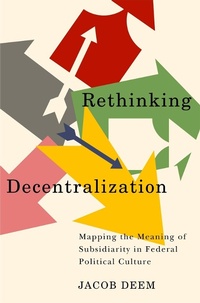
Rethinking Decentralization
Mapping the Meaning of Subsidiarity in Federal Political Culture
1st Edition
Published on 15. July 2023
227 pages
978-0-2280-1840-7 (ISBN)
Description

Federal countries face innumerable challenges including public health crises, economic uncertainty, and widespread public distrust in governing institutions. They are also home to 40 per cent of the world's population.
Rethinking Decentralization explores the question of what makes a successful federal government by examining the unique role of public attitudes in maintaining the fragile institutions of federalism. Conventional wisdom is that successful federal governance is predicated on the degree to which authority is devolved to lower levels of government and the extent to which citizens display a "federal spirit" - a term often referenced but rarely defined. Jacob Deem puts these claims to the test, examining public attitudes in Australia, Belgium, Canada, France, Germany, Switzerland, the United Kingdom, and the United States. Deem demonstrates how the role of citizen attachment to particular manifestations of decentralization, subsidiarity, and federalism is unique to each country and a reflection of its history, institutions, and culture.
Essential reading for policymakers, academics, and everyday citizens, Rethinking Decentralization re-centres the public to offer a nuanced way of thinking about federal governance.
Rethinking Decentralization explores the question of what makes a successful federal government by examining the unique role of public attitudes in maintaining the fragile institutions of federalism. Conventional wisdom is that successful federal governance is predicated on the degree to which authority is devolved to lower levels of government and the extent to which citizens display a "federal spirit" - a term often referenced but rarely defined. Jacob Deem puts these claims to the test, examining public attitudes in Australia, Belgium, Canada, France, Germany, Switzerland, the United Kingdom, and the United States. Deem demonstrates how the role of citizen attachment to particular manifestations of decentralization, subsidiarity, and federalism is unique to each country and a reflection of its history, institutions, and culture.
Essential reading for policymakers, academics, and everyday citizens, Rethinking Decentralization re-centres the public to offer a nuanced way of thinking about federal governance.
Reviews / Votes
"Rethinking Decentralization breaks new theoretical ground in its multidimensional understanding of subsidiarity. Showcasing his deep knowledge on the peculiarities of eight different countries, Jacob Deem elegantly weaves his findings into case-specific narratives. There is no other book on this subject with the same conceptual, theoretical, historical, and empirical breadth." Sean Mueller, University of Lausanne and author of Theorising Decentralisation: Comparative Evidence from Subnational Switzerland "An impressive theoretical, conceptual, historical, and cultural understanding of why some countries enjoy greater federal success than others. Highly recommended." ChoiceMore details
Series
Language
English
Place of publication
Montreal, QC
Canada
Target group
Professional and scholarly
Edition type
Digital original
Illustrations
20 tables, 4 diagrams
20 tables, 4 diagrams
File size
1,12 MB
ISBN-13
978-0-2280-1840-7 (9780228018407)
Copyright in bibliographic data and cover images is held by Nielsen Book Services Limited or by the publishers or by their respective licensors: all rights reserved.
Schweitzer Classification
Other editions
Additional editions
Jacob Deem
Rethinking Decentralization
Mapping the Meaning of Subsidiarity in Federal Political Culture
Book
07/2023
McGill-Queen's University Press
€42.50
Shipment within 15-20 days
Jacob Deem
Rethinking Decentralization
Mapping the Meaning of Subsidiarity in Federal Political Culture
Book
07/2023
McGill-Queen's University Press
€154.64
Article not available at the moment
Person
Jacob Deem is lecturer at Central Queensland University.
Content
- Cover
- RETHINKING DECENTRALIZATION
- Title
- Copyright
- Dedication
- Contents
- Tables and Figures
- Acknowledgments
- 1 Introduction
- PART ONE: BACKGROUND AND CONTEXT
- 2 Understanding Federal Political Culture
- 3 How Subsidiarity Lost Its meaning
- 4 Charting a New Course: Measuring Public Value for Subsidiarity and Federalism
- PART TWO: SURVEY FINDINGS
- 5 Classic Federations: Germany, Switzerland, and the US
- 6 The Case for Supportive Subsidiarity: Australia, Canada, and the UK
- 7 To Federate or Not to Federate? Belgium and France
- PART THREE: RESEARCH IMPLICATIONS
- 8 Decentralization and Successful Federalism: What Is the Role for Subsidiarity?
- 9 Conclusion: Subsidiarity on the Map of Federal Political Culture
- Notes
- Index
