

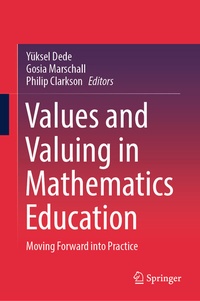
Values and Valuing in Mathematics Education
Description

This book is a follow-up to 'Values and Valuing in Mathematics Education: Scanning and Scoping the Territory' (2019, Springer). This book adds a critical emphasis on practice and fosters thinking concerning positive mathematical well-being, engagement, teacher noticing, and values alignment among a range of critical notions that intersect with values and valuing. Values and valuing play a key role in many aspects of education, such as assessment, planning, classroom interactions, choosing tasks, and general well-being. What one values and finds important in the learning and teaching of mathematics operates within the intersection of all social, cognitive, and affective aspects of school pedagogy, making values a significant holistic factor in education.
The chapters explore potential teaching strategies that enhance the understanding of the central place of values in mathematics itself as a subject, as well as how values impact how mathematics is used withinsociety. This book includes examples of strategies for facilitating students' meaningful engagement with, and conscious learning of, values when engaging in mathematical thinking and doing.
Reviews / Votes
"This book aligns with the editors' aims to inspire the development of teaching strategies that enhance the exploration of values by students and teachers in various mathematical contexts. . As claimed in its title, this book focuses on practice and, thus, contributes timely and significantly to the existing body of literature on values in mathematics education. It is a worthwhile read for a broad audience, including practitioners, researchers, and curriculum designers alike." (Haoyi Wang, Educational Studies in Mathematics, Vol. 118 (1), 2025)
More details
Other editions
Additional editions
Persons
Professor Yüksel Dede is a faculty member at the Department of Mathematics Education at Gazi University, Turkey. He worked at Berlin Freie University in Germany with the Alexander von Humboldt [AvH] Scholarship and the Scientific and Technological Research Council of Turkey [TUBITAK] Scholarship. He has worked as a director, expert, or consultant in projects supported by various public institutions in Turkey (TUBITAK, Governorships, Governorates, Provincial Directorates of National Education) and abroad (AvH-Berlin Freie University, Germany; Monash University, Australia; Korea University, South Korea). He is also on the editorial board of refereed national and international journals, and has published journal articles, book chapters, translated book chapters, and conference proceedings nationally and internationally. His research interests include the affective domain in mathematics education, especially values education, the teaching of mathematics concepts (e.g., algebrateaching), mathematics teacher education, international comparative studies, research methods, and the application of advanced statistical techniques in mathematics education.
Dr Gosia Marschall is an Assistant Professor in Teacher Professional Learning at the University of Cambridge, United Kingdom. Her main research agenda and interests relate to teacher professional learning, conceptualized from a holistic perspective (paying particular attention to teacher self-efficacy, affect, teacher identity and aspects of human functioning and self-regulation). Her research work is predominantly abductive and phenomenological, focusing on theory-building and theory-advancing ideas. She is currently working on projects concerning the relationship between mathematics teachers' professional identity and the development of knowledge and skills for teaching; theorizing in teacher professional learning; teacher decision making; and values in mathematics education.
Professor Philip Clarkson is an emeritus professor at Australian Catholic University, Australia, where he worked for 28 years, and honorary fellow at the University of Melbourne, Australia. He spent nearly five years in the early 1980s as the director of a Research Centre at the Papua New Guinea University of Technology. Prior to that, he taught at Monash University and tertiary colleges in Melbourne. He began his professional life as a teacher of chemistry, environmental science, mathematics, and physical education in secondary schools. Philip has led major consultancies and Australian Research Council (ARC) research projects, and was the president, secretary, and vice president (Publications) of the Mathematics Education Research Group of Australasia (MERGA).
Content
An Overview of Values in Mathematics Education.- Mystery: One of Six Mathematics Values.- Towards a Reconceptualisation of Values Research in Mathematics Education: A Systematic Review.- Collectivist and Individualist Values in Mathematics Education.- Values into Pedagogical Practices in Mathematics: Promoting Prospective Teachers' Ethical Responsibility for Making Mathematics Meaningful.- Designing a Professional Development Model for Values Alignment Strategies in Inclusive Mathematics Instruction.- The Text Mining Approach to Identifying What Students Value in Mathematics Learning.- Values Alignment as Teacher Craft for Effective Mathematics Teaching and Learning.- Comparative Study of Primary School Students' Values in Mathematics Learning in Ghana and Australia.- Dominant Values and Value Shifts: The Valuing Process Seen from Curriculum Levels.
