

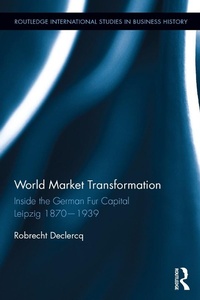
World Market Transformation
Inside the German Fur Capital Leipzig 1870 and 1939
Published on 25. May 2017
248 pages
978-1-317-21263-8 (ISBN)
Description

To the surprise of many, regionally embedded clusters of small to medium sized businesses have continued to exist in spite of industrialisation and mass production. While scholars have discovered that the advantages of embeddedness in terms of industrialisation were situated in interfirm cooperation and conflict resolving mechanisms, it is far less clear how changing historical circumstances on the world market, i.e. globalisation, affected such systems.
Taking a look inside Leipzig, a capital of the global fur industry between 1870 and 1939 with its numerous highly specialised businesses, both in production as well as trade, World Market Transformation examines the robustness of district firms within the highly volatile international fur business. This book examines how firm embeddedness not only served to overcome challenges related to industrialisation, but also strengthened the abilities of cluster firms to deal with changing world market circumstances.
World Market Transformation integrates the "interior-biased" research tradition on local business systems and industrial districts into the "exterior" fields of global and transnational history. It is demonstrated that the local business district not only emerged because of the expansion of international trade, but that district processes of interfirm cooperation also gave shape to the spatial distribution, conventions and structures of the very same world market. The analysis of embedded communities thus offers an important instrument to examine phenomena of economic globalisation, but also how such macro-economic developments have been shaped and actively constructed by local actors.
Taking a look inside Leipzig, a capital of the global fur industry between 1870 and 1939 with its numerous highly specialised businesses, both in production as well as trade, World Market Transformation examines the robustness of district firms within the highly volatile international fur business. This book examines how firm embeddedness not only served to overcome challenges related to industrialisation, but also strengthened the abilities of cluster firms to deal with changing world market circumstances.
World Market Transformation integrates the "interior-biased" research tradition on local business systems and industrial districts into the "exterior" fields of global and transnational history. It is demonstrated that the local business district not only emerged because of the expansion of international trade, but that district processes of interfirm cooperation also gave shape to the spatial distribution, conventions and structures of the very same world market. The analysis of embedded communities thus offers an important instrument to examine phenomena of economic globalisation, but also how such macro-economic developments have been shaped and actively constructed by local actors.
More details
Series
Language
English
Place of publication
London
United Kingdom
Publishing group
Taylor & Francis Ltd
Target group
College/higher education
Product notice
Reflowable
Illustrations
11 s/w Tabellen
11 Tables, black and white
File size
2,63 MB
ISBN-13
978-1-317-21263-8 (9781317212638)
Copyright in bibliographic data and cover images is held by Nielsen Book Services Limited or by the publishers or by their respective licensors: all rights reserved.
Schweitzer Classification
Other editions
Additional editions
Book
06/2019
1st Edition
Routledge
€68.40
Shipment within 15-20 days
Book
05/2017
1st Edition
Routledge
€231.80
Shipment within 10-20 days
Person
Robrecht Declercq is Postdoctoral Researcher connected to the research group Communities, Connections, and Comparisons (CCC) and the History Department of the Ghent University, Belgium.
Content
Part 1: Local Business Systems and Global Trade
1. The Leipzig Fur Capital as a Local Business System
2. The Making of the Fur Capital Leipzig (1850-1914)
3. Linking the Capital to the Outside World
Part 2: Finding World Market Alternatives 1903-1939
4. The Karakul Farming Experiment in South West Africa (1903-1933)
5. Resource Substitution and World Market Isolation: The First World War as a Testing Field for Interfirm Cooperation (1914-1920)
6. Fur Farming in the Interwar Period: A Source for World Market Retreat?
Part 3: World Market Restructuring and the Fur Capital (1920-1939)
7. Business as Usual? Adaptation to World Market Restructuring, 1919-1925 8. Market Engineering as a Collective Enterprise (1921-1930)
9. Promoting the Capital. The Leipzig International Fur Exhibition and Congress in 1930
Part 4: Epilogue
10. Economic Depression, Soviet Plan Economy and Antisemitism: the Limits of Collective Action (1931-1939)
11. Conclusion
1. The Leipzig Fur Capital as a Local Business System
2. The Making of the Fur Capital Leipzig (1850-1914)
3. Linking the Capital to the Outside World
Part 2: Finding World Market Alternatives 1903-1939
4. The Karakul Farming Experiment in South West Africa (1903-1933)
5. Resource Substitution and World Market Isolation: The First World War as a Testing Field for Interfirm Cooperation (1914-1920)
6. Fur Farming in the Interwar Period: A Source for World Market Retreat?
Part 3: World Market Restructuring and the Fur Capital (1920-1939)
7. Business as Usual? Adaptation to World Market Restructuring, 1919-1925 8. Market Engineering as a Collective Enterprise (1921-1930)
9. Promoting the Capital. The Leipzig International Fur Exhibition and Congress in 1930
Part 4: Epilogue
10. Economic Depression, Soviet Plan Economy and Antisemitism: the Limits of Collective Action (1931-1939)
11. Conclusion
