

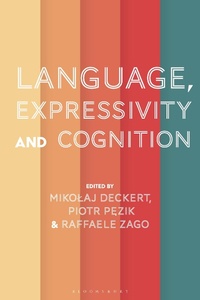
Language, Expressivity and Cognition
1st Edition
Published on 26. January 2023
256 pages
978-1-350-33287-4 (ISBN)
Description

Providing an up-to-date, multi-perspective and cross-linguistic account of the centrality of the expressive function in communication, this book explores the conceptualization of emotions in language and the high emotional 'temperature' of a variety of contemporary discourses.
Adopting a number of methodological angles, both qualitative and quantitative, the chapters present insights from cognitive linguistics, (critical) discourse analysis, corpus linguistics and sociolinguistics, as well as those resulting from the combination of these approaches. Using a wide variety of data types, from song lyrics and TV series to Twitter posts and political speeches, and through the analysis of a range of languages, including Arabic, English, Polish, Italian, Hungarian, and Turkish, the book offers a panoramic view of the multi-faceted interaction between language, expressivity and cognition.
Adopting a number of methodological angles, both qualitative and quantitative, the chapters present insights from cognitive linguistics, (critical) discourse analysis, corpus linguistics and sociolinguistics, as well as those resulting from the combination of these approaches. Using a wide variety of data types, from song lyrics and TV series to Twitter posts and political speeches, and through the analysis of a range of languages, including Arabic, English, Polish, Italian, Hungarian, and Turkish, the book offers a panoramic view of the multi-faceted interaction between language, expressivity and cognition.
More details
Edition
1. Auflage
Language
English
Place of publication
London
United Kingdom
Publishing group
Bloomsbury Publishing PLC
Target group
Professional and scholarly
Illustrations
13 bw illus
ISBN-13
978-1-350-33287-4 (9781350332874)
Copyright in bibliographic data and cover images is held by Nielsen Book Services Limited or by the publishers or by their respective licensors: all rights reserved.
Schweitzer Classification
Other editions
Additional editions
Mikolaj Deckert | Piotr Pezik | Raffaele Zago
Language, Expressivity and Cognition
Book
08/2024
Bloomsbury Academic
€55.89
Shipment within 15-20 days
Persons
Mikolaj Deckert is Associate Professor at the University of Lodz, Poland.
Piotr Pezik is Associate Professor at the University of Lodz, Poland.
Raffaele Zago is a researcher at the University of Catania, Italy.
Piotr Pezik is Associate Professor at the University of Lodz, Poland.
Raffaele Zago is a researcher at the University of Catania, Italy.
Content
List of Figures
List of Tables
List of Contributors
1. Constructing Emotion in Contemporary Discourses, Mikolaj Deckert (University of Lódz, Poland), Piotr Pezik (University of Lódz, Poland), Raffaele Zago (University of Catania, Italy)
2. Hungarian Metaphors of Szív 'Heart' in Relation to Emotions and Reasoning, Judit Baranyiné Kóczy (University of Gyor, Hungary)
3. A Comparative Study of English, Italian and Polish Conceptual Metaphors of Emotion Regulation and Cognitive Inhibition, Marcin Trojszczak (University of Bialystok, Poland) and Chiara Astrid Gebbia (University of Agder, Norway)
4. Linguistic Means to Discursively Construct Dehumanization, Serena Coschignano (University Of Pavia, Italy) and Chiara Zanchi (University Of Pavia, Italy)
5. A Comparative Study of Donald J. Trump and Matteo Salvini's Populist Strategies in the Representation of Immigrants and Refugees on Twitter, Ester Di Silvestro (University of Catania, Italy)
6. Collective Identities in Online Contexts, Barbara Lewandowska-Tomaszczyk (State University of Applied Sciences in Konin, Poland) and Paul A. Wilson (University of Lódz, Poland)
7. A Phraseological Perspective on COVID-19 Vaccination in Polish Web-Based News, Mikolaj Deckert (University of Lódz, Poland), Krzysztof Hejduk (University of Lódz, Poland), Piotr Pezik (University of Lódz, Poland)
8. Arabic-English Code-Switching in Egyptian Rap Music and Social Networks, Lucia La Causa (University of Catania, Italy)
9. Innovation and Emotion in Teen Talk in TV Series, Silvia Bruti (University of Pisa, Italy)
10. Emotion, Culture and Discourse in Audio Description Quality in Turkey, Hilal Erkazanci Durmus and Sirin Okyayuz (Bilkent University, Turkey)
11. Conclusion, Raffaele Zago (University of Catania, Italy)
Index
List of Tables
List of Contributors
1. Constructing Emotion in Contemporary Discourses, Mikolaj Deckert (University of Lódz, Poland), Piotr Pezik (University of Lódz, Poland), Raffaele Zago (University of Catania, Italy)
2. Hungarian Metaphors of Szív 'Heart' in Relation to Emotions and Reasoning, Judit Baranyiné Kóczy (University of Gyor, Hungary)
3. A Comparative Study of English, Italian and Polish Conceptual Metaphors of Emotion Regulation and Cognitive Inhibition, Marcin Trojszczak (University of Bialystok, Poland) and Chiara Astrid Gebbia (University of Agder, Norway)
4. Linguistic Means to Discursively Construct Dehumanization, Serena Coschignano (University Of Pavia, Italy) and Chiara Zanchi (University Of Pavia, Italy)
5. A Comparative Study of Donald J. Trump and Matteo Salvini's Populist Strategies in the Representation of Immigrants and Refugees on Twitter, Ester Di Silvestro (University of Catania, Italy)
6. Collective Identities in Online Contexts, Barbara Lewandowska-Tomaszczyk (State University of Applied Sciences in Konin, Poland) and Paul A. Wilson (University of Lódz, Poland)
7. A Phraseological Perspective on COVID-19 Vaccination in Polish Web-Based News, Mikolaj Deckert (University of Lódz, Poland), Krzysztof Hejduk (University of Lódz, Poland), Piotr Pezik (University of Lódz, Poland)
8. Arabic-English Code-Switching in Egyptian Rap Music and Social Networks, Lucia La Causa (University of Catania, Italy)
9. Innovation and Emotion in Teen Talk in TV Series, Silvia Bruti (University of Pisa, Italy)
10. Emotion, Culture and Discourse in Audio Description Quality in Turkey, Hilal Erkazanci Durmus and Sirin Okyayuz (Bilkent University, Turkey)
11. Conclusion, Raffaele Zago (University of Catania, Italy)
Index
