

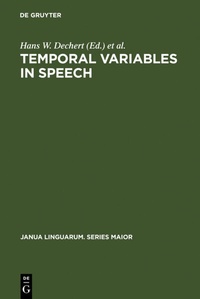
Temporal Variables in Speech
Studies in Honour of Frieda Goldman-Eisler
1st Edition
Published on 2. May 2011
XII, 370 pages
978-3-11-081657-0 (ISBN)
Description

No detailed description available for "Temporal Variables in Speech".
More details
Series
Edition
Reprint 2010
Language
English
Place of publication
Berlin/Boston
Germany
Publishing group
de Gruyter Mouton
Target group
Professional and scholarly
US School Grade: College Graduate Student
Illustrations
22 s/w Tabellen, 38 Abbildungen
38 ill., 22 tbl.
File size
53,20 MB
ISBN-13
978-3-11-081657-0 (9783110816570)
Schweitzer Classification
Other editions
Additional editions
Hans W. Dechert | Manfred Raupach
Temporal Variables in Speech
Studies in Honour of Frieda Goldman-Eisler
Book
07/1980
1st Edition
De Gruyter Mouton
€119.95
Shipment within 10-20 days
Hans W. Dechert | Manfred Raupach
Temporal Variables in Speech
Studies in Honour of Frieda Goldman-Eisler
Book
01/1980
1st Edition
De Gruyter Mouton
€169.95
Article exhausted; check different version
Content
- Intro
- General introduction
- Prospectus for a science of pausology
- First section: General aspects
- The place of pragmatics in the syntactic and semantic organization of language
- Slips of the tongue as neuromuscular evidence for a model of speech production
- Grammatical incoherence
- The competing plans hypothesis: An heuristic viewpoint on the causes of errors in speech
- Models of verbal planning in the theory of catastrophes
- Pausological research at Saint Louis University
- Second section: Syntactic and structural aspects
- Pauses, prosody, and the demands of production in language
- Pause and syntactic structure
- Linguistic structures and performance structures: Studies in pause distribution
- Phonological status of the pause
- Pauses as indicators of cognitive functioning in aphasia
- Speech control and paraphasia in fluent and nonfluent aphasics
- Third section: Conversational aspects
- Encoding units in spontaneous speech: Some implications for the dynamics of conversation
- Hesitancy as a conversational resource: Some methodological implications
- The relationship between gaze and speech examined afresh with a Mackworth eye-mark camera
- Verbal planning in route directions
- Some reasons for hesitating
- Fourth section: Prosodic aspects
- Syllable omission errors and isochrony
- Suprasegmental structure and sentence perception
- Juncture pause and intonation fall and the perceptual segmentation of speech
- Some neglected aspects of intonation
- The role of pauses and suprasegmentals in a grammar
- A functional analysis of some pause and pitch step-up combinations
- Towards a subcategorization of speech pauses
- Perception of pauses and automatic speech recognition
- A digital method of pause extraction
- Fifth section: Crosslinguistic aspects
- The syntactical distribution of pauses in English spoken as a second language by French students
- Temporal variables in first and second language speech production
- Pauses and intonation as indicators of verbal planning in second-language speech productions:
- Two examples from a case study
- Results of a contrastive study of hesitation phenomena in French and German
- Towards a theory of speech processing: Some methodological considerations
- Probe latencies, foreign languages and foreign language learners
- Comparative studies of temporal variables in spoken and sign languages: A short review
- Verbal strategies: A neglected dimension in language acquisition studies
- Final discussion
- On the current understanding of temporal variables in speech
- References
- Index of names
