

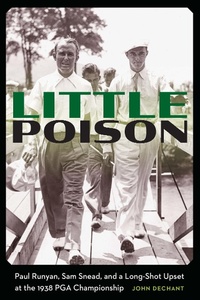
Little Poison
Paul Runyan, Sam Snead, and a Long-Shot Upset at the 1938 PGA Championship
1st Edition
Published on 1. April 2023
304 pages
978-1-4962-3594-7 (ISBN)
Description

Shortlisted for the 2023 Herbert Warren Wind Book Award
Paul Runyan-the Arkansas farm boy who stood five feet, six inches and weighed 130 pounds-shocked the golf world by defeating long and lean, sweet-swinging Sam Snead in the finals of the 1938 PGA Championship, thus earning the nickname "Little Poison." Runyan did more than beat Snead: he shellacked him as decisively as David toppled mighty Goliath. His resounding victory was so convincing, so dominant, that even Snead had to shake his head when it was finished and wonder how the porkpie-wearing, pint-sized golf pro had gotten the better of him in the thirty-six-hole final. One bookmaker made Snead a 10-to-1 favorite before the match. Despite Snead's physical gifts-he routinely outdrove Runyan by fifty yards or more-Snead was no match for Runyan, the underdog victor in one of golf's four major championships.
Little Poison is the story of a man who made a career out of punching above his weight on the golf course. Runyan won twenty-nine PGA tournaments between 1930 and 1941, as well as another major championship in 1934. Runyan served in the navy during World War II, joining Snead and other prominent professionals who played exhibition matches to entertain troops and help raise money. After the war he played sparingly-but successfully-and focused on his career as an instructor, teaching his revolutionary short-game techniques. Little Poison follows Runyan throughout these stages of his life, from anonymity to stardom and into golf mythology.
At the heart of Runyan's story is his Depression-era grit. He believed passionately that proper technique and relentless hard work would outlast talent and brawn. Americans who emerged from the Great Depression likely had a little Runyan in them, too, making him the perfect sports hero for the era. His story began not on the immaculate fairways of a country club but on a farm in Hot Springs, Arkansas, near a golf course with oiled sand greens. A disadvantage, some would say-but not Runyan. On those sand surfaces he developed a sustainable technique that became the bedrock of his hall of fame career.
Paul Runyan-the Arkansas farm boy who stood five feet, six inches and weighed 130 pounds-shocked the golf world by defeating long and lean, sweet-swinging Sam Snead in the finals of the 1938 PGA Championship, thus earning the nickname "Little Poison." Runyan did more than beat Snead: he shellacked him as decisively as David toppled mighty Goliath. His resounding victory was so convincing, so dominant, that even Snead had to shake his head when it was finished and wonder how the porkpie-wearing, pint-sized golf pro had gotten the better of him in the thirty-six-hole final. One bookmaker made Snead a 10-to-1 favorite before the match. Despite Snead's physical gifts-he routinely outdrove Runyan by fifty yards or more-Snead was no match for Runyan, the underdog victor in one of golf's four major championships.
Little Poison is the story of a man who made a career out of punching above his weight on the golf course. Runyan won twenty-nine PGA tournaments between 1930 and 1941, as well as another major championship in 1934. Runyan served in the navy during World War II, joining Snead and other prominent professionals who played exhibition matches to entertain troops and help raise money. After the war he played sparingly-but successfully-and focused on his career as an instructor, teaching his revolutionary short-game techniques. Little Poison follows Runyan throughout these stages of his life, from anonymity to stardom and into golf mythology.
At the heart of Runyan's story is his Depression-era grit. He believed passionately that proper technique and relentless hard work would outlast talent and brawn. Americans who emerged from the Great Depression likely had a little Runyan in them, too, making him the perfect sports hero for the era. His story began not on the immaculate fairways of a country club but on a farm in Hot Springs, Arkansas, near a golf course with oiled sand greens. A disadvantage, some would say-but not Runyan. On those sand surfaces he developed a sustainable technique that became the bedrock of his hall of fame career.
Reviews / Votes
"Little Poison is a wonderful tribute to a golfer whose life and accomplishments deserve such recognition."-Stuart Shiffman, bookreporter.com "In these fast-moving pages and masterfully researched chapters, John Dechant has given a true gift to devotees of both golf and storytelling. Golf history loves its overlooked underdogs, but few are as overlooked or as interesting as Paul Runyan. Little Poison is a book that will have you cheering from the jump."-Tom Coyne, New York Times best-selling author of A Course Called Scotland and A Course Called America "Little Poison is a well-written account of a very interesting man and time in golf history. John Dechant weaves through time and space effortlessly as he details what made Paul Runyan special. The intangible character traits of high performers have always fascinated me. If you love golf, history, and appreciate greatness, this book is for you."-James Sieckmann, 2018 National PGA Teacher of the YearMore details
Language
English
Place of publication
Lincoln
United States
Illustrations
30 photographs
File size
21,04 MB
ISBN-13
978-1-4962-3594-7 (9781496235947)
Copyright in bibliographic data and cover images is held by Nielsen Book Services Limited or by the publishers or by their respective licensors: all rights reserved.
Schweitzer Classification
Other editions
Additional editions
John Dechant
Little Poison
Paul Runyan, Sam Snead, and a Long-Shot Upset at the 1938 PGA Championship
Book
04/2023
University of Nebraska Press
€31.00
Shipment within 15-20 days
Person
John Dechant is the author of several books, including Scoreless: Omaha Central, Creighton Prep, and Nebraska's Greatest High School Football Game (Bison Books, 2016). His writing has appeared in a variety of magazines and the Golfer's Journal. He is the president of the publishing firm Legacy Preservation.
Content
List of Illustrations
Prologue
Part 1. Hot Springs Boys
1. Something in the Water
2. Six Hundred Balls a Day
3. Samuel Jackson
Part 2. Little Poison
4. White Plains
5. "I Don't Know How He Does It"
6. A Code of His Own
Part 3. On the Delaware
7. A Talent Nonpareil
8. "Lawdy, the Man Ain't Human"
9. No Days Off
Part 4. Go West
10. "Whatever Became of Paul Runyan?"
11. La Jolla
12. Last Hurrah
13. High Heavenly Ground
Part 5. On the Tee until the Last
14. Author and Influencer
15. "The Legend Never Really Died"
Acknowledgments
Bibliographic Essay
Prologue
Part 1. Hot Springs Boys
1. Something in the Water
2. Six Hundred Balls a Day
3. Samuel Jackson
Part 2. Little Poison
4. White Plains
5. "I Don't Know How He Does It"
6. A Code of His Own
Part 3. On the Delaware
7. A Talent Nonpareil
8. "Lawdy, the Man Ain't Human"
9. No Days Off
Part 4. Go West
10. "Whatever Became of Paul Runyan?"
11. La Jolla
12. Last Hurrah
13. High Heavenly Ground
Part 5. On the Tee until the Last
14. Author and Influencer
15. "The Legend Never Really Died"
Acknowledgments
Bibliographic Essay
