

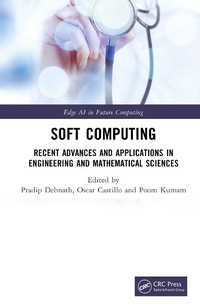
Soft Computing
Recent Advances and Applications in Engineering and Mathematical Sciences
1st Edition
Published on 28. February 2023
246 pages
978-1-000-83084-2 (ISBN)
Description

This book explores soft computing techniques in a systematic manner starting from their initial stage to recent developments in this area. The book presents a survey of the existing knowledge and the current state-of-the-art development through cutting-edge original new contributions from the researchers. Soft Computing: Recent Advances and Applications in Engineering and Mathematical Sciences presents a survey of the existing knowledge and the current state-of-the-art development through cutting-edge original new contributions from the researchers.
As suggested by the title, this book particularly focuses on the recent advances and applications of soft computing techniques in engineering and mathematical sciences. Chapter 1 describes the contribution of soft computing techniques towards a new paradigm shift. The subsequent chapters present a systematic application of fuzzy logic in mathematical sciences and decision-making. New research directions are also provided at the end of each chapter. The application of soft computing in health sciences and in the modeling of epidemics including the effects of vaccination are also examined. Sustainability of green product development, optimum design of 3D steel frame, digitalization investment analysis in the maritime industry, forecasting return rates of individual pension funds are among some of the topics where engineering and industrial applications of soft computing have been studied in the book. The readers of this book will require minimum prerequisites of undergraduate studies in computation and mathematics.
This book is meant for graduate students, faculty, and researchers who are applying soft computing in engineering and mathematics. New research directions are also provided at the end of each chapter.
As suggested by the title, this book particularly focuses on the recent advances and applications of soft computing techniques in engineering and mathematical sciences. Chapter 1 describes the contribution of soft computing techniques towards a new paradigm shift. The subsequent chapters present a systematic application of fuzzy logic in mathematical sciences and decision-making. New research directions are also provided at the end of each chapter. The application of soft computing in health sciences and in the modeling of epidemics including the effects of vaccination are also examined. Sustainability of green product development, optimum design of 3D steel frame, digitalization investment analysis in the maritime industry, forecasting return rates of individual pension funds are among some of the topics where engineering and industrial applications of soft computing have been studied in the book. The readers of this book will require minimum prerequisites of undergraduate studies in computation and mathematics.
This book is meant for graduate students, faculty, and researchers who are applying soft computing in engineering and mathematics. New research directions are also provided at the end of each chapter.
More details
Series
Edition
1. Auflage
Language
English
Place of publication
London
United Kingdom
Publishing group
Taylor & Francis Ltd
Target group
Professional and scholarly
Illustrations
28 Tables, black and white; 22 Halftones, black and white; 22 Illustrations, black and white
ISBN-13
978-1-000-83084-2 (9781000830842)
Copyright in bibliographic data and cover images is held by Nielsen Book Services Limited or by the publishers or by their respective licensors: all rights reserved.
Schweitzer Classification
Other editions
Additional editions
Pradip Debnath | Oscar Castillo | Poom Kumam
Soft Computing
Recent Advances and Applications in Engineering and Mathematical Sciences
Book
10/2024
1st Edition
CRC Press
€71.40
Shipment within 10-20 days
Pradip Debnath | Oscar Castillo | Poom Kumam
Soft Computing
Recent Advances and Applications in Engineering and Mathematical Sciences
Book
02/2023
1st Edition
CRC Press
€140.60
Shipment within 10-20 days
Persons
Pradip Debnath is an Assistant Professor (in Mathematics) at the Department of Applied Science and Humanities, Assam University, Silchar (a central university), India. He received his Ph.D. in Mathematics from the National Institute of Technology Silchar, India. His research interests include fixed point theory, nonlinear functional analysis, soft computing and mathematical statistics. He has published more than 60 papers in various journals of international repute and is reviewer for more than 40 international journals. Dr. Debnath is also a reviewer for "Mathematical Reviews" published by the American Mathematical Society. He is the Lead Editor of the books "Metric Fixed Point Theory - Applications in Science, Engineering and Behavioural Sciences" (2021, Springer Nature), "Soft Computing Techniques in Engineering, Health, Mathematical and Social Sciences" (2021, CRC Press) and "Fixed Point Theory and Fractional Calculus: Recent Advances and Applications" (2022, Springer Nature). He has successfully guided Ph.D. students in the areas of fuzzy logic, soft computing and fixed point theory. He has recently completed a Basic Science Research Project on fixed point theory funded by the UGC, the Government of India. Having been an academic gold medalist during his post-graduation studies from Assam University, Silchar, Dr. Debnath has qualified several national-level examinations in mathematics in India.
Oscar Castillo holds the Doctor in Science degree (Doctor Habilitatus) in Computer Science from the Polish Academy of Sciences (with the Dissertation "Soft Computing and Fractal Theory for Intelligent Manufacturing"). He is a Professor of Computer Science in the Graduate Division, Tijuana Institute of Technology, Tijuana, Mexico. In addition, he is serving as Research Director of Computer Science and head of the research group on Hybrid Fuzzy Intelligent Systems. Currently, he is President of HAFSA (Hispanic American Fuzzy Systems Association) and Past President of IFSA (International Fuzzy Systems Association). Prof. Castillo is also Chair of the Mexican Chapter of the Computational Intelligence Society (IEEE). He also belongs to the Technical Committee on Fuzzy Systems of IEEE and to the Task Force on "Extensions to Type-1 Fuzzy Systems". He is also a member of NAFIPS, IFSA and IEEE. He belongs to the Mexican Research System (SNI Level 3). His research interests are in Type-2 Fuzzy Logic, Fuzzy Control, Neuro-Fuzzy and Genetic-Fuzzy hybrid approaches.
Poom Kumam received the B.S., M.Sc., and Ph.D. degrees in mathematics from Burapha University (BUU), Chiang Mai University (CMU), and Naresuan University (NU), respectively. In 2008, he received a grant from Franco-Thai Cooperation for short-term visited at the Laboratoire de Mathematiques, Universite de Bretagne Occidentale, France. He was also a Visiting Professor for a short-term research with Professor Anthony To-Ming Lau at the University of Alberta, AB, Canada. He is currently a Full Professor with the Department of Mathematics, King Mongkut's University of Technology Thonburi (KMUTT), where he is also the Head of the KMUTT Fixed Point Theory and Applications Research Group since 2007 and also leading of the Theoretical and Computational Science Center (TaCS-Center) in 2014 (now, became to TaCS-Center of Excellence in 2021). He has successfully advised 5 master's, and 44 Ph.D. graduates. . Dr. Poom Kumam has been Highly Cited Researcher (HCR 2015, 2016, 2017). He has also been listed and ranked in the 197th Place in General Mathematics among the Top 2% Scientists in the World 2021 (Published by Stanford University in USA).
Oscar Castillo holds the Doctor in Science degree (Doctor Habilitatus) in Computer Science from the Polish Academy of Sciences (with the Dissertation "Soft Computing and Fractal Theory for Intelligent Manufacturing"). He is a Professor of Computer Science in the Graduate Division, Tijuana Institute of Technology, Tijuana, Mexico. In addition, he is serving as Research Director of Computer Science and head of the research group on Hybrid Fuzzy Intelligent Systems. Currently, he is President of HAFSA (Hispanic American Fuzzy Systems Association) and Past President of IFSA (International Fuzzy Systems Association). Prof. Castillo is also Chair of the Mexican Chapter of the Computational Intelligence Society (IEEE). He also belongs to the Technical Committee on Fuzzy Systems of IEEE and to the Task Force on "Extensions to Type-1 Fuzzy Systems". He is also a member of NAFIPS, IFSA and IEEE. He belongs to the Mexican Research System (SNI Level 3). His research interests are in Type-2 Fuzzy Logic, Fuzzy Control, Neuro-Fuzzy and Genetic-Fuzzy hybrid approaches.
Poom Kumam received the B.S., M.Sc., and Ph.D. degrees in mathematics from Burapha University (BUU), Chiang Mai University (CMU), and Naresuan University (NU), respectively. In 2008, he received a grant from Franco-Thai Cooperation for short-term visited at the Laboratoire de Mathematiques, Universite de Bretagne Occidentale, France. He was also a Visiting Professor for a short-term research with Professor Anthony To-Ming Lau at the University of Alberta, AB, Canada. He is currently a Full Professor with the Department of Mathematics, King Mongkut's University of Technology Thonburi (KMUTT), where he is also the Head of the KMUTT Fixed Point Theory and Applications Research Group since 2007 and also leading of the Theoretical and Computational Science Center (TaCS-Center) in 2014 (now, became to TaCS-Center of Excellence in 2021). He has successfully advised 5 master's, and 44 Ph.D. graduates. . Dr. Poom Kumam has been Highly Cited Researcher (HCR 2015, 2016, 2017). He has also been listed and ranked in the 197th Place in General Mathematics among the Top 2% Scientists in the World 2021 (Published by Stanford University in USA).
Content
1. A Study on Approximate Fixed Point Property in Intuitionistic Fuzzy N-Normed Linear Spaces.
2. Sequential Extended Parametric and Sequential Extended Fuzzy B-Metrics With an Application in Integral Equations.
3. Analytical Sequel of Rational Type Fuzzy Contraction in Fuzzy B-Metric Spaces.
4. Weak Wardowski Contractions in Generalized Triple-Controlled Modular Metric Spaces and Generalized Triple-Controlled Fuzzy Metric Spaces.
5. Some First Order-Like Methods for Solving Systems of Nonlinear Equations.
6. Cubic Inverse Soft Set.
7. Inverse Soft-Rough Matrices.
8. New Observations on Lacunary I-Invariant Convergence for Sequences in Fuzzy Cone Normed Spaces.
9. Some Convergent Sequence Spaces of Fuzzy Star-Shaped Numbers.
10. Digitalization Investment Analysis in Maritime Industry with Interval-Valued Pythagorean Fuzzy Present Worth Analysis.
11. Composite Mapping on Hesitant Fuzzy Soft Classes.
12. Ulam Stability of Mixed Type Functional Equation in Non-archimedean Ifn-Space.
13. Optimum Design of 3D Steel Frames with Composite Slabs Using Adaptive Harmony Search Method.
14. Fostering Sustainability in Open Innovation, to Select the Right Partner on Green Product Development.
15. Index.
2. Sequential Extended Parametric and Sequential Extended Fuzzy B-Metrics With an Application in Integral Equations.
3. Analytical Sequel of Rational Type Fuzzy Contraction in Fuzzy B-Metric Spaces.
4. Weak Wardowski Contractions in Generalized Triple-Controlled Modular Metric Spaces and Generalized Triple-Controlled Fuzzy Metric Spaces.
5. Some First Order-Like Methods for Solving Systems of Nonlinear Equations.
6. Cubic Inverse Soft Set.
7. Inverse Soft-Rough Matrices.
8. New Observations on Lacunary I-Invariant Convergence for Sequences in Fuzzy Cone Normed Spaces.
9. Some Convergent Sequence Spaces of Fuzzy Star-Shaped Numbers.
10. Digitalization Investment Analysis in Maritime Industry with Interval-Valued Pythagorean Fuzzy Present Worth Analysis.
11. Composite Mapping on Hesitant Fuzzy Soft Classes.
12. Ulam Stability of Mixed Type Functional Equation in Non-archimedean Ifn-Space.
13. Optimum Design of 3D Steel Frames with Composite Slabs Using Adaptive Harmony Search Method.
14. Fostering Sustainability in Open Innovation, to Select the Right Partner on Green Product Development.
15. Index.
