

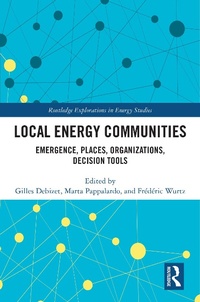
Local Energy Communities
Emergence, Places, Organizations, Decision Tools
1st Edition
Published on 6. September 2022
376 pages
978-1-000-64378-7 (ISBN)
Description

This book draws on social science analysis to understand the ongoing dynamics within and surrounding local energy communities in reliably electrified countries: Belgium, Canada, Colombia, France, Germany, India, the Netherlands, Spain, Switzerland and the United Kingdom.
It offers a comprehensive overview of recent results and thus outlines a diversity of drivers and levers for scaling up energy communities or, at least, local energy sharing. Analysing the main types of energy communities such as collective self-consumption, citizen cooperatives and peer-to-peer digital platforms, the book does not only raise new questions for social scientists, but also offers a comprehensive overview for all those contributing to the circular economy and the decentralization of energy production in inhabited areas where energy consumption is concentrated. This book provides input for the ongoing debates in many European countries implementing the national law on the European directives for energy communities. Furthermore, without evading the antagonism between cooperative and market approaches, or the contradictions between different issues, the book outlines the innovative decision-making tools that can facilitate the development of local energy production and sharing systems.
As well as being of interest to postgraduates and researchers in the field of energy studies, this book will be vital to energy professionals looking to support local energy communities' decision-making and design, who wish to consider sociological, organizational and territorial dimensions.
It offers a comprehensive overview of recent results and thus outlines a diversity of drivers and levers for scaling up energy communities or, at least, local energy sharing. Analysing the main types of energy communities such as collective self-consumption, citizen cooperatives and peer-to-peer digital platforms, the book does not only raise new questions for social scientists, but also offers a comprehensive overview for all those contributing to the circular economy and the decentralization of energy production in inhabited areas where energy consumption is concentrated. This book provides input for the ongoing debates in many European countries implementing the national law on the European directives for energy communities. Furthermore, without evading the antagonism between cooperative and market approaches, or the contradictions between different issues, the book outlines the innovative decision-making tools that can facilitate the development of local energy production and sharing systems.
As well as being of interest to postgraduates and researchers in the field of energy studies, this book will be vital to energy professionals looking to support local energy communities' decision-making and design, who wish to consider sociological, organizational and territorial dimensions.
More details
Series
Edition
1. Auflage
Language
English
Place of publication
London
United Kingdom
Publishing group
Taylor & Francis Ltd
Target group
College/higher education
Professional and scholarly
Product notice
Reflowable
Illustrations
1 Tables, black and white; 31 Line drawings, black and white; 11 Halftones, black and white; 42 Illustrations, black and white
ISBN-13
978-1-000-64378-7 (9781000643787)
Copyright in bibliographic data and cover images is held by Nielsen Book Services Limited or by the publishers or by their respective licensors: all rights reserved.
Schweitzer Classification
Other editions
Additional editions
Gilles Debizet | Marta Pappalardo | Frederic Wurtz
Local Energy Communities
Emergence, Places, Organizations, Decision Tools
Book
05/2024
1st Edition
Routledge
€64.20
Shipment within 10-20 days
Gilles Debizet | Marta Pappalardo | Frederic Wurtz
Local Energy Communities
Emergence, Places, Organizations, Decision Tools
Book
09/2022
1st Edition
Routledge
€207.30
Shipment within 10-20 days
Persons
Gilles Debizet is an Associate Professor of Urban Planning at Universite Grenoble Alpes and a researcher at the Pacte Social Sciences Laboratory since 2006. His research focuses on the integration of climate issues in the making of the contemporary city. He was/is a member of scientific committees (Universite Grenoble Alpes, Agence Nationale de la Recherche, Reseau RAMAU). He has co-lead the Eco-SESA Cross-Disciplinary Programme since 2017.
Marta Pappalardo is an Architect, with a PhD in Urban Planning, currently researcher at the Institute of Urban Planning and Alpine Geography and Pacte Social Sciences Laboratory (Universite Grenoble Alpes, CNRS, Science Po Grenoble). Her research focuses on the practices of occupation and management of energy-efficient buildings and on the governance of energy communities.
Frederic Wurtz is a CNRS senior researcher at Grenoble Electrical Engineering Laboratory (G2ELAB) of Grenoble INP - Universite Grenoble Alpes and CNRS. He has developed skills at the interface of engineering and social science in the design of energy systems: typically, cars, flights, smart-buildings and smart-grids, eco-districts, smart districts and smart cities, with a current focus on micro-grids and local energy communities.
Marta Pappalardo is an Architect, with a PhD in Urban Planning, currently researcher at the Institute of Urban Planning and Alpine Geography and Pacte Social Sciences Laboratory (Universite Grenoble Alpes, CNRS, Science Po Grenoble). Her research focuses on the practices of occupation and management of energy-efficient buildings and on the governance of energy communities.
Frederic Wurtz is a CNRS senior researcher at Grenoble Electrical Engineering Laboratory (G2ELAB) of Grenoble INP - Universite Grenoble Alpes and CNRS. He has developed skills at the interface of engineering and social science in the design of energy systems: typically, cars, flights, smart-buildings and smart-grids, eco-districts, smart districts and smart cities, with a current focus on micro-grids and local energy communities.
Content
Table of contents
Co-editors
List of chapter contributors
Preface
Origin of the book
Framework of the book
Acknowledgments
Introduction
Social sciences introduction. Local energy communities: state of the art and chapters cross-sectional analysis
Gilles Debizet and Marta Pappalardo
Engineering sciences introduction. Local Energy Communities: transversal reading
Frederic Wurtz
Section A) Motivations and internal/local dynamics of energy sharing communities
A.1) Inhabitants' activities and needs relative to renewable energy pooling and sharing: a prospective scenario approach
Antoine Martin, Marie-France Agnoletti and Eric Brangier
A.2) Shared geothermal energy projects in Montreal: the importance of pre-existing collective action spaces
Myriam Proulx and Sophie Van Neste
A.3) Energy communities and commons: rethinking collective action through inhabited spaces
Marta Pappalardo
A.4) Anticipating energy communities in urban projects: challenges and limits
Ines Ramirez-Cobo, Gilles Debizet and Silvere Tribout
Section B) Collective self-consumption: regulatory framework set-up and controversies
B.1) Regulatory framework of collective self-consumption operations: comparative study France, Spain, Germany
Blanche Lormeteau
B.2) The controversial emergence of collective self-consumption in France
Thibaut Fonteneau
Section C) Citizen cooperatives: inter-scalar idealizing, learning and structuring for scaling up
C.1) Trajectories of renewable energy communities: between democratic processes and economic constraints
Armelle Gomez, Benjamin Tyl, and Aude Pottier
C.2) Emergence and transformation of Enercoop: The French network of electricity supply cooperatives as a new social economy initiative
Remi Maitre
C.3) Cooperation within and the institutionalization of participatory renewable energy projects in France: a focus on co-developed citizen, public and private partnership projects
Amelie Artis, Justine Ballon, Dorian Litvine, Emilie Dias and Sylvie Blangy
Section D) Digital services for peer-to-peer communities: regulatory framework and market
D.1) Emerging digital business models for energy communities: Enablers for citizen participation in the energy transition? - Perspectives from Germany
Christine Dede and Monika Heyder
D.2) Digital technologies for consumer-centred energy markets: opportunities and risks of an energy internet.
Hugo Schoenbeck, Anna Gorbacheva and Alexandra Schneiders
D.3) Digital Energy Trading Platforms: An Economic Analysis
Thomas Cortade and Jean-Christophe Poudou
Section E) Design energy projects for multi-stakeholders' communities: decision-support tools
E.1) Proposal to take into account stakeholders' motivations in models of optimization decision support tools
Lou Morriet, Frederic Wurtz and Gilles Debizet
E.2) Decision support for technical design of on-the-spot renewable energy projects involving several stakeholders
Jaume Fito, Sacha Hodencq, Lou Morriet, Julien Ramousse, Frederic Wurtz and Gilles DebizetIndex
Co-editors
List of chapter contributors
Preface
Origin of the book
Framework of the book
Acknowledgments
Introduction
Social sciences introduction. Local energy communities: state of the art and chapters cross-sectional analysis
Gilles Debizet and Marta Pappalardo
Engineering sciences introduction. Local Energy Communities: transversal reading
Frederic Wurtz
Section A) Motivations and internal/local dynamics of energy sharing communities
A.1) Inhabitants' activities and needs relative to renewable energy pooling and sharing: a prospective scenario approach
Antoine Martin, Marie-France Agnoletti and Eric Brangier
A.2) Shared geothermal energy projects in Montreal: the importance of pre-existing collective action spaces
Myriam Proulx and Sophie Van Neste
A.3) Energy communities and commons: rethinking collective action through inhabited spaces
Marta Pappalardo
A.4) Anticipating energy communities in urban projects: challenges and limits
Ines Ramirez-Cobo, Gilles Debizet and Silvere Tribout
Section B) Collective self-consumption: regulatory framework set-up and controversies
B.1) Regulatory framework of collective self-consumption operations: comparative study France, Spain, Germany
Blanche Lormeteau
B.2) The controversial emergence of collective self-consumption in France
Thibaut Fonteneau
Section C) Citizen cooperatives: inter-scalar idealizing, learning and structuring for scaling up
C.1) Trajectories of renewable energy communities: between democratic processes and economic constraints
Armelle Gomez, Benjamin Tyl, and Aude Pottier
C.2) Emergence and transformation of Enercoop: The French network of electricity supply cooperatives as a new social economy initiative
Remi Maitre
C.3) Cooperation within and the institutionalization of participatory renewable energy projects in France: a focus on co-developed citizen, public and private partnership projects
Amelie Artis, Justine Ballon, Dorian Litvine, Emilie Dias and Sylvie Blangy
Section D) Digital services for peer-to-peer communities: regulatory framework and market
D.1) Emerging digital business models for energy communities: Enablers for citizen participation in the energy transition? - Perspectives from Germany
Christine Dede and Monika Heyder
D.2) Digital technologies for consumer-centred energy markets: opportunities and risks of an energy internet.
Hugo Schoenbeck, Anna Gorbacheva and Alexandra Schneiders
D.3) Digital Energy Trading Platforms: An Economic Analysis
Thomas Cortade and Jean-Christophe Poudou
Section E) Design energy projects for multi-stakeholders' communities: decision-support tools
E.1) Proposal to take into account stakeholders' motivations in models of optimization decision support tools
Lou Morriet, Frederic Wurtz and Gilles Debizet
E.2) Decision support for technical design of on-the-spot renewable energy projects involving several stakeholders
Jaume Fito, Sacha Hodencq, Lou Morriet, Julien Ramousse, Frederic Wurtz and Gilles DebizetIndex
