

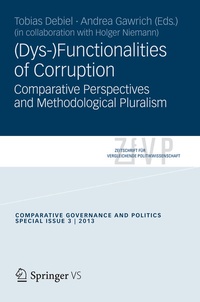
(Dys-)Functionalities of Corruption
Description

Corruption is usually understood as hampering political development, economic growth and democratic participation of citizens, but comparing the effects of corruption for different political regimes presents astonishingly complex findings. The ongoing persistence of corruption underlines that it is not only dysfunctional, but can be highly functional as well. This special issue brings together contributions from comparative politics, political science and economics which precisely focus on these (dys) functionalities of corruption in political regimes across various world regions. The question of methodological pluralism is especially important for studying corruption comparatively. While on an international level a trend towards an increased use of quantitative methods in political science as well as in economics can be observed, the special issue underlines the importance of having a pluralistic approach for grasping the complex and multi-layered effects of the phenomenon. Of similar importance is the adoption of a comparative perspective that includes different world regions in order to understand the different roles of corruption in developing, transforming and developed countries alike.
Dr. Tobias Debiel is Director of the Centre for Global Cooperation Research and of the Institute for Development and Peace (INEF). Since 2006, he is also Professor in International Relations and Development Policy, Institute of Political Science, University of Duisburg-Essen.
Dr. Andrea Gawrich is Professor for International Integration at the University of Gießen.
More details
Other editions
Additional editions
Persons
Content
- Intro
- Zeitschrift für Vergleichende Politikwissenschaft
- (Dys-)Functionalities of corruption: comparative perspectives and methodological pluralism
- References
- Corruption, method choice, and constraints- exploring methodological pluralism in corruption research
- Korruption, die Wahl von Forschungsmethoden und ihre Grenzen. Eine Untersuchung des methodologischen Pluralismus in der Korrupti
- 1 Introduction
- 2 The quest for methodological pluralism in researching corruption
- 3 Content analysis of journal articles
- 4 Results
- 5 Conclusion
- References
- Clientelist corruption networks: conceptual and empirical approaches
- Klientelistische Korruptions-Netzwerke - Konzeptionelle und empirische Ansätze
- Wolfgang Muno
- 1 Introduction: corruption and clientelism
- 2 Clientelist corruption networks
- 3 Studying and measuring clientelism
- 4 Proxies
- 5 Surveys
- 6 Conclusion
- References
- Persistent systemic corruption: why democratisation and economic liberalisation have failed to undo an old evil
- Anhaltende systemische Korruption: Warum Demokratisierung und ökonomische Liberalisierung ein altes Problem nicht gelöst haben -
- Christian von Soest
- 1 Introduction
- 2 Potential effects of democratisation and economic liberalisation
- 3 Conceptualising systemic corruption and personal rule
- 4 Comparative data for six selected countries
- 5 Case study analysis
- 6 Enduring patterns: the persistence of systemic corruption
- References
- Relational corruption in the PR China. Institutional foundations and its (Dys)-functionality for economic development and growth
- Relationale Korruption in der VR China. Institutionelle Grundlagen und ihre (Dys)Funktionalität für wirtschaftliche Entwicklung
- Markus Taube
- 1 Introduction
- 2 Guanxi networks and the facilitation of 'corrupt cooperation'
- 3 Motivation and 'functionality' of corruption in China's transforming economy
- 4 Concluding remarks: the changing impact of corruption on economic development and growth in China
- References
- Corruption and trust: a model design
- Korruption und Vertrauen - Ein Modellentwurf
- 1 Introduction
- 2 Trust and Corruption
- 3 Hypotheses
- 4 Data and Measures
- 5 Analysis and Results
- 6 Discussion and Conclusion
- References
- Corruption and citizens' satisfaction with democracy in Europe: what is the empirical linkage?
- Korruption und Bürgereinstellungen zu Demokratie in Europa: Was ist der empirische Zusammenhang?
- 1 Introduction
- 2 Existing literature
- 3 De
- ning corruption and satisfaction with democracy
- 4 Operationalizations and control variables
- 5 Methodology
- 6 Results
- 7 Conclusion
- Appendix: Descriptive statistics
- References
- Justifying corrupt exchanges: rational-choice corruptors
- Die Rechtfertigung korrupter Tausche: Rational-choice corruptors
- 1 Introduction
- 2 Theoretical framework and hypotheses
- 3 Data, hypotheses and methodology
- 4 Data analysis
- 5 Conclusions
- Appendix
- References
- Anti-corruption revisited: the case of the Czech Republic and Slovakia
- Anti-Korruptions-Strategien in der Kritik: Tschechien und Slowakei als Analysefälle
- 1 Introduction
- 2 Corruption in the Czech Republic and Slovakia: some theoretical insights
- 3 The non-institutionalization of anti-corruption in the Czech Republic
- 4 Possibilities of institutionalizing anti-corruption politics: the case of Slovakia
- 5 Conclusion
- Annexure
- References
- Warriors unchained: critical junctures and anti-corruption in Taiwan and South Korea
- Entfesselte Krieger: Critical Junctures und Korruptionsbekämpfung in Taiwan und Südkorea
- 1 Introduction
- 2 Anti-corruption and the power of institutions
- 3 Antecedent conditions: embedded political corruption in Taiwan and Korea
- 4 Institutional crisis?
- 5 Institutional change: anti-corruption in Taiwan and Korea
- 6 Implementing anti-corruption laws: diverging outcomes in Taiwan and Korea
- 7 Conclusion
- References
- The changing global norm of anti-corruption: from bad business to bad government
- Die globale Anti-Korruptionsnorm im Wandel: Von Bad Business to Bad Government
- 1 Introduction
- 2 Global norm evolution: changing actors and changing characteristics
- 3 Norm internalization at societal level? Shifts in anti-corruption attitudes at societal level
- 4 Conclusions and outlook
- References
- Zeitschrift für Vergleichende Politikwissenschaft
