

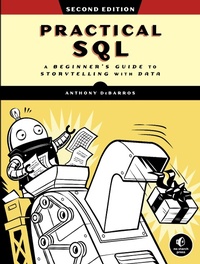
Practical SQL, 2nd Edition
A Beginner's Guide to Storytelling with Data
Published on 25. January 2022
427 pages
978-1-7185-0107-2 (ISBN)
Description

Second edition of the best-selling Practical SQL. An approachable guide to programming in SQL (Structured Query Language) that will teach even beginning programmers how to build powerful databases and analyze data to find meaningful information.
Practical SQL is an approachable and fast-paced guide to SQL (Structured Query Language) written by longtime professional journalist Anthony DeBarros. SQL is the primary tool that programmers, web developers, researchers, journalists, and others use to explore data in a database. DeBarros focuses on using SQL to find the story in data, with the aid of the popular open-source database PostgreSQL and the pgAdmin interface.
This thoroughly revised second edition includes a new chapter describing how to set up PostgreSQL and more extensive discussion of pgAdmin's best features. The author has also added a chapter on the JSON data format that shows readers how to store and query JSON data. DeBarros has also updated the data in the book throughout, added coverage of additional topics, and perfected the book's examples.
Readers love DeBarros's use of exercises and real-world examples that demonstrate how to:
• Create databases and related tables using your own data
• Correctly define data typesAggregate, sort, and filter data to find patterns
• Clean their data and transfer data as text files
• Create advanced queries and automate tasks
This book uses PostgreSQL, but the SQL syntax is applicable to many database applications, including Microsoft SQL Server and MySQL.
Practical SQL is an approachable and fast-paced guide to SQL (Structured Query Language) written by longtime professional journalist Anthony DeBarros. SQL is the primary tool that programmers, web developers, researchers, journalists, and others use to explore data in a database. DeBarros focuses on using SQL to find the story in data, with the aid of the popular open-source database PostgreSQL and the pgAdmin interface.
This thoroughly revised second edition includes a new chapter describing how to set up PostgreSQL and more extensive discussion of pgAdmin's best features. The author has also added a chapter on the JSON data format that shows readers how to store and query JSON data. DeBarros has also updated the data in the book throughout, added coverage of additional topics, and perfected the book's examples.
Readers love DeBarros's use of exercises and real-world examples that demonstrate how to:
• Create databases and related tables using your own data
• Correctly define data typesAggregate, sort, and filter data to find patterns
• Clean their data and transfer data as text files
• Create advanced queries and automate tasks
This book uses PostgreSQL, but the SQL syntax is applicable to many database applications, including Microsoft SQL Server and MySQL.
More details
Other editions
Additional editions
Book
01/2022
2nd Edition
No Starch Press
€37.50
Available immediately
Person
Anthony DeBarros is a longtime journalist who has combined his interests in data analysis, coding, software product development, and storytelling for much of his career. He is a data news editor for The Wall Street Journal, focusing on topics such as the economy, trade, the U.S. Census, and politics. He previously held positions with USA TODAY, the Poughkeepsie Journal, and the DocumentCloud project for Investigative Reporters and Editors. His work has received multiple honors, including a prestigious Silver Baton from the Alfred I. duPont-Columbia University Awards.
Content
Introduction
1. Setting up pgAdmin
2. Creating Your First Database and Table
3. Beginning Data Exploration with SELECT
4. Understanding Data Types
5. Importing and Exporting Data
6. Basic Math and Stats
7. Joining Tables in a Relational Database
8. Table Design that Works for You
9. Extracting Information by Grouping and Summarizing
10. Inspecting and Modifying Data
11. Statistical Functions in SQL
12. Working with Dates and Times
13. Advanced Query Techniques
14. Mining Text to Find Meaningful Data
15. Analyzing Spatial Data with PostGIS
16. Working with JSON Data
17. Saving Time with Views, Functions, and Triggers
18. Using PostgreSQL from the Command Line
19. Maintaining Your Database
20. Identifying and Telling the Story Behind Your Data
Appendix A. Additional Resources
1. Setting up pgAdmin
2. Creating Your First Database and Table
3. Beginning Data Exploration with SELECT
4. Understanding Data Types
5. Importing and Exporting Data
6. Basic Math and Stats
7. Joining Tables in a Relational Database
8. Table Design that Works for You
9. Extracting Information by Grouping and Summarizing
10. Inspecting and Modifying Data
11. Statistical Functions in SQL
12. Working with Dates and Times
13. Advanced Query Techniques
14. Mining Text to Find Meaningful Data
15. Analyzing Spatial Data with PostGIS
16. Working with JSON Data
17. Saving Time with Views, Functions, and Triggers
18. Using PostgreSQL from the Command Line
19. Maintaining Your Database
20. Identifying and Telling the Story Behind Your Data
Appendix A. Additional Resources
