

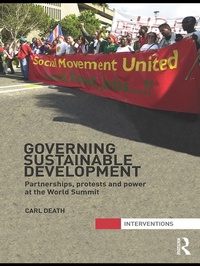
Governing Sustainable Development
Partnerships, Protests and Power at the World Summit
Published on 14. July 2010
208 pages
978-1-136-94111-5 (ISBN)
Description

Multilateral UN summits from Stockholm to Copenhagen have set the pace and direction for the global governance of sustainable development. The 2002 Johannesburg World Summit on Sustainable Development (WSSD) was a key moment in the evolution of sustainable development as a discourse and summitry as a technology of government. It firmly established multi-stakeholder partnerships, carbon-trading and communication strategies as primary techniques for dealing with environmental crises. It was also a significant event in terms of South African domestic politics, witnessing some of the largest protests since the end of Apartheid.
Carl Death draws on Foucauldian governmentality literature to argue that the Johannesburg Summit was a key site for the refashioning of sustainable development as advanced liberal government; for the emergence of an exemplary logic of rule; and for the mutually interdependent relationship between 'mega-events' (summits, world cups, Olympic games) and 'mega-protests' understood as Foucauldian counter-conducts.
Analysing detailed and original research on the WSSD, Death argues that summits work to make politically sustainable a global order which is manifestly unsustainable. Paradoxically however, they also provide opportunities for the status quo to be protested and resisted. This work will be of great interest to scholars of development studies, global governance and environmental politics.
Carl Death draws on Foucauldian governmentality literature to argue that the Johannesburg Summit was a key site for the refashioning of sustainable development as advanced liberal government; for the emergence of an exemplary logic of rule; and for the mutually interdependent relationship between 'mega-events' (summits, world cups, Olympic games) and 'mega-protests' understood as Foucauldian counter-conducts.
Analysing detailed and original research on the WSSD, Death argues that summits work to make politically sustainable a global order which is manifestly unsustainable. Paradoxically however, they also provide opportunities for the status quo to be protested and resisted. This work will be of great interest to scholars of development studies, global governance and environmental politics.
Reviews / Votes
Carl Death's innovative examination of power/knowledge relations in operation at the 2002 WSSD reveals fascinating insights into how different stakeholders 'performed' and used the summit for their own ends. It also provides a nuanced interrogation of the underlying discourses and processes of 'sustainable development'.Prof David Simon, Royal Holloway, University of London
In Governing Sustainable Development, Carl Death deftly explores how mega-summits, a staple of global environmental politics, cannot be dismissed as theatrical grandstanding, because it is precisely in their theatre that they (re)produce powerful political discourses that shape the world's responses to environmental change. As part of a growing Foucauldian literature on environmental politics, it is indispensable to understanding the role of mega-summits in global politics.
Matthew Paterson, University of Ottawa, Canada
"This is an exciting, new take on sustainable development. Too often dismissed in scholarly circles as mere rhetoric and empty slogans, this book lays bare the political effects of sustainable development, both globally and locally in South Africa. It is a major contribution to the emerging literature on global governmentality, highlighting not only the power of partnerships in contemporary environmental governance but also the possibilities of resistance. Incisive, engaging and timely, the book speaks directly to a wide range of audiences, including those interested in global governance, environment, development and South African politics."
Rita Abrahamsen, University of Ottawa, Canada
More details
Series
Language
English
Place of publication
London
United Kingdom
Publishing group
Taylor & Francis Ltd
Target group
College/higher education
Product notice
Reflowable
Illustrations
8 s/w Abbildungen, 8 s/w Photographien bzw. Rasterbilder
8 Halftones, black and white; 8 Illustrations, black and white
File size
2,47 MB
ISBN-13
978-1-136-94111-5 (9781136941115)
Copyright in bibliographic data and cover images is held by Nielsen Book Services Limited or by the publishers or by their respective licensors: all rights reserved.
Schweitzer Classification
Other editions
Additional editions
Book
09/2011
1st Edition
Routledge
€70.90
Shipment within 15-20 days
Book
07/2010
1st Edition
Routledge
€230.60
Shipment within 15-20 days
Person
Carl Death teaches environmental politics and African politics in the Department of International Politics, Aberystwyth University. His chief area of research is the governance and contestation of sustainable development in Southern Africa, and he has spent time conducting research at the University of the Witwatersrand, the University of KwaZulu-Natal, and Dublin City University in recent years.
Content
1. Introduction 2. Power, Discourse, Government 3. Producing Sustainable Development 4. Negotiating Sustainable Development 5. Performing Sustainable Development 6. Resisting Sustainable Development 7. Conclusion
