

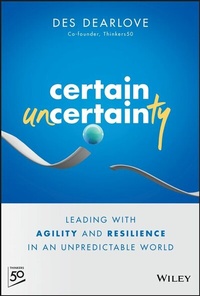
Certain Uncertainty
Description

In Certain Uncertainty, renowned management theorist Des Dearlove delivers an exciting and illuminating discussion of how to build resilience and agility into our lives and businesses. As rapid and foundational change becomes ever more constant, a state of constant disruption increasingly becomes our new normal. Certain Uncertainty collects advice and fresh thinking from accomplished business leaders to help managers and executives navigate contemporary markets.
In the book, you'll find:
* Ways to structure your business to better respond to constant fluidity and change
* Discussions of why the concepts of economic and social certainty were always largely illusory
* Strategies for embracing forward-looking humility that acknowledges uncertainty about what lies around the next corner
* Thought-provoking insights from leading business experts including Sheree Atcheson, Ori Brafman, Rom Brafman, Paul R. Carlile, Julie Carrier, Kirstin Ferguson, Nathan Furr, Susannah Harmon Furr, Amy Gallo, Matt Gitsham, Ruth Gotian, Mehran Gul, Diane Hamilton, Maja Korica, Marianne W. Lewis, David Liddle, Terence Mauri, Jennifer Moss, Gorick Ng, David Nour, Simone T.A. Phipps, Leon C. Prieto, Ben Pring, Megan Reitz, Wendy K. Smith, Lisa Kay Solomon, Modupe Taylor-Pearce, Tamsen Webster, Ben Whitter, Andrew Winston, and Kai D. Wright
An engaging and insightful exploration of a dynamic and ambiguous world that's increasingly full of surprises, Certain Uncertainty will earn a place on the bookshelves of business leaders, entrepreneurs, and visionaries seeking ways to adapt to a world in which sameness and certainty are relics of the past.
More details
Other editions
Additional editions
Person
Content
Introduction by Des Dearlove 1
I Future Thinking 5
1 Resilient, Net Positive Leadership 7
Andrew Winston
2 Leading Like a Futurist 15
Lisa Kay Solomon
3 The Privilege of Leadership: A Constant in an Uncertain World 23
Sheree Atcheson
4 Leading from the Future (Not the Past) 31
Terence Mauri
5 Toward Uncertainty Ability: Leading Self and Others to Possibility Beyond the Unknown 41
Nathan Furr and Susannah Harmon Furr
II Transformational Leadership 49
6 Leading with the Head and Heart: The Modern Leader Our World Needs Today 51
Kirstin Ferguson
7 The Nine Derailers of Strategy 59
Ben Pring
8 Radical Empathy: How to Craft Effective Communications About Change 71
Tamsen Webster
9 Leading Sustainability Transitions 77
Matt Gitsham
10 Navigating Paradoxes 85
Wendy K. Smith and Marianne W. Lewis
11 The WHY, WHAT, and HOW of Leadership 95
Paul R. Carlile
III Organizational Culture 101
12 Developing a Curious Culture at Work 103
Diane Hamilton
13 Is Your Company Alive? 109
Mehran Gul
14 Staying in the Know in Extraordinary Times 115
Maja Korica
15 Stop Quiet Quitting Your Life 123
Ori Brafman and Rom Brafman
16 Policy: The Path to Prevent Burnout 131
Jennifer Moss
IV Voices of Difference 139
17 Voices of Difference at Work 141
Megan Reitz
18 Want More Female Leaders? Develop Leadership When It Matters Most 149
Julie Carrier
19 Servant Leadership, Cooperative Advantage, and Social Sustainability 159
Leon C. Prieto and Simone T.A. Phipps
20 Leaders Talk Less and Speak Last 167
Modupe Taylor- Pearce
V Talent Magnets 175
21 Deciding Whom to Promote: Beware of "DEIB Debt" 177
Gorick Ng
22 Justice at Work 183
David Liddle
23 Personal Branding in a Creator Economy 191
Kai D. Wright
24 The Need for High Achievers in the Era of Uncertainty 207
Ruth Gotian
VI Relationships@work 215
25 Curve Benders: Quality vs. Quantity of Strategic Relationships in the Future of Work 217
David Nour
26 Navigating Ambivalence in Our Professional Relationships 225
Amy Gallo
27 How Leaders Can Help Employees Face Uncertainty 233
Ben Whitter
About the Editor 241
Acknowledgments 243
Index 245
1
Resilient, Net Positive Leadership
Andrew Winston
It was the missing toilet paper that shook the world. The empty shelves that used to overflow with basic necessities finally woke us up to a harsh reality: our economy and our supply chains are fragile. The lack of resilience in the system created massive product losses and waste.
Supply chains are still a mess, in large part because they're not flexible. We built an economy that values efficiency above all, with limited redundancy or back-ups. That certainly keeps costs down and pleases shareholder value purists, but it's completely unfit for a volatile world. The pandemic was (we hope) a once-in-a-century phenomenon, but clearly the world is more uncertain than ever. Sudden shocks to the system are the norm. The only real way to prepare and lead is to build resilient organizations, communities, and economies.
At all scales, from companies to sectors to economies, leaders will need to change how they think about business. With a resilience lens--and I'll argue a sustainability lens as well-a company can greatly increase the odds of surviving, doing better than its peers in the face of deep change, and bouncing back faster from disruptions. From my work and observations of companies (and people) under stress, it seems that resilience is built on three fundamental pillars: (1) diversity and redundancy; (2) strong networks (i.e., friends you can trust); and (3) purpose or mission.
Before diving into those three areas, it's useful to look at the nature of today's volatility-that is, why are things so uncertain? It's a time when the only thing that's certain is uncertainty. We are in what the US military has called a "VUCA" world (volatile, uncertain, complex, and ambiguous). Others might call it anarchy. It's also an era of exponential change, which is a challenge for we mortals who think in linear terms and at scales we can get our heads round (go ahead, create a mental picture of a trillion of anything).
Extraordinary forces are rocking the world, but three disruptions in particular-each tied to our greatest challenges-are driving unprecedented uncertainty: (1) biophysical collapse; (2) declining democracy and the breakdown of trust; and (3) rapid technological change.
"Biophysical" means the planet's species and resources which we utterly depend on; not just things we dig up, grow, or cut down, but also fundamental resources such as clean air and water and a relatively stable climate. Climate change and loss of biodiversity are the two greatest challenges we face. Extreme weather, which will accelerate until the world eliminates carbon emissions, is disrupting lives, communities, supply chains, and economies. And as species die off, we risk the collapse of the ecosystems and food pyramids that support our existence.
Second, democracy is in decline all over the world. There are clearly many causes, but the rise of inequality is a key driver. In the developed world, effectively all of the gains in income and wealth over the last 40 years has gone to the top 1% and even the top 0.1%. A 50-year experiment in neoliberal economics and obsession with shareholder value have created rapid growth and helped reduce the percentage in abject poverty. But it has left the middle behind. When people feel unheard or ignored, they become attracted to leaders who say, "I haven't forgotten you and I'll work for you-give me the power to fix it all." Unfortunately, those leaders are most often autocrats, demagogues, and narcissists who rarely care at all about the masses.
Finally, exponential technological capacity, and the "who really knows what will happen" potential of artificial intelligence (AI), create both radical opportunities and destabilizing risks. The algorithm-led misinformation campaigns feed the other disruptions, giving people reasons to doubt climate change or to fear change and hate the "other." Misinformation is breaking down trust, without which the world can hardly work on shared challenges. On the upside, technology can help solve our biggest problems. We are on the verge of massive improvements in the efficiency of buildings, transportation and logistics, manufacturing, food production, and waste reduction, and much more.
With this level of change and instability on multiple fronts, it's little wonder that piling on things like pandemics and the first war in Europe in 80 years can overload the system and leaders' ability to process and act. How can a leader help ensure near- or long-term success in the face of such unpredictability? Surely, building resilience is at the core. Resilience, most simply, means the ability to survive large swings in fortunes in any one part of a system (think portfolio theory in investments that has generally outperformed every other strategy), plus greater odds of bouncing back quicker than others, perhaps even stronger than before.
So back to the three fundamental pillars of resilience. Let's look at what they mean in today's world.
Diversity and Redundancy
It's a bad idea to have no back-up for things that are valuable-in essence, don't put all your eggs in one basket. Nassim Taleb, a leading thinker on risk, makes the case in his book, Anti-Fragile1 that nature loves redundancies. Humans, he points out, have two of each of the body's critical systems (eyes, ears, lungs, kidneys, arms, and legs). That redundancy creates much more resilience.
Our economic systems are anything but resilient. The pandemic created a great irony when the world was short on medical equipment (or PPE). One of the largest producers of masks was in Wuhan, China, and major manufacturers of nasal swabs were based in Lombardy, Italy-the two regions that were first overwhelmed by Covid and were shut down. From a purely economic perspective, with efficiency (and pleasing investors) at the core of all decisions, it makes sense to produce something in vast quantities in one place; the larger the scale, the lower the per unit cost. That keeps costs low . until that one place can't operate because everyone is sent home, or it's literally under water-in 2011, floods in Thailand shut down what was effectively the only source of key parts for hard drives and engines for major automakers. Extreme weather conditions like that are only increasing.
The pandemic exposed many flaws in our system. Even products that seemed to have diverse channels really didn't. Dairy farmers who produced milk for hotels, schools, and other institutions had to dump millions of gallons-they couldn't repurpose production and packaging to shift from bulk to gallon-scale offerings for supermarkets and homes.
Redundancy avoids those problems. But is there a catch? Is there a tension between the diversity that creates resilience and other goals, such as the overall reduction in material use and carbon emissions we desperately need to fight climate change, i.e., isn't it wasteful to have duplication? Maybe. It depends on what the redundancy protects against. In a famous example, after the Exxon Valdez oil spill in 1989, double hulls became the norm in the oil tanker world. More metal and expense, but it protects against vast environmental damage and wasted fuel.
Stepping further out, if we think about systems, diversity of all kinds offers strength and reduced total footprint. Having alternative pathways in a supply chain, for example, could make it less disruptive when one channel goes down. If you only have the one supply chain, rushing production elsewhere could produce material waste. Or consider some societal systems. In a city's metro area, having multiple ways to get around-cars, subway, bus, light rail-creates a lot of material production, but it can also greatly reduce emissions by giving people options besides their cars. Similarly, high speed rail can offset short plane journeys.
Finally, on the human side of the sustainability agenda, the case for diversity is more literal and clearer every day. A growing body of evidence2 shows the vast business benefits of commitment to and action on diversity, equity, and inclusion (DEI). We've been talking about organizational level of resilience, but these principles apply on the personal leadership level too. As a leader or manager, it pays to bring in multiple voices with a range of perspectives by race, gender, abilities, and especially age. Listen to younger people who have a longer stake in where the world is heading.
Networks of Support
Modern economics and political systems have been based on some fairly egregious misreading of influential works. Adam Smith, for example, talked about the invisible hand much less than people realize, and when he did, it was in the service of equal distribution of resources, not hands off wealth accumulation. Similarly, Charles Darwin did not coin the phrase "survival of the fittest." His work pointed to the power of being adaptable (yes, resilient). In the intervening century and a half, the understanding of how nature works has shown something quite the opposite of the dog-eat-dog philosophy so many misread into Darwin.
Forests are not filled with individual trees competing for sunlight, but a much more nuanced dance and cooperation, facilitated by vast, incredibly complex networks of fungi connecting them...
