

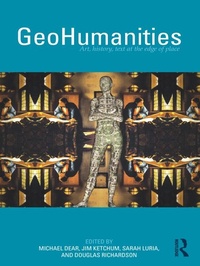
GeoHumanities
Art, History, Text at the Edge of Place
1st Edition
Published on 14. April 2011
344 pages
978-1-136-88347-7 (ISBN)
Description

In the past decade, there has been a convergence of transdisciplinary thought characterized by geography's engagement with the humanities, and the humanities' integration of place and the tools of geography into its studies.
GeoHumanities maps this emerging intellectual terrain with thirty cutting edge contributions from internationally renowned scholars, architects, artists, activists, and scientists. This book explores the humanities' rapidly expanding engagement with geography, and the multi-methodological inquiries that analyze the meanings of place, and then reconstructs those meanings to provoke new knowledge as well as the possibility of altered political practices. It is no coincidence that the geohumanities are forcefully emerging at a time of immense intellectual and social change. This book focuses on a range of topics to address urgent contemporary imperatives, such as the link between creativity and place; altered practices of spatial literacy; the increasing complexity of visual representation in art, culture, and science and the ubiquitous presence of geospatial technologies in the Information Age.
GeoHumanties is essential reading for students wishing to understand the intellectual trends and forces driving scholarship and research at the intersections of geography and the humanities disciplines. These trends hold far-reaching implications for future work in these disciplines, and for understanding the changes gripping our societies and our globalizing world.
GeoHumanities maps this emerging intellectual terrain with thirty cutting edge contributions from internationally renowned scholars, architects, artists, activists, and scientists. This book explores the humanities' rapidly expanding engagement with geography, and the multi-methodological inquiries that analyze the meanings of place, and then reconstructs those meanings to provoke new knowledge as well as the possibility of altered political practices. It is no coincidence that the geohumanities are forcefully emerging at a time of immense intellectual and social change. This book focuses on a range of topics to address urgent contemporary imperatives, such as the link between creativity and place; altered practices of spatial literacy; the increasing complexity of visual representation in art, culture, and science and the ubiquitous presence of geospatial technologies in the Information Age.
GeoHumanties is essential reading for students wishing to understand the intellectual trends and forces driving scholarship and research at the intersections of geography and the humanities disciplines. These trends hold far-reaching implications for future work in these disciplines, and for understanding the changes gripping our societies and our globalizing world.
Reviews / Votes
"This volume stands at the forefront of one of the most exciting new fields of cross-disciplinary work. The editors have assembled a spectacular array of original contributions from an impressive group of authors, whose work opens new routes into the emerging field known as the geohumanities. It is bound to become a landmark book." Anthony J. Cascardi, Director, Townsend Center for the Humanities, U.C. Berkeley, USA."Making a compelling case for re-aligning geography with the humanities, GeoHumanities provides a series of richly-interwoven textual, visual and cartographic essays to demonstrate the creative potential of new forms of artistic, literary and historical engagement with place. Issuing a challenge to transcend disciplinary boundaries, to forge novel connections between past and present, and to re-imagine the world in novel ways, the contributors to GeoHumanities invite us to explore afresh the politics and poetics of place." Professor Peter Jackson, University of Sheffield, UK.
"The case studies chosen for the volume have much in common: they are contemporary projects that can elicit potential interdisciplinary interaction... Many can be contextualized through use of its companion volume Envisioning Landscapes. Together, both volumes forge a new era for geographic, cultural, urban, and regional studies." - Harvey K. Flad, Journal of Regional Science
More details
Language
English
Place of publication
London
United Kingdom
Publishing group
Taylor & Francis Ltd
Target group
College/higher education
Product notice
Reflowable
Illustrations
15 farbige Abbildungen, 29 s/w Photographien bzw. Rasterbilder, 25 Farbfotos bzw. farbige Rasterbilder, 12 farbige Zeichnungen
12 Line drawings, color; 25 Halftones, color; 29 Halftones, black and white; 15 Illustrations, color
File size
47,60 MB
ISBN-13
978-1-136-88347-7 (9781136883477)
Copyright in bibliographic data and cover images is held by Nielsen Book Services Limited or by the publishers or by their respective licensors: all rights reserved.
Schweitzer Classification
Other editions
Additional editions
Book
04/2011
1st Edition
Routledge
€215.41
Shipment within 15-20 days
Book
04/2011
1st Edition
Routledge
€111.90
Shipment within 15-20 days
Persons
Michael Dear is Professor of City and Regional Planning at the University of California Berkeley. His interests are in comparative urbanism and the US-Mexico borderlands. Recent publications include: Urban Latino Cultures; la vida latina en L.A., The Postmodern Urban Condition, and Postborder City: cultural spaces of Bajalta California.
Jim Ketchum is special projects coordinator and newsletter editor for the Association of American Geographers in Washington, D.C. A cultural geographer with interests in contemporary art and visual culture, his research examines the ways that artists use geographic perspectives and technologies in responding to war. He received his PhD from Syracuse University in 2005.
Sarah Luria is Associate Professor of English at College of the Holy Cross in Worcester, Massachusetts. She is the author of Capital Speculations: Writing and Building Washington, D.C. (University of New Hampshire Press, 2006). Her current book project is a study of land surveying and property making in the work of Thomas Jefferson, Henry David Thoreau, and Robert Moses.
Doug Richardson is Executive Director of the Association of American Geographers (AAG). He previously founded and was President of the firm GeoResearch, Inc., which invented, developed, and patented the first interactive GPS/GIS (global positioning system/geographic information system) technology, leading to major advances in the ways geographic information is collected, mapped, integrated, and used within geography and in society at large. He has worked closely with American Indian tribes for over twenty years on cultural and ecological issues, and is the Project Director of the AAG's National Endowment for the Humanities funded Historical GIS Clearinghouse and Online Research Forum.
Jim Ketchum is special projects coordinator and newsletter editor for the Association of American Geographers in Washington, D.C. A cultural geographer with interests in contemporary art and visual culture, his research examines the ways that artists use geographic perspectives and technologies in responding to war. He received his PhD from Syracuse University in 2005.
Sarah Luria is Associate Professor of English at College of the Holy Cross in Worcester, Massachusetts. She is the author of Capital Speculations: Writing and Building Washington, D.C. (University of New Hampshire Press, 2006). Her current book project is a study of land surveying and property making in the work of Thomas Jefferson, Henry David Thoreau, and Robert Moses.
Doug Richardson is Executive Director of the Association of American Geographers (AAG). He previously founded and was President of the firm GeoResearch, Inc., which invented, developed, and patented the first interactive GPS/GIS (global positioning system/geographic information system) technology, leading to major advances in the ways geographic information is collected, mapped, integrated, and used within geography and in society at large. He has worked closely with American Indian tribes for over twenty years on cultural and ecological issues, and is the Project Director of the AAG's National Endowment for the Humanities funded Historical GIS Clearinghouse and Online Research Forum.
Content
Introduction Part 1: Creative Places Geocreativity 1. Creativity and Place 2. Experimental Geography: a conversation with Trevor Paglen 3. Drive-by Tijuana 4. (Fake) Fake Estates: Reconsidering Gordon Matta-Clark's Fake Estates 5. The City Formerly Known as Cambridge: a Useless Map by the Institute for Infinitely Small Things 6. Undisciplined Geography: Notes from the Field of Contemporary Art 7. Codex Profundo Part 2: Spatial Literacies Geotexts 8. 'The Stratified Record upon which we Set our Feet': The Spatial Turn and the Multilayering of History, Geography, and Geology 9. Monument of Myth: Finding Robert Moses through Geographic Fiction 10. Fate and Redemption in New Orleans; Or, Why Geographers Should Care about Narrative Form 11. Wordmaps 12. Using Early Modern Maps in Literary Studies: Views and Caveats from London 13. "Along Broadway, 2009" 14. Thoreau's Geopoetics Part 3: Visual Geographies Geoimagery 15. El otro Lado de la Linea / The other side of the line 16. The Space of Ambiguity: Sophie Ristelhueber's Aerial Perspective 17. Counter-Geographies in the Sahara 18. Laura Kurgan, September 11th, and the Art of Critical Geography 19. The Earth Exposed: How Geographers use Art & Science in their Exploration of the Earth from Space 20. Disorientation Guide: Cartography as Artistic Medium 21. Avarice and Tenderness in Cinematic Landscapes of the American West 22. Altered Landscapes Philip Govedare Part 4: Spatial Histories Geohistories 23. Mapping Time 24. Humanities GIS: Place, Spatial Storytelling and Immersive Visualization in the Humanities 25. Without Limits: Ancient History & GIS 26. History and GIS: Railways, Population Change, and Agricultural Development in Late Nineteenth Century Wales 27. Spatiality and the Social Web: Resituating Authoritative Content 28. Teaching Race and History with Historical GIS: Lessons from Mapping the Dubois Philadelphia Negro 29. Ha'ahonua: Using GIScience to Link Hawaiian and Western Knowledge about the Environment 30. What Do Humanists Want? What Do Humanists Need? What Might Humanists Get? Afterword: Historical Moments in the Rise of the Geohumanities
