

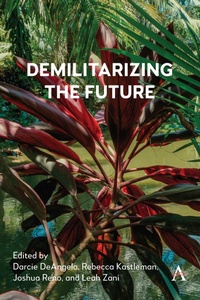
Demilitarizing the Future
1st Edition
Published on 11. November 2025
230 pages
978-1-83999-341-1 (ISBN)
Description

Demilitarizing the Future draws from art, anthropology, and activism to investigate the entrenchment of militarism in everyday lives and to consider novel imaginaries of its dissolution. The pieces collected in this anthology track across military training camps in the United States, the tenements of Palestine, and other sites in the global networks of warfare and military preparedness to consider the pathways by which more equitable futures might be envisioned and sustained. Representing fields from anthropology to poetry and from literary studies to community organizing, the authors together weave a multidisciplinary collection of creative scholarship. Rather than presuming that the aftermath of war requires the reimposition of new military infrastructures, the collection speaks to the socially and artistically generative potentialities of military waste infrastructures as well as their enduring toxicities. Militarism and preparedness for war undergirds the infrastructure and design of everyday lives across the globe and its satellites, but the processes of demilitarization offer their own affordances. Within this collection, the authors broaden our understanding of militarization to examine its excesses and their repurposing toward demilitarized futures.
Reviews / Votes
New Books Network "What futures do people conjure and endure in worlds shattered by war and its many aftermaths? The essays in this essential volume exemplify a critical approach to demilitarization-grounding the reader in the material realities of violence while remaining perceptive to political possibilities that resonate across bodies, landscapes, and memories." - Eleana Kim, Professor of Anthropology and Asian American Studies, University of California, Irvine, and author of Making Peace with Nature: Ecological Encounters along the Korean DMZ"Militarism is multiple, alternatively spectacular and mundane, embodied and ecological. Ranging from essays to poetry to speculative script, the pieces in this volume span Palestine to Peru, Afghanistan to America, Vietnam to Cambodia to Iraq, attesting to the plural spaces and times of demilitarization. A must-read for those committed to demilitarized futures!" - Evyn Le Espiritu Gandhi, author of Archipelago of Resettlement: Vietnamese Refugee Settlers and Decolonization across Guam and Israel-Palestine
"An engaging, genre-crossing collection that illuminates how war's legacies haunt and remake our everyday worlds. The powerful essays outline the basis for demilitarizing our bodies, homes, art forms, and landscapes. Original, powerful, and deeply moving. Essential reading for anyone interested in envisioning a post-militarized Earth." - Ken MacLean, Professor at The Strassler Center for Holocaust and Genocide Studies, Clark University, USA
"Combining powerful storytelling with poetry and photography, this timely collection unravels the lingering effects of militarism that percolate into the most intimate domains of life, bodies, and environments. In an era of accelerated planetary arms races, we urgently need to ask what it would take to demilitarize the future. This volume is an important stepping-stone toward doing that." -David Henig, Associate Professor, Department of Cultural Anthropology, Utrecht University
"Demilitarizing the Future presents an innovative approach to deconstructing/reimagining/reinterpreting our wholly militarized world. It presents a new way of seeing (or unseeing) what we somehow take for granted or leave to military specialists (war makers) and post-conflict experts (peace makers/builders) to interpret and 'deal with' for us. While there are many scholars who bring a critical lens to particular aspects of demilitarization, it seems to me that there are no collections like this one." -Larry Swatuk, Professor Emeritus, University of Waterloo, ON, Canada
More details
Series
Language
English
Place of publication
London
United Kingdom
Target group
Professional and scholarly
US School Grade: College Graduate Student
Edition type
Digital original
File size
3,49 MB
ISBN-13
978-1-83999-341-1 (9781839993411)
Copyright in bibliographic data and cover images is held by Nielsen Book Services Limited or by the publishers or by their respective licensors: all rights reserved.
Schweitzer Classification
Other editions
Additional editions
Darcie Deangelo | Rebecca Kastleman | Joshua Reno
Demilitarizing the Future
Book
11/2025
Anthem Press
€126.20
Shipment within 3-4 weeks
Persons
Darcie DeAngelo is an Assistant Professor of Anthropology at the University of Alberta in Canada. As an environmental and medical anthropologist trained in visual methods, her work engages with human-nonhuman relations such as the love between landmine detection rats and their handlers, the excitement of dogs and humans as they hunt for rats in cities, and the kinship of humans and their sourdough starters.
Rebecca Kastleman is Assistant Professor of English and Comparative Literature at Columbia University. Her research focuses on modern drama, theater, and performance and its intersections with social thought.
Joshua O Reno is Professor of Anthropology at Binghamton University. He is the author of several books on subjects ranging from waste management, the military industrial complex, and White supremacy in the United States, to disability and non-verbal communication.
Leah Zani is a public anthropologist based in Oakland, California. She is the author of several books and articles that investigate the social impact of explosives.
Rebecca Kastleman is Assistant Professor of English and Comparative Literature at Columbia University. Her research focuses on modern drama, theater, and performance and its intersections with social thought.
Joshua O Reno is Professor of Anthropology at Binghamton University. He is the author of several books on subjects ranging from waste management, the military industrial complex, and White supremacy in the United States, to disability and non-verbal communication.
Leah Zani is a public anthropologist based in Oakland, California. She is the author of several books and articles that investigate the social impact of explosives.
Content
Contents; Figures; Acknowledgment; Preface: More Than One Future; Darcie DeAngelo-Rebecca Kastleman, Joshua Reno, and Leah Zani; Occupied Sleep: Notes on Ambient Ecologies of Rest in War-Sophia Stamatopoulou-Robbins; Deadly Infrastructure: Veteran Narratives of the Toxicity of Warfare in Iraq and Afghanistan-Peter C. Little, Joshua Reno, Jennifer Sare, and Chelsey Simoni; ??t Nu?c: On the Metabolic Entanglements of Life and Death- Boone Nguyen; Witnessing the Upheavals of Democracy in Peru-Alonso Gamarra and Luis Javier Maguina; Bathed in Sunlight-Darcie DeAngelo; A Walking Tour of the Dynamite District-Leah Zani; Fifty Empty Verbs: A Speculative Performance for the Big Hole-Rebecca Kastleman; Lives and Afterlives of Military Technologies-Nomi Stone
