

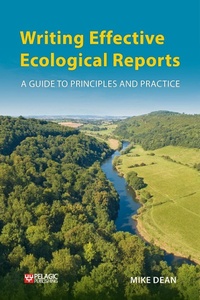
Writing Effective Ecological Reports
A Guide to Principles and Practice
Published on 4. January 2021
228 pages
978-1-78427-242-5 (ISBN)
Description

An in-depth guide to writing high-quality and effective professional ecological reports. Mike Dean distils the knowledge and experience gained over a period of more than 20 years working as an ecological consultant, during which time he has written and reviewed many such reports.
There are existing good practice guidelines on ecological report writing, published by CIEEM and co-authored by the author of this book. Writing Effective Ecological Reports goes beyond those guidelines. It provides practical advice on the structure, content and style of ecological reports, using numerous case study examples to help the reader's understanding. It also tackles topics not covered by the guidelines, such as how to write an effective summary, how to create and use a report template, how to proofread reports, and what those tasked with reviewing reports should be looking for.
This book will be invaluable for any professional ecologist, or anyone hoping to become a professional ecologist. It is particularly aimed at those who write ecological reports, such as ecological consultants. However, it also provides practical advice for those tasked with reading and reviewing reports written by others, including those working for local planning authorities or nature conservation consultees.
The book has been written to be useful to those with limited experience, such as recent graduates, as well as those with many years of experience as a professional ecologist, and everyone in the middle.
There are existing good practice guidelines on ecological report writing, published by CIEEM and co-authored by the author of this book. Writing Effective Ecological Reports goes beyond those guidelines. It provides practical advice on the structure, content and style of ecological reports, using numerous case study examples to help the reader's understanding. It also tackles topics not covered by the guidelines, such as how to write an effective summary, how to create and use a report template, how to proofread reports, and what those tasked with reviewing reports should be looking for.
This book will be invaluable for any professional ecologist, or anyone hoping to become a professional ecologist. It is particularly aimed at those who write ecological reports, such as ecological consultants. However, it also provides practical advice for those tasked with reading and reviewing reports written by others, including those working for local planning authorities or nature conservation consultees.
The book has been written to be useful to those with limited experience, such as recent graduates, as well as those with many years of experience as a professional ecologist, and everyone in the middle.
Reviews / Votes
This is a useful guide particularly for those with limited experience, such as recent graduates, but also for those who write or review ecological reports in their profession, including ecological consultants and individuals working for local planning authorities. * Conservation Land Management * Anyone producing or reviewing reports within the ecology sector, at whatever level, would benefit from reading this book. In short - not 'preferential', but 'essential' for anyone involved with reports within our sector. -- Neil Middleton, author of The Effective Ecologist The author, undoubtedly a skilled writer with a lucid mind, describes how one can produce quality ecological reports with proper style, structure, and contents...It should be on the bookshelf of every ecologist or anyone who wishes to write effective ecological reports. -- Som B. Ale * The Quarterly Review of Biology *More details
Language
English
Place of publication
Exeter
United Kingdom
Target group
Professional and scholarly
Illustrations
7 s/w Tabellen
7 Tables, black and white
ISBN-13
978-1-78427-242-5 (9781784272425)
Copyright in bibliographic data and cover images is held by Nielsen Book Services Limited or by the publishers or by their respective licensors: all rights reserved.
Schweitzer Classification
Other editions
Additional editions
Book
01/2021
Pelagic Publishing
€47.30
Shipment within 10-15 days
Person
Mike Dean has worked as an ecological consultant since 1997, with roles in varying size consultancies from the very small (one or two staff members) to the very large multi-disciplinary consultancy, and a few in between. He's undertaken ecological surveys and produced ecological reports of all different types and sizes. In 2013 he joined the Chartered Institute of Ecology and Environmental Management's (CIEEM) Professional Standards Committee, tasked with producing guidelines on, amongst other things, ecological report writing. He has been delivering training on report writing for CIEEM since 2015.
Content
Introduction
Competence, qualifications and experience
Getting the basics right
Fact versus opinion
Report structure
Making a start
First impressions and opening lines
Getting your facts right
So what does all this mean?
Keeping it in proportion
Tables, figures, photos and appendices
Creating and using a template
Writing an effective Summary
PEA or EcIA - what's the difference?
Writing Environmental Statement chapters
Proofreading, technical review and quality assurance
Tips for those reviewing reports
Dealing with references
How long is a report valid for?
Useful sources of information
Competence, qualifications and experience
Getting the basics right
Fact versus opinion
Report structure
Making a start
First impressions and opening lines
Getting your facts right
So what does all this mean?
Keeping it in proportion
Tables, figures, photos and appendices
Creating and using a template
Writing an effective Summary
PEA or EcIA - what's the difference?
Writing Environmental Statement chapters
Proofreading, technical review and quality assurance
Tips for those reviewing reports
Dealing with references
How long is a report valid for?
Useful sources of information
