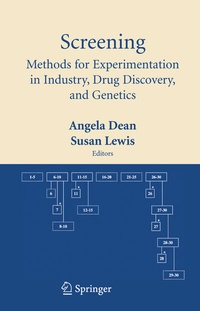
Screening
Description

The process of discovery in science and technology may require investigation of a large number of features, such as factors, genes or molecules. In Screening, statistically designed experiments and analyses of the resulting data sets are used to identify efficiently the few features that determine key properties of the system under study.
This book brings together accounts by leading international experts that are essential reading for those working in fields such as industrial quality improvement, engineering research and development, genetic and medical screening, drug discovery, and computer simulation of manufacturing systems or economic models. Our aim is to promote cross-fertilization of ideas and methods through detailed explanations, a variety of examples and extensive references.
Topics cover both physical and computer simulated experiments. They include screening methods for detecting factors that affect the value of a response or its variability, and for choosing between various different response models. Screening for disease in blood samples, for genes linked to a disease and for new compounds in the search for effective drugs are also described. Statistical techniques include Bayesian and frequentist methods of data analysis, algorithmic methods for both the design and analysis of experiments, and the construction of fractional factorial designs and orthogonal arrays.
The material is accessible to graduate and research statisticians, and to engineers and chemists with a working knowledge of statistical ideas and techniques. It will be of interest to practitioners and researchers who wish to learn about useful methodologies from within their own area as well as methodologies that can be translated from one area to another.
Reviews / Votes
From the reviews:
"This is an excellent aggregation of fourteen papers about screening, covering general areas. It includes recent work and provides first class summaries of various topics. The fourteen chapters have about twenty-two pages of references between them, helping the reader to delve further as needed. It is definitely an excellent library selection . ." (N. R. Draper, Short Book Reviews, Vol. 26 (2), 2006)
"The book provides a comprehensive and accessible overview of historical and modern screening approaches, including design generation strategies, analysis methods, visualization techniques, and gives many examples to illustrate the theory developed. ...The book is an important summary of the work of key researchers in this area and will be a valuable addition to the reference shelf of practioners and researchers alike." (Christine M. Anderson-Cook, Journal of the American Statistical Association, Vol. 102, No. 477, 2007)
"Due to the nontechnical nautre of most of the chapters, this book is a great place for interested readers to start learning about the subject of screening experiments. Each chapter is concluded with a listing of references, so that finding follow-up reading is easy. I can genuinely recommend this book to statisticians of all levels and to numerically minded practitioners. I would especially suggest the book to any graduate student embarking on a research program on some topic related to screening experiments." (Editor, Biometrics, December 2006)
More details
Other editions
Additional editions