

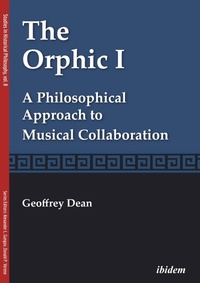
The Orphic I
A Philosophical Approach to Musical Collaboration
Published on 13. November 2023
156 pages
978-3-8382-7629-8 (ISBN)
Description

The Orphic I: A Philosophical Approach to Musical Collaboration starts from the premise that music is a realm of intersubjective human experience. Drawing on ideas common to both hermeneutic and pragmatic aesthetics, it examines forms of collaboration involving those who create, perform, and listen to music. A new interpretation of the Orpheus myth suggests a model for thinking about creative interactions where composer and performer adopt each other's perspectives. This imaginative transfer of self-the Orphic I-has significant implications, both for the listener's perception of authenticity in musical performance, and for the interactions of performers within a musical ensemble. Empathy and entrainment emerge as seminal animating forces in group music-making, providing a non-verbal basis for ethical decision-making among group members. The originality of The Orphic I is due in part to its truly unique, first-person illustrations of the theoretical theses. But Dean's real innovation is in the specificity of his philosophical approach. His book is a clear example of the applicability of philosophical knowledge, of how ideas that too often remain solely in the realm of academic discourse can actually "work" in the discussion of cultural phenomena. -Dr Pravda Spasova,Professor of Philosophy, National Art Academy, Sofia
More details
Series
Edition
New edition
Language
English
Place of publication
Hannover
Germany
Target group
Professional and scholarly
Edition type
New edition
Illustrations
Illustrations
File size
3,02 MB
ISBN-13
978-3-8382-7629-8 (9783838276298)
Copyright in bibliographic data and cover images is held by Nielsen Book Services Limited or by the publishers or by their respective licensors: all rights reserved.
Schweitzer Classification
Other editions
Additional editions
Book
11/2023
ibidem
€24.90
Shipment within 10-15 days
Persons
Geoffrey Dean, PhD, served on the music faculty of the American University in Bulgaria for over twenty years. He has performed internationally as a chamber musician and recitalist and premiered many new works at his AmBul Festival of American and Bulgarian Music. His articles have appeared in the Sofia Philosophical Review, Bulgarian Musicology, and Strings Magazine, and his transcriptions have been heard around the world. Now living in Minneapolis, he leads the orchestra program at Parnassus Preparatory School, a leading US institution for classical education.
Content
- Intro
- Preface
- Part I: An Aesthetics of Social Awareness and Participation
- Chapter 1 Heidegger and Hegel: Art as the Happening of Truth
- On the History of Philosophy
- Aletheia and the Nature of Truth
- The Work of Art as Illuminating Projection
- Reclaiming the Happening of Truth
- Chapter 2 Dewey and Gadamer: Art as Community of Experience
- Two Anti-Foundational Approaches to Aesthetics
- The Post-Philosophical Debate
- Reunifying Art and Experience
- The Work of Art as Expressive Object and as Symbol
- Part II: Orphic Intersubjectivity
- Chapter 3 The Performer as Co-Composer: "Hearing As" and the Creative Orphic "I"
- Orpheus, Inspired Poet-Musician of Antiquity
- Ricoeurian Implications of the Orpheus Myth
- Lazar Nikolov, A Modern-Day Orpheus
- Creative Orphic Intersubjectivity
- Chapter 4 Consensual Empathic Manipulation: Listener-Performer Identification and the Interpretative Orphic "I"
- Philosophical and Psychological Theories of Empathy
- Perceived Authenticity in Music
- Interpretative Orphic Intersubjectivity
- Part III: Ensemble Ethics
- Chapter 5 Cultural Values in Music: Control and Conversation in String Quartet Playing
- Play, Festival, and Musicking
- Communitarian Conceptions of Musical Utopia
- Core Values in String Quartet Performance Traditions
- Quartet Playing Styles of the Dimov and Sofia Quartets
- Chapter 6 The Ethics of Entrainment: Music-Making and Habermasian Practical Discourse
- Habermas' Unity of Reason and Discourse Ethics
- The Care-Free Empathy of Mutual Perspective-taking
- The Music-Making Situation as an Ethical Model
- Prosocial Interaction in Music Improvisation Projects
- Bibliography
- Index
