

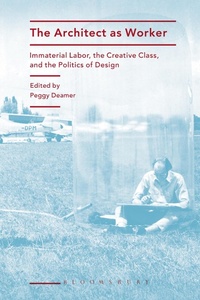
The Architect as Worker
Immaterial Labor, the Creative Class, and the Politics of Design
1st Edition
Published on 30. July 2015
256 pages
978-1-4725-7052-9 (ISBN)
Description

Directly confronting the nature of contemporary architectural work, this book is the first to address a void at the heart of architectural discourse and thinking. For too long, architects have avoided questioning how the central aspects of architectural "practice" (professionalism, profit, technology, design, craft, and building) combine to characterize the work performed in the architectural office. Nor has there been a deeper evaluation of the unspoken and historically-determined myths that assign cultural, symbolic, and economic value to architectural labor.
The Architect as Worker presents a range of essays exploring the issues central to architectural labor. These include questions about the nature of design work; immaterial and creative labor and how it gets categorized, spatialized, and monetized within architecture; the connection between parametrics and BIM and labor; theories of architectural work; architectural design as a cultural and economic condition; entrepreneurialism; and the possibility of ethical and rewarding architectural practice.
The book is a call-to-arms, and its ultimate goal is to change the practice of architecture. It will strike a chord with architects, who will recognize the struggle of their profession; with students trying to understand the connections between work, value, and creative pleasure; and with academics and cultural theorists seeking to understand what grounds the discipline.
The Architect as Worker presents a range of essays exploring the issues central to architectural labor. These include questions about the nature of design work; immaterial and creative labor and how it gets categorized, spatialized, and monetized within architecture; the connection between parametrics and BIM and labor; theories of architectural work; architectural design as a cultural and economic condition; entrepreneurialism; and the possibility of ethical and rewarding architectural practice.
The book is a call-to-arms, and its ultimate goal is to change the practice of architecture. It will strike a chord with architects, who will recognize the struggle of their profession; with students trying to understand the connections between work, value, and creative pleasure; and with academics and cultural theorists seeking to understand what grounds the discipline.
More details
Edition
1. Auflage
Language
English
Place of publication
London
United Kingdom
Publishing group
Bloomsbury Publishing PLC
Target group
Professional and scholarly
College/higher education
Illustrations
16 halftones
ISBN-13
978-1-4725-7052-9 (9781472570529)
Copyright in bibliographic data and cover images is held by Nielsen Book Services Limited or by the publishers or by their respective licensors: all rights reserved.
Schweitzer Classification
Other editions
Additional editions
Peggy Deamer
The Architect as Worker
Immaterial Labor, the Creative Class, and the Politics of Design
Book
02/2023
Bloomsbury Visual Arts
€36.50
Shipment within 15-20 days
Peggy Deamer
The Architect as Worker
Immaterial Labor, the Creative Class, and the Politics of Design
Book
07/2015
Bloomsbury Academic
€50.94
Article exhausted; check different version
Person
Peggy Deamer is Professor of Architecture and Assistant Dean at Yale University, USA, and a visiting scholar at Victoria University in Wellington, New Zealand.
Content
Foreword
Joan Ockman, University of Pennsylvania School of Design, USA
Introduction
Peggy Deamer, Yale University, USA
Part I: The Commodification of Design Labor
1. Dynamic of the General Intellect
Franco Berardi, Nuova Accademia di Belle Arti, Milano, Italy
2. White Night before a Manifesto
Daniel van der Velden and Vinca Kruk, Metahaven, The Netherlands
3. The Capitalist Origin of the Concept of Creative Work
Richard Biernacki, University of California, San Diego, USA
4. The Architect as Entrepreneurial Self: Hans Hollein's TV Performance 'Mobile Office' (1969)
Andreas Rumpfhuber, Expanded Design, Vienna, Austria
Part II: The Concept of Architectural Labor
5. Work
Peggy Deamer, Yale University, USA
6. More for Less: Architectural Labor and Design Productivity
Paolo Tombesi, University of Melbourne, Australia
7. Form and Labor: Towards a History of Abstraction in Architecture
Pier Vittorio Aureli, Architectural Association, UK
Part III: Design(ers)/Build(ers)
8. Writing Work: Changing Practices of Architectural Specification
Katie Lloyd Thomas, Newcastle University, UK and Tilo Amhoff, University of Brighton, UK
9. Working Globally: The Human Networks of Transnational Architectural Projects
Mabel O. Wilson, Columbia University, USA, Jordan Carver, University at Buffalo School of Architecture, USA and Kadambari Baxi, Barnard College, USA
Part IV: The Construction of the Commons
10. Labor, Architecture, and the New Feudalism: Urban Space as Experience
Norman M. Klein, California Institute of the Arts, USA
11. The Hunger Games: Architects in Danger
Alicia Carrió, Carrió Studio, Spain
12. Foucault's 'Environmental' Power: Architecture and Neoliberal Subjectivization
Manuel Shvartzberg, University of Columbia, USA
Part V: The Profession
13. Three Strategies for New Value Propositions of Design Practice
Phillip G. Bernstein, Yale University, USA and Autodesk, USA
14. Labor and Talent in Architecture
Thomas Fisher, University of Minnesota, USA
15. The (Ac)Credit(ation) Card
Neil Leach, University of Southern California, USA
Afterword
Michael Sorkin, Bernard and Anne Spitzer School of Architecture, CUNY, USA
Index
Joan Ockman, University of Pennsylvania School of Design, USA
Introduction
Peggy Deamer, Yale University, USA
Part I: The Commodification of Design Labor
1. Dynamic of the General Intellect
Franco Berardi, Nuova Accademia di Belle Arti, Milano, Italy
2. White Night before a Manifesto
Daniel van der Velden and Vinca Kruk, Metahaven, The Netherlands
3. The Capitalist Origin of the Concept of Creative Work
Richard Biernacki, University of California, San Diego, USA
4. The Architect as Entrepreneurial Self: Hans Hollein's TV Performance 'Mobile Office' (1969)
Andreas Rumpfhuber, Expanded Design, Vienna, Austria
Part II: The Concept of Architectural Labor
5. Work
Peggy Deamer, Yale University, USA
6. More for Less: Architectural Labor and Design Productivity
Paolo Tombesi, University of Melbourne, Australia
7. Form and Labor: Towards a History of Abstraction in Architecture
Pier Vittorio Aureli, Architectural Association, UK
Part III: Design(ers)/Build(ers)
8. Writing Work: Changing Practices of Architectural Specification
Katie Lloyd Thomas, Newcastle University, UK and Tilo Amhoff, University of Brighton, UK
9. Working Globally: The Human Networks of Transnational Architectural Projects
Mabel O. Wilson, Columbia University, USA, Jordan Carver, University at Buffalo School of Architecture, USA and Kadambari Baxi, Barnard College, USA
Part IV: The Construction of the Commons
10. Labor, Architecture, and the New Feudalism: Urban Space as Experience
Norman M. Klein, California Institute of the Arts, USA
11. The Hunger Games: Architects in Danger
Alicia Carrió, Carrió Studio, Spain
12. Foucault's 'Environmental' Power: Architecture and Neoliberal Subjectivization
Manuel Shvartzberg, University of Columbia, USA
Part V: The Profession
13. Three Strategies for New Value Propositions of Design Practice
Phillip G. Bernstein, Yale University, USA and Autodesk, USA
14. Labor and Talent in Architecture
Thomas Fisher, University of Minnesota, USA
15. The (Ac)Credit(ation) Card
Neil Leach, University of Southern California, USA
Afterword
Michael Sorkin, Bernard and Anne Spitzer School of Architecture, CUNY, USA
Index
