

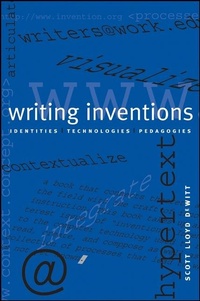
Writing Inventions
Description

Winner of the 2002 Computers & Composition Distinguished Book Award presented by Clarkson University's Eastman Kodak Center for Excellence in Communication
The increasing role of computer technology in the classroom has left many teachers searching for resources that will make sense of complex theories and provide them with practical pedagogical direction. Offering instructional stories, histories, and classroom applications, Writing Inventions connects the theoretical aspirations of the field with the craft of innovative composition instruction. Focusing on issues of "invention," the book explores "writing inventions"-the computer technology that students use to research, read, create, and compose. But "invention" also refers to the rich collection of processes that lead to what is not yet known: topics for writing, personal and professional identities, and new pedagogies. Methods for teaching invention using the World Wide Web are also outlined, arguing that the Web allows students and teachers to see into each other's learning processes. In the end, Writing Inventions tells stories-instructional accounts of computers and teaching writing that balance theory and practice.
Scott Lloyd DeWitt is Associate Professor of English at The Ohio State University at Marion, and coeditor (with Kip Strasma) of Contexts, Intertexts, and Hypertexts.
More details
Other editions
Additional editions
Person
Scott Lloyd DeWitt is Associate Professor of English at The Ohio State University at Marion, and coeditor (with Kip Strasma) of Contexts, Intertexts, and Hypertexts.
Content
Figures
Author's Note
Acknowledgments
Introduction: Inventing Ourselves
Inventing Audience
Inventing Myself
1 Inventing Invention
Contexts of Invention
Moments of Invention
A Point of Invention/Contention
What Writers Do
What Students Do-or Don't Do
The Technology of Invention
2 Inventing Discussions, Inventing Pedagogies
A Comfortable Middle?
Technology Round 1: An Invention
Technology's Second Round: A New (Re)Invention
Integrating CmD: Sequencing Assignments
Concluding Discussions
Appendix: One Computer-Mediated Discussion on Computer-Mediated Discussion
3 Inventing Hypertext Reading
Positioning the Web
Web Workings
Upgrades and Upshots
Inventing Instructional Web Sites
Inventing Method
Multi-Tasking Applied
Constructing Web Experiences
Connecting the Disconnected Snapshots
Conversing the Web
Appendix: Possible Lives, Chapter 1-Los Angeles and the LA Basin
4 Inventing Hypertext Writing
One Hypertext Application
Designing a Hypertext
Case Portrait: Devin
Case Portrait: Daniel
Case Portrait: Marie
Case Portrait: Yvonne
Case Portrait: Matthew
Reflections and Conclusions
5 Inventing Scenes
A Sequence of Assignments
Understanding Students' Inventions: Reading Their Work
Concluding Reflections
Bibliography
Index
