

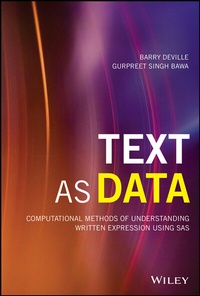
Text as Data
Computational Methods of Understanding Written Expression Using SAS
1st Edition
Published on 29. September 2021
240 pages
978-1-119-48717-3 (ISBN)
Description

Text As Data: Combining qualitative and quantitative algorithms within the SAS system for accurate, effective and understandable text analytics
The need for powerful, accurate and increasingly automatic text analysis software in modern information technology has dramatically increased. Fields as diverse as financial management, fraud and cybercrime prevention, Pharmaceutical R&D, social media marketing, customer care, and health services are implementing more comprehensive text-inclusive, analytics strategies. Text as Data: Computational Methods of Understanding Written Expression Using SAS presents an overview of text analytics and the critical role SAS software plays in combining linguistic and quantitative algorithms in the evolution of this dynamic field.
Drawing on over two decades of experience in text analytics, authors Barry deVille and Gurpreet Singh Bawa examine the evolution of text mining and cloud-based solutions, and the development of SAS Visual Text Analytics. By integrating quantitative data and textual analysis with advanced computer learning principles, the authors demonstrate the combined advantages of SAS compared to standard approaches, and show how approaching text as qualitative data within a quantitative analytics framework produces more detailed, accurate, and explanatory results.
* Understand the role of linguistics, machine learning, and multiple data sources in the text analytics workflow
* Understand how a range of quantitative algorithms and data representations reflect contextual effects to shape meaning and understanding
* Access online data and code repositories, videos, tutorials, and case studies
* Learn how SAS extends quantitative algorithms to produce expanded text analytics capabilities
* Redefine text in terms of data for more accurate analysis
This book offers a thorough introduction to the framework and dynamics of text analytics--and the underlying principles at work--and provides an in-depth examination of the interplay between qualitative-linguistic and quantitative, data-driven aspects of data analysis. The treatment begins with a discussion on expression parsing and detection and provides insight into the core principles and practices of text parsing, theme, and topic detection. It includes advanced topics such as contextual effects in numeric and textual data manipulation, fine-tuning text meaning and disambiguation. As the first resource to leverage the power of SAS for text analytics, Text as Data is an essential resource for SAS users and data scientists in any industry or academic application.
The need for powerful, accurate and increasingly automatic text analysis software in modern information technology has dramatically increased. Fields as diverse as financial management, fraud and cybercrime prevention, Pharmaceutical R&D, social media marketing, customer care, and health services are implementing more comprehensive text-inclusive, analytics strategies. Text as Data: Computational Methods of Understanding Written Expression Using SAS presents an overview of text analytics and the critical role SAS software plays in combining linguistic and quantitative algorithms in the evolution of this dynamic field.
Drawing on over two decades of experience in text analytics, authors Barry deVille and Gurpreet Singh Bawa examine the evolution of text mining and cloud-based solutions, and the development of SAS Visual Text Analytics. By integrating quantitative data and textual analysis with advanced computer learning principles, the authors demonstrate the combined advantages of SAS compared to standard approaches, and show how approaching text as qualitative data within a quantitative analytics framework produces more detailed, accurate, and explanatory results.
* Understand the role of linguistics, machine learning, and multiple data sources in the text analytics workflow
* Understand how a range of quantitative algorithms and data representations reflect contextual effects to shape meaning and understanding
* Access online data and code repositories, videos, tutorials, and case studies
* Learn how SAS extends quantitative algorithms to produce expanded text analytics capabilities
* Redefine text in terms of data for more accurate analysis
This book offers a thorough introduction to the framework and dynamics of text analytics--and the underlying principles at work--and provides an in-depth examination of the interplay between qualitative-linguistic and quantitative, data-driven aspects of data analysis. The treatment begins with a discussion on expression parsing and detection and provides insight into the core principles and practices of text parsing, theme, and topic detection. It includes advanced topics such as contextual effects in numeric and textual data manipulation, fine-tuning text meaning and disambiguation. As the first resource to leverage the power of SAS for text analytics, Text as Data is an essential resource for SAS users and data scientists in any industry or academic application.
More details
Other editions
Additional editions
Barry DeVille | Gurpreet Singh Bawa
Text as Data - Computational Methods of Understanding Written Expression Using SAS
Software
10/2021
Wiley
€65.40
No shipping information available
Barry DeVille | Gurpreet Singh Bawa
Text as Data: Computational Methods of Understanding Written Expression Using SAS
Computational Methods of Understanding Written Expression Using SAS
Book
09/2021
1st Edition
Wiley
€56.00
Shipment within 15-20 days
Persons
BARRY DEVILLE is a Data Scientist and Solutions Architect with 18 years of experience working at SAS. He led the development of the KnowledgeSEEKER decision tree package and has given workshops and tutorials on decision trees for Statistics Canada, the American Marketing Association, the IEEE, and the Direct Marketing Association.
GURPREET SINGH BAWA is the Data Science Senior Manager at Accenture PLC in India. He delivers advanced analytics solutions for global clients in a variety of corporate sectors.
GURPREET SINGH BAWA is the Data Science Senior Manager at Accenture PLC in India. He delivers advanced analytics solutions for global clients in a variety of corporate sectors.
Content
Preface xi
Acknowledgments xiii
About the Authors xv
Introduction 1
Chapter 1 Text Mining and Text Analytics 3
Chapter 2 Text Analytics Process Overview 15
Chapter 3 Text Data Source Capture 33
Chapter 4 Document Content and Characterization 43
Chapter 5 Textual Abstraction: Latent Structure, Dimension Reduction 73
Chapter 6 Classification and Prediction 103
Chapter 7 Boolean Methods of Classification and Prediction 125
Chapter 8 Speech to Text 139
Appendix A Mood State Identification in Text 157
Appendix B A Design Approach to Characterizing Users Based on Audio Interactions on a Conversational AI Platform 175
Appendix C SAS Patents in Text Analytics 189
Glossary 197
Index 203
