

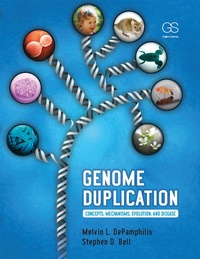
Genome Duplication
1st Edition
Published on 6. October 2010
476 pages
978-1-136-73823-4 (ISBN)
Description

Genome Duplication provides a comprehensive and readable overview of the underlying principles that govern genome duplication in all forms of life, from the simplest cell to the most complex multicellular organism.
Using examples from the three domains of life - bacteria, archaea, and eukarya - Genome Duplication shows how all living organisms store their genome as DNA and how they all use the same evolutionary-conserved mechanism to duplicate it: semi-conservative DNA replication by the replication fork. The text shows how the replication fork determines where organisms begin genome duplication, how they produce a complete copy of their genome each time a cell divides, and how they link genome duplication to cell division.
Genome Duplication explains how mistakes in genome duplication are associated with genetic disorders and cancer, and how understanding genome duplication, its regulation, and how the mechanisms differ between different forms of life, is critical to the understanding and treatment of human disease.
Using examples from the three domains of life - bacteria, archaea, and eukarya - Genome Duplication shows how all living organisms store their genome as DNA and how they all use the same evolutionary-conserved mechanism to duplicate it: semi-conservative DNA replication by the replication fork. The text shows how the replication fork determines where organisms begin genome duplication, how they produce a complete copy of their genome each time a cell divides, and how they link genome duplication to cell division.
Genome Duplication explains how mistakes in genome duplication are associated with genetic disorders and cancer, and how understanding genome duplication, its regulation, and how the mechanisms differ between different forms of life, is critical to the understanding and treatment of human disease.
Reviews / Votes
"...an accessible work that undergraduate students in their first molecular genetics class can easily read and understand. At the same time, this book has much to offer graduate students and researchers in the field. Many excellent tables summarize the information in each chapter. The volume also includes a glossary, clear illustrations, and chapter references." - Klevickis, C.A., CHOICE, April 2011"This book will be very informative for a wide audience-population biologists, molecular epidemiologists, and ecology/evolution instructors, as well as graduate students."
- The Quarterly Review of Biology "...an accessible work that undergraduate students in their first molecular genetics class can easily read and understand. At the same time, this book has much to offer graduate students and researchers in the field. Many excellent tables summarize the information in each chapter. The volume also includes a glossary, clear illustrations, and chapter references." - Klevickis, C.A., CHOICE, April 2011
"This book will be very informative for a wide audience-population biologists, molecular epidemiologists, and ecology/evolution instructors, as well as graduate students."
- The Quarterly Review of Biology
More details
Edition
1. Auflage
Language
English
Place of publication
London
United Kingdom
Publishing group
Taylor & Francis Ltd
Target group
College/higher education
Professional and scholarly
Illustrations
69 Tables, black and white; 185 Line drawings, color; 44 Halftones, color; 14 Halftones, black and white; 243 Illustrations, color
ISBN-13
978-1-136-73823-4 (9781136738234)
Copyright in bibliographic data and cover images is held by Nielsen Book Services Limited or by the publishers or by their respective licensors: all rights reserved.
Schweitzer Classification
Other editions
Additional editions
Melvin DePamphilis | Stephen Bell
Genome Duplication
Book
10/2010
1st Edition
Focal Press
€133.69
Shipment within 15-20 days
Persons
DePamphilis, Melvin; Bell, Stephen
Content
1. Genomes
2. Three Domains of Life
3. Replication Forks
4. Replication Proteins: Leading-Strand Synthesis
5. Replication Proteins: Lagging-Strand Synthesis
6. Termination
7. Chromatin Assembly, Cohesion, and Modification
8. Replicons
9. Replication Origins
10. Origin Paradigms
11. Initiation
12. Cell Cycles
13. Checkpoints
14. Human Disease
15. Evolution of Cellular Replication Machines
2. Three Domains of Life
3. Replication Forks
4. Replication Proteins: Leading-Strand Synthesis
5. Replication Proteins: Lagging-Strand Synthesis
6. Termination
7. Chromatin Assembly, Cohesion, and Modification
8. Replicons
9. Replication Origins
10. Origin Paradigms
11. Initiation
12. Cell Cycles
13. Checkpoints
14. Human Disease
15. Evolution of Cellular Replication Machines
