

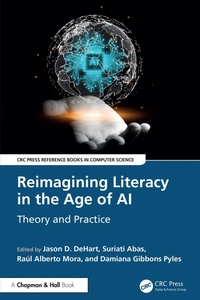
Reimagining Literacy in the Age of AI
Theory and Practice
1st Edition
Published on 6. March 2025
213 pages
978-1-040-33294-8 (ISBN)
Description

This volume assesses the critical intersection of artificial intelligence (AI) and literacy education. Drawing on the concept of "living literacies," it explores the transformative potential of AI in literacy practices, offering a comprehensive narrative that bridges theoretical frameworks with practical applications.
The book goes beyond the conventional understanding of AI literacy as mere technological proficiency. Instead, it positions AI as a catalyst for expansive, inclusive, and multifaceted literacy practices in the digital age. Scholars from different parts of the world examine how AI is not just changing what we read and write but how we think, create, and express ourselves in a post-human context.
KEY FEATURES
Explores AI literacy that encompasses critical thinking, ethical reasoning, and creative expression
Offers insights into the role of educators and researchers in cultivating AI literacy among learners
Discusses how creativity and identity intertwine with AI literacy
Suggests practical approaches to integrating AI into classroom instruction across different age groups
This timely work serves as an essential guide for educators, researchers, and learners by navigating the evolving terrain of literacy in a world increasingly augmented by AI.
The book goes beyond the conventional understanding of AI literacy as mere technological proficiency. Instead, it positions AI as a catalyst for expansive, inclusive, and multifaceted literacy practices in the digital age. Scholars from different parts of the world examine how AI is not just changing what we read and write but how we think, create, and express ourselves in a post-human context.
KEY FEATURES
Explores AI literacy that encompasses critical thinking, ethical reasoning, and creative expression
Offers insights into the role of educators and researchers in cultivating AI literacy among learners
Discusses how creativity and identity intertwine with AI literacy
Suggests practical approaches to integrating AI into classroom instruction across different age groups
This timely work serves as an essential guide for educators, researchers, and learners by navigating the evolving terrain of literacy in a world increasingly augmented by AI.
More details
Series
Edition
1. Auflage
Language
English
Place of publication
London
United Kingdom
Publishing group
Taylor & Francis Ltd
Target group
College/higher education
Illustrations
6 Tables, black and white; 9 Line drawings, black and white; 3 Halftones, black and white; 12 Illustrations, black and white
File size
11,63 MB
ISBN-13
978-1-040-33294-8 (9781040332948)
Copyright in bibliographic data and cover images is held by Nielsen Book Services Limited or by the publishers or by their respective licensors: all rights reserved.
Schweitzer Classification
Other editions
Additional editions
Jason D. DeHart | Suriati Abas | Raul Alberto Mora
Reimagining Literacy in the Age of AI
Theory and Practice
Book
approx. 07/2026
1st Edition
Chapman & Hall/CRC
€65.00
Not yet published

Jason D. DeHart | Suriati Abas | Raul Alberto Mora
Reimagining Literacy in the Age of AI
Theory and Practice
Book
05/2025
CRC Press
Unfortunately, price unknown
Available (delivery time upon request)
Jason D. DeHart | Suriati Abas | Raul Alberto Mora
Reimagining Literacy in the Age of AI
Theory and Practice
Book
03/2025
1st Edition
Chapman & Hall/CRC
€156.50
Shipment within 10-20 days
Persons
Jason D. DeHart earned a PhD in 2019 at the University of Tennessee, Knoxville. His research interests include digital literacy, graphic novels and comics, and adolescent literacy. DeHart is the author of Building Critical Literacy and Empathy with Graphic Novels (NCTE).
Suriati Abas is an Assistant Professor in the Department of Elementary Education and Reading at the State University of New York (SUNY) Oneonta. Her research interests center on critical, multimodal, and spatial literacies within school and in out-of-school contexts. Her most recent publications titled "Critical Multimodal Literacy Practices in Student-Created Comics" and "Fostering Artificial Intelligence (AI) Literacy in Higher Education" were published in Literacy and Teaching Media, respectively. Suriati was awarded the Divergent Award for Excellence in the Implementation of Literacy in a Digital Age in 2022 for the university-community partnership (i.e., involving pre-service teachers, teachers, authors, librarians, and children in K-12 schools) in promoting diverse social justice-themed picture books through in-person book-reading events and digital platforms. She teaches literacy, diversity, and children's literature to pre-service and in-service teachers.
Raul Alberto Mora is an Associate Professor at the School of Education and Pedagogy at Universidad Pontificia Bolivariana in Medellin, Colombia (while teaching remotely from Norway), where he also chairs the award-winning Literacies in Second Languages Project research lab. He is also a visiting professor at the Doctorate in Education (ELT Emphasis) at Universidad del Valle and has served as visiting faculty at universities in Colombia, Mexico, and Poland. His research has explored literacy theories' conceptual and practical applications to understand second-language practices in city, virtual, and school spaces. Raul was awarded the Divergent Award for Excellence in Literacy in a Digital Age Research in 2019 for his contributions to the field of literacy studies and the Clare de Silva Award by the Colombian Association of English Teachers (ASOCOPI) in 2024 for his impact on the English-language teaching community in Colombia.
Damiana Gibbons Pyles is a Professor in the Department of Learning, Teaching, and Curriculum at Appalachian State University. Her research interests focus on media production, identity, and media literacy practices in order to understand the intersections of the visual, the spoken, the written, and the performed in digital and print literacies. Recent publications include her book Literacy and Identity through Streaming Media: Kids, Teens, and Representation on Netflix (2023) and several publications, such as scholarship about turning Red and Asian American representation and teaching using different media, i.e., The Last Kids on Earth. She currently teaches courses for pre-service and practicing teachers to learn how to integrate media and technology for teaching and learning. Her most recent projects focus on how censorship legislation is impacting how teachers perceive how they can and should teach in their classrooms.
Suriati Abas is an Assistant Professor in the Department of Elementary Education and Reading at the State University of New York (SUNY) Oneonta. Her research interests center on critical, multimodal, and spatial literacies within school and in out-of-school contexts. Her most recent publications titled "Critical Multimodal Literacy Practices in Student-Created Comics" and "Fostering Artificial Intelligence (AI) Literacy in Higher Education" were published in Literacy and Teaching Media, respectively. Suriati was awarded the Divergent Award for Excellence in the Implementation of Literacy in a Digital Age in 2022 for the university-community partnership (i.e., involving pre-service teachers, teachers, authors, librarians, and children in K-12 schools) in promoting diverse social justice-themed picture books through in-person book-reading events and digital platforms. She teaches literacy, diversity, and children's literature to pre-service and in-service teachers.
Raul Alberto Mora is an Associate Professor at the School of Education and Pedagogy at Universidad Pontificia Bolivariana in Medellin, Colombia (while teaching remotely from Norway), where he also chairs the award-winning Literacies in Second Languages Project research lab. He is also a visiting professor at the Doctorate in Education (ELT Emphasis) at Universidad del Valle and has served as visiting faculty at universities in Colombia, Mexico, and Poland. His research has explored literacy theories' conceptual and practical applications to understand second-language practices in city, virtual, and school spaces. Raul was awarded the Divergent Award for Excellence in Literacy in a Digital Age Research in 2019 for his contributions to the field of literacy studies and the Clare de Silva Award by the Colombian Association of English Teachers (ASOCOPI) in 2024 for his impact on the English-language teaching community in Colombia.
Damiana Gibbons Pyles is a Professor in the Department of Learning, Teaching, and Curriculum at Appalachian State University. Her research interests focus on media production, identity, and media literacy practices in order to understand the intersections of the visual, the spoken, the written, and the performed in digital and print literacies. Recent publications include her book Literacy and Identity through Streaming Media: Kids, Teens, and Representation on Netflix (2023) and several publications, such as scholarship about turning Red and Asian American representation and teaching using different media, i.e., The Last Kids on Earth. She currently teaches courses for pre-service and practicing teachers to learn how to integrate media and technology for teaching and learning. Her most recent projects focus on how censorship legislation is impacting how teachers perceive how they can and should teach in their classrooms.
Content
Introduction. Section I: Ethical Considerations. 1. The AI Literacy Framework for Higher Education: A Grounded Theory Exploration of the Foundational, Social, Conceptual, Ethical, and Affective Domains of AI Literacy. 2. Exploring the Speculative: AI Literacies and Creativity. Section II: Practical Applications in Educational Contexts. 3. Teachers First: Building AI Literacy to Address Mundane Tasks and Enhance Creative Applications in Secondary English Classrooms. 4. When AI Literacy Meets Computational Creativity - Vignettes of a Preservice Teacher's Journey with Generative AI. 5. Intelligent-TPACK for AI-Assisted Literacy Instruction: A Novel Technological and Pedagogical Approach to Prepare Teachers for Future Classrooms. 6. Cultivating Global Writers: The Role of AI in Creating Authentic Writing Situations for Young Learners. Section III: Theoretical Grounding and Future Applications. 7. The Song Need Not Remain the Same: AI Literacies in the Lives of Youth. 8. Building a Future with AI: Entry Points for Reimagining Literacy in Higher Education. 9. Framing a Critical, Historical, Proactive View of AI Literacies in "Zero-Gravity" Spaces.
