

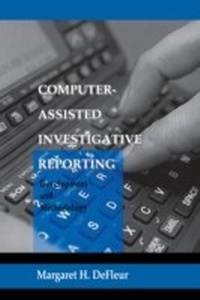
Computer-assisted Investigative Reporting
Development and Methodology
1st Edition
Published on 26. November 2013
264 pages
978-1-136-68636-8 (ISBN)
Description

Conducting computer analyses for the purposes of revealing information of significance to the press represents an extension of one of the most important forms of American journalism into the contemporary era of new technologies. Investigative reporting had its start with the establishment of the metropolitan newspaper during the early decades of the 1900s. At the time, it was a continuation of the evolving tradition of freedom of the press that had characterized American political life since colonial times. As it developed, investigative reporting stressed facts rather than the opinions of the editor or reporter. In turn, that tradition had its own intellectual roots. Today, computer-assisted investigative reporting (CAIR) extends that "marketplace of ideas" into systematic examinations of the electronic records of government. In addition, computer analyses of other kinds of information systematically gathered by journalists can provide the press with insights into trends and patterns unlikely to be revealed by other means.
This unique volume addresses procedures and issues in investigative journalism that have not been explained in other publications. It sets forth -- for the first time -- a detailed and specific methodology for conducting computer-assisted investigative analyses of both large and small scale electronic records of government and other agencies. That methodology consists of the logic of inquiry, strategies for reaching valid conclusions, and rules for reporting what has been revealed by the analyses to the public in clear ways. Such systematic methodologies are essential in social and other sciences and the development of a counterpart for investigative journalism has been badly needed.
That systematic methodology is developed within a context that explains the origin and major characteristics of those elements that have come together in American society to make computer-assisted investigative reporting both possible and increasingly a part of standard newsroom practices. These include the development of traditional investigative journalism, the evolution of computer technology, the use of computers by government to keep records, the legal evolution of freedom of information laws, the rapid adoption of computers in newsrooms, the increasing importance of precision journalism, and the sharp increase in recent times of computer-assisted investigative reporting by American newspapers both large and small. The issues addressed in this book are discussed in a very readable context with an abundance of examples and illustrations drawn from the real world of journalism as it is practiced daily in newsrooms around the country. Explanations of concepts, principles, and procedures are set forth in layperson's terms that require very little in the way of knowledge of computers or statistical methods.
This unique volume addresses procedures and issues in investigative journalism that have not been explained in other publications. It sets forth -- for the first time -- a detailed and specific methodology for conducting computer-assisted investigative analyses of both large and small scale electronic records of government and other agencies. That methodology consists of the logic of inquiry, strategies for reaching valid conclusions, and rules for reporting what has been revealed by the analyses to the public in clear ways. Such systematic methodologies are essential in social and other sciences and the development of a counterpart for investigative journalism has been badly needed.
That systematic methodology is developed within a context that explains the origin and major characteristics of those elements that have come together in American society to make computer-assisted investigative reporting both possible and increasingly a part of standard newsroom practices. These include the development of traditional investigative journalism, the evolution of computer technology, the use of computers by government to keep records, the legal evolution of freedom of information laws, the rapid adoption of computers in newsrooms, the increasing importance of precision journalism, and the sharp increase in recent times of computer-assisted investigative reporting by American newspapers both large and small. The issues addressed in this book are discussed in a very readable context with an abundance of examples and illustrations drawn from the real world of journalism as it is practiced daily in newsrooms around the country. Explanations of concepts, principles, and procedures are set forth in layperson's terms that require very little in the way of knowledge of computers or statistical methods.
Reviews / Votes
"...offers a formal 'systematic methodology' for large database analysis...reflects considerable thought...provides...added value."-Journalism & Mass Communication
More details
Series
Language
English
Place of publication
London
United Kingdom
Publishing group
Taylor & Francis Ltd
Target group
Professional and scholarly
File size
9,61 MB
ISBN-13
978-1-136-68636-8 (9781136686368)
Copyright in bibliographic data and cover images is held by Nielsen Book Services Limited or by the publishers or by their respective licensors: all rights reserved.
Schweitzer Classification
Other editions
Additional editions
Book
02/1997
1st Edition
Routledge
€40.10
Shipment within 10-20 days
Book
02/1997
1st Edition
Routledge
€132.60
Shipment within 10-20 days
Person
Margaret H. DeFleur
Content
Contents: From Bordello to Watergate and Beyond: The Changing Nature of Investigative Reporting. Coming Together: Computers, Government Record Keepers and Journalists. Freedom of Information Laws: The Legal Status of Electronic Records. Computer-Assisted Investigative Reporting: Its Development, Definition and Current Status. Basic CAIR Techniques: As Used in Contemporary Newsrooms. Analyzing Large-Scale Electronic Records: An Example Using Data From the Federal Courts. CAIR Analyses and the Press: Problems of Reporting on Disclosures. Social Science, Precision Journalism, and CAIR: A Conceptual Comparison. A Formal Methodology for CAIR Analysis. Appendix.
