

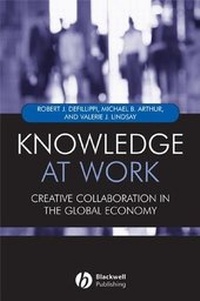
Knowledge at Work
Description

Reviews / Votes
"In this book the authors bridge a gap in the economic literaturewith a fresh and lively account of the crucial links among workers,knowledge work, and economic performance. Given themulti-dimensional character of the topic, they do not provide allthe answers but they pose questions and guide the reader forward.This book sets the agenda on the knowledge-based economy and thecomplex relations that drive it." Michael Best, University ofMassachusetts Lowell "This book provides an extraordinary integration of literatureon knowledge work, accompanied by a large number of cases andstories to illustrate underlying ideas. I can think of no book thatoffers such a stimulating and thought-provoking blend of theory andpractice. Both present and future managers will greatly enjoy thisbook." Lars Lindkvist, Linköping University "Both scholarly and streetwise, this book does a great job inshowing what knowledge work means for the lives of the people whodo it, and the performance of the organizations that try to manageit." Harry Scarborough, University of Warwick "A very impressive account of 'knowledge at work' onseveral levels of analysis: individual, organization, industry, andcommunity; that successfully connects with managerial practice"Joerg Sydow, Free University of Berlin "This book provides unique insights into the drivers behind theknowledge economy, showing how individuals, groups, organizationsand industries create and use knowledge. It provides an importantand highly readable contribution to contemporary understanding ofknowledge and learning processes." David Gann, ImperialCollege London "For those of us wilting under the weight of new publications onknowledge and knowledge management this book provides a welcomerefuge in what is a busy, crowded and often confusing zone. Notonly does it provide a broad ranging and thorough review of the keyissues, but it also challenges the reader to reflect on themchapter by chapter. The book recognises what too many othersdon't that all the company procedures and IT-based knowledgemanagement systems are just tools and that people are at the centreof the knowledge based economy. The strength of the book lies inits grounding in real work examples and in its consistent use of aframework - the knowledge diamond - which highlightsthe interdependencies of four key participants in knowledge work:individuals, communities, organizations and industries. It shouldbe useful to both knowledge workers themselves and those that studythem." Dr Tim Brady, University of BrightonMore details
Other editions
Additional editions

Persons
Content
1. Knowledge Workers and Knowledge Work.
Knowledge Work in the Global Economy.
What Do Knowledge Workers Do?.
Explicit and Tacit Knowledge.
Who Owns the Knowledge?.
Knowing and Learning.
The Interplay of Knowing and Learning.
Knowledge Work as Practice.
Communication between Practices.
Tools for Knowledge Work.
Clossed versus Open Perspectives.
Participants in Knowledge Work.
The Individual.
The Community.
The Organization.
The Industry.
The Knowledge Diamond.
The Chapters to Follow.
Questions for Reflection.
2. Individual Knowledge at Work.
Three Ways of Knowing.
Knowing-why.
Knowing-how.
Knowing-whom.
Interdependence among the Ways of Knowing.
The Individual and the Knowledge Diamond.
One Individual and Another.
The Individual and the Community.
The Individual and the Organization.
The Individual and the Industry.
Keeping the Individual in View.
Other Ways of Knowing?.
Free Agency and Trust.
Networks and Social Capital.
Tools for Individuals.
Summary.
Questions for Reflection.
3. Community Knowledge at Work.
Three Dimensions of Community Activity.
Joint Enterprise.
Shared Repertoire.
Mutual Engagement.
Interdependence among the Dimensions.
The Community and the Knowledge Diamond.
One Community and Another.
The Community and the Organization.
The Community and the Industry.
The Community and the Individual.
Keeping the Community in View.
Other Meanings of Community.
Organizational Communities.
Occupational Communities.
Community Social Capital.
The Returns on Community Social Capital.
Community and Inter-Community Knowledge Work.
Tools for Communities.
Summary.
Questions for Reflection.
4. Organizational Knowledge at Work.
The Organization's Core Competencies.
Organizational Culture.
Organizational Capabilities.
Organizational Connections.
Interdependencies Among the Core Competencies.
The Organization and the Knowledge Diamond.
One Organization and Another.
The Organization and the Individual.
The Organization and the Community.
The Organization and the Industry.
Keeping the Organization in View.
Knowledge Transfer in Strategic Alliances.
Exploitation versus Exploration.
Codification versus Personalization.
Closed versus Open Innovation.
Tools for Organizations.
Summary.
Questions for Reflection.
5. Industry Knowledge at Work.
Three Attributes of Industry Activity.
Industry Milieu.
Industry Recipes.
Industry System.
Interdependence among Industry Attributes.
The Industry and the Knowledge Diamond.
One Industry and another.
The Industry and the individual.
The Industry and the community.
The Industry and the organization.
Keeping the Industry in View.
Industry Regions and Regional Advantage.
Regional Closure and Brokerage.
Knowledge Transfer between Industries.
Business Ecosystems.
Tools for Industries.
Summary.
Questions for Reflection.
6. Projects and Knowledge Work.
The Evolution of Project-Based Knowledge.
Variation: The Beginnings of Exploration.
Selection: Between Exploration and Exploitation.
Retention: The shift to exploitation.
Projects As Episodes in Knowledge Work.
Contrasting Project-based Learning Experiences.
Low Performance, Low Learning.
High Performance, Low Learning.
Low Performance, High Learning.
High Performance, High Learning.
Learning Landscapes and their Beneficiaries.
Organizations and Project Organizing.
Projects, Practice and "Boundary Objects".
Tools for Project Work.
Summary.
Questions for Reflection.
7. Virtual Knowledge Work.
Virtual versus Physical Space.
Properties of Virtual Communications.
Brokerage and Closure in Virtual Work.
Managing Virtual Projects.
Working with a Distant Subsidiary.
Working on a Complex Project.
Selecting Communications Media.
Facilitating Cross-Disciplinary Teams.
Open Source Software Communities.
Grid Computing.
From e-Business to Virtual Product Testing.
Tools for Virtual Work.
Summary.
Questions for Reflection.
8. Global Knowledge and Learning.
The Global Organization.
Harnessing and exploiting local knowledge.
Acting Locally, Thinking Globally.
Born Global through International Alliances.
Knowledge Flows in Global Organizations.
The Individual's Role in Global Knowledge Work.
The Community's Role in Global Knowledge Work.
Local versus Global Knowledge.
Accessing Global Knowledge Workers.
An Integrative Model.
Tools for Global Knowledge Work.
Summary.
Questions for Reflection.
9. Intellectual Property in Knowledge Work.
Intellectual Property and the Knowledge Diamond.
The Individual.
The Community.
The Organization.
The Industry.
A Changing Global Context.
Individual-Organization Conflict.
Contrasting Organizational Strategies.
National Initiatives.
Open Knowledge Sharing.
An Intellectual Property Paradox.
Tools Related to Intellectual Property.
Knowledge Policy in the Corporate World.
Summary.
Questions for Reflection.
10. Participating in the Knowledge Economy.
The Knowledge Diamond at Work.
Why, How and with Whom We Work.
Conditions Underlying Knowledge Work.
Alignment.
Conflict.
Open Versus Closed Positions.
Process Behind Knowledge Work.
Making and Sustaining Connections.
The evolution of projects.
Collaboration Over the Web.
Contributing to Global Knowledge Work.
Developing Intellectual Property.
Using the Knowledge Work Tool-kit.
Playing Parallel Roles.
A Final Message.
Questions for Reflection.
Bibliography.
Index.
