

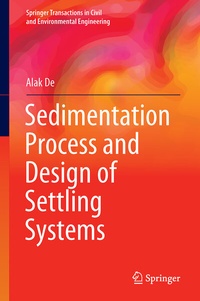
Sedimentation Process and Design of Settling Systems
Description

This book is designed to serve as a comprehensive source of information of sedimentation processes and design of settling systems, especially as applied to design of such systems in civil and environmental engineering. The book begins with an introduction to sedimentation as a whole and goes on to cover the development and details of various settling theories. The book traces the chronological developments of the comprehensive knowledge of settling studies and design of settling systems from 1889.A new concept of 'Velocity Profile Theorem', tool for settling problem analysis, has been employed to the analysis of the phenomenon of short circuiting. Complete theory of tube settling has been developed and its application to the computation of residual solids from the assorted solids through the same has been demonstrated. Experimental verification of the tube settling theory has also been presented. Field-oriented compatible design and operation methodology of settling system hasbeen developed from the detailed study of a real settling system. New parameter for settling performance comparison appears to do justice for its purpose. Design methodology of high rate settling systems has been presented with worked out examples and the flexibility of control of operation has been shown. Lastly, along with the presentation of all the theories of 'Thickener Design' the same problem of thickening has been solved with all the methods to reveal the variation in the designed thickeners. The contents of this book will be useful to students, researchers, and professional engineers alike.
Reviews / Votes
"The book is well planned and contains much required diverse information compounded in a single volume. As such, it will be useful for designers of various hydraulic components as well as water purification plants. . The numericals are very useful as illustrations of use of various approaches suggested for computation of settled load. Overall the book serves as a good reference." (Dr. Aniruddha Banhatti, Amazon.in, February, 2017)More details
Other editions
Additional editions
Person
Content
Chapter 1: Introduction.- Chapter 2: Developments In Settling Studies.- Chapter 3: Velocity Profile Theorem - Concept for Solving Settling Problem Analysis.- Chapter 4: Sedimentation Process.- Chapter 5: Discrete Settling.- Chapter 6: Flocculant Settling.- Chapter 7: Zone Settling and Compression.- Chapter 8: Revised Mode of Analysis of Column Settling Data.- Chapter 9 : Effect of Short Circuiting on Settling.- Chapter 10: Parameter for Settling Performance Comparison.- Chapter 11: Design of Settling System - An Introduction.- Chapter 12: Compatible 'Jar Testing 'to The Settling in Real System.- Chapter 13: Compatible Design of A Real Settling System.- Chapter 14: High Rate Settling System.- Chapter 15: Experimental Verification of The Theory of 'Tube Settling'.- Chapter 16: Computational Methodology for Residual Solids Through Tube Settler.- Chapter 17: Theoretic Study on The Control of Design Parameters for Tube Settling.- Chapter 18: Design of High Rate Settlers.- Chapter 19: Design of Simple Couette Flow Module For The Removal Of Solids.- Chapter 20: Design of Thickeners.
