

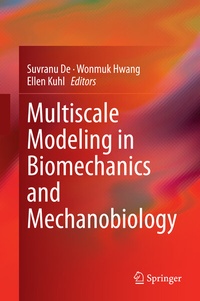
Multiscale Modeling in Biomechanics and Mechanobiology
Description

Presenting a state-of-the-art overview of theoretical and computational models that link characteristic biomechanical phenomena, this book provides guidelines and examples for creating multiscale models in representative systems and organisms. It develops the reader's understanding of and intuition for multiscale phenomena in biomechanics and mechanobiology, and introduces a mathematical framework and computational techniques paramount to creating predictive multiscale models.
Biomechanics involves the study of the interactions of physical forces with biological systems at all scales - including molecular, cellular, tissue and organ scales. The emerging field of mechanobiology focuses on the way that cells produce and respond to mechanical forces - bridging the science of mechanics with the disciplines of genetics and molecular biology. Linking disparate spatial and temporal scales using computational techniques is emerging as a key concept in investigating some of the complex problems underlying these disciplines.
Providing an invaluable field manual for graduate students and researchers of theoretical and computational modelling in biology, this book is also intended for readers interested in biomedical engineering, applied mechanics and mathematical biology.
More details
Other editions
Additional editions
Persons
Prof Suvranu De serves as Professor and Head of the Department of Mechanical, Aerospace and Nuclear Engineering (MANE) and Director of the Center for Modeling, Simulation and Imaging in Medicine (CeMSIM) at Rensselaer Polytechnic Institute, NY, USA. His research is at the intersection of computational mechanics and the health sciences. He currently serves on the editorial boards of the Journal of Computational Surgery , International Journal of Modern Mechanics , International Journal of Computational Methods , and Computers & Structures . Prof De has authored or co-authored 12 book chapters, 97 papers in peer-reviewed journals and more than 187 papers appearing in conference proceedings. He has co-edited a book on Computational Modeling in Biomechanics (Springer, 2010). He is also a member of various editorial boards, national and international technical committees and workgroups.
Dr Wonmuk Hwang is an expert in computational biophysics. With a Ph.D. degree in theoretical condensed matter physics at Boston University, his research changed to biomolecular simulation during his postdoctoral training at Massachusetts Institute of Technology. His research focuses on mechanics and self-assembly of biofilaments and molecular motors. He has made a number of discoveries about their operation mechanisms. Dr Hwang is currently Associate Professor of Biomedical Engineering at Texas A&M University. He has over 45 publications in international refereed journals and is a developer of the molecular dynamics simulation program, CHARMM (Chemistry at Harvard Molecular Mechanics).
Prof Ellen Kuhl is an Associate Professor of Mechanical Engineering, Bioengineering (affiliate), and Cardiothoracic Surgery (courtesy). Her area of professional expertise is Computational Biomechanics, the creation of theoretical and computational models to predict the acute and chronic response of living biologicaltissue to environmental changes during development and disease progression. Her specific interest is the multiscale modeling of growth and remodeling, the study of how biological tissues adapt their form and function to changes in mechanical loading, and how this adaptation could be traced back to structural alterations on the cellular or molecular levels. Growth and remodeling might be induced naturally, e.g., through elevated pressure, stress, or strain, or interventionally, e.g., through prostheses, stents, tissue grafts, or stem cell injection. Combining theories of electrophysiology, biophysics, and continuum mechanics, her lab has specialized in predicting the chronic loss of form and function in growing and remodeling cardiac tissue using patient-specific custom-designed finite element models.
